What happened
The Transit introduced in 1965 had to serve operators who carried different people, tools and loads. A common van family offered scale in parts, servicing and manufacture. Fleet customers still needed bodies and equipment matched to the job, leaving Ford and specialist converters to divide the work sensibly.
The Transit began with a brief on 9 January 1960 to develop one van for Europe instead of separate vans for each market, Ford says. The project was known as Project Redcap.
The first Transit came off the line at Ford’s Langley plant in Berkshire, England, on 9 August 1965, according to Ford.
Prices at launch ranged widely. Ford says the cheapest model was a short-wheelbase petrol van costing £542, while the most expensive was a 15-seat Custom bus at £997 plus purchase tax.
Ford quickly added longer vans and chassis-cab versions so specialist converters could build bodies to customers’ needs. Today Ford says 217 converter partners across 18 European markets build bespoke versions.
Production grew steadily. The one millionth Transit was built in 1976, and by 2015 almost eight million had been made, according to SMMT.
By 2025 Ford said more than 13 million Transits had been produced worldwide, with about 10.1 million built in Europe and Türkiye.
The van leads its markets. Ford says the Transit or Transit Custom has been the UK’s best-selling van for 59 years, and almost one in five 1-tonne and 2-tonne vans sold in Europe in 2024 was a Transit or Transit Custom.
The Transit also entered North America. Ford says its Kansas City plant has built more than 1.5 million Transit vans since US production began in 2014.
The exhibit shows the Transit’s growth from one million vans in 1976 to more than 13 million by 2025.
Operating leverage helps here. High volume spreads design and factory costs over millions of vans.
Converters add value by building specialist bodies, letting one base van serve many trades.
A strong dealer and service network matters to fleets, who need vans back on the road quickly.
An economic moat forms when a product becomes the default choice for businesses.
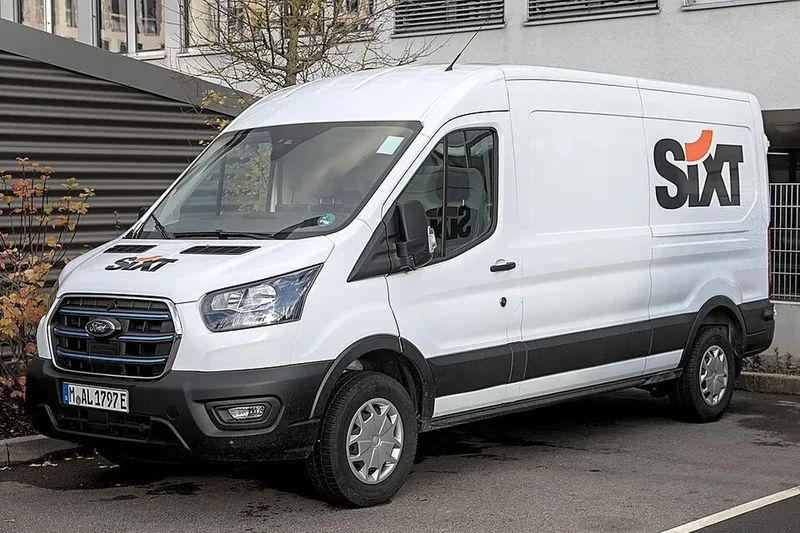
Electric versions such as the E-Transit show how the platform is adapting to new technology.
Rival vans compete hard, so the Transit must keep improving to stay ahead.
Students can ask how one product can be designed to serve very different customers.
Key concept: economic moats. An economic moat is a lasting advantage that protects a company’s profits from competitors, much as a moat protects a castle. Sources include strong brands, patents, cost advantages, networks and high switching costs for customers.
Brands with deep heritage and loyal customers can charge higher prices for many years, but moats must be maintained: a brand that disappoints customers can lose its advantage.
Key concept: operating leverage. A business with high fixed costs and low variable costs has high operating leverage: once fixed costs are covered, each additional sale adds a large amount of profit. Car making is a classic example, with heavy spending on design, tooling and plants.
The flip side is that falling sales hit profits hard, because fixed costs remain. That is why car makers care so much about keeping factories busy.
Key concept: opportunity cost. Opportunity cost is the value of the best alternative given up when making a choice. Money and time spent on one project cannot be spent on another.
Good decisions compare options against each other, not just against doing nothing.
Key concept: risk and return. In business and investing, higher potential returns usually come with higher risk. Entering a new market or launching a new kind of product can bring large rewards, but the chance of failure is also greater.
Managers weigh the size of the possible gain against the likelihood and cost of failure, and they often reduce risk by testing ideas on a small scale before committing large sums.
Key moments
A commercial family is designed for varied duties
Transit enters production
Variants and conversions serve different businesses
Sources: Ford; SMMT.
The trade-offs at the heart of the case
A closer look
A parcel carrier, a plumber and a passenger shuttle operator may all order a Transit while needing quite different access, seating and service arrangements. Identify the portions of the body and drivetrain that can be common without forcing every buyer to pay for unused capability. Then ask the converters how long their work takes. A standard platform that is slow to convert can move cost downstream instead of eliminating it.
The alternative on the table
For comparison, consider the option to let independent coachbuilders supply all specialist variants. The related case “A parcel carrier helps specify the van it wants to buy” supplies a useful reference point. Ford began producing the StreetScooter WORK XL in Cologne for Deutsche Post DHL. The WORK XL programme involved an anchor buyer specifying a particular duty. Transit serves many smaller operators. Standard interfaces for specialist bodies can preserve factory scale without forcing every use onto the same production line.
For your seminar, paper or interview
- Q1
Which body changes should a Transit converter handle and which belong on the common platform?
- Q2
Which finding in the records on common component use across delivery, trade and passenger bodies would persuade you to let independent coachbuilders supply all specialist variants?
- Q3
Compare this decision with “A parcel carrier helps specify the van it wants to buy”. Which difference between the cases would change your recommendation?
- Product platform
- Customisation
- Commercial customers
- Scale economies
How we would approach it
Simplifying Finance’s opinion, offered as a starting point for debate, not as fact or investment advice.
We think the Transit succeeded because one well-designed van could be adapted for almost any business. Ford built a common base in high volume and let converters and options handle the differences. That combination of scale and flexibility has kept the Transit at the top of the market for decades.
Build one strong base
Design a van family for many jobs.
Work with converters
Let specialists build bespoke bodies.
Keep the network close
Support fleets with service and parts.
What this plan gives up
One common design saves cost but cannot fit every special need on its own.
The strongest counter-argument
Some argue specialist vehicles serve particular trades better than a general van.
Metrics to watch
- Share of the van market
- Number of converter partners
Propose your solution
Pick a discussion question and set out what you would do, why, and what it would cost. Strong, well-argued answers are reviewed and published below with your first name and programme.
Published solutions
Loading published solutions…
- Ford Motor Company • The Ford Transit | Articles | Ford Motor Company ↗
- Ford Motor Company • Ford Transit: ↗
- fordpresse.be • TRANSIT HISTORY (pdf) ↗
- Ford Motor Company • Ford Transit facts ↗
- Ford Media Center • Celebrating 60 Years and Counting ↗
- SMMT • Transit celebrates 50th anniversary at CV Show ↗
- Ford Motor Company • Happy Birthday Transit as Iconic Commercial Vehicle Turns 59 ↗
- Photo: 2016 Ford Transit 350 2.2 by Vauxford, CC BY-SA 4.0 (cropped and resized) ↗
Figures are as reported by the companies or cited outlets as of 22 November 2026. Check the source before quoting. Corrections: let us know through the solution form.