What happened
At the opening of Factory 56 in Sindelfingen in September 2020, Mercedes-Benz put roughly €730 million against the new facility. The wider investment announced for the Sindelfingen site was about €2.1 billion. Those are different scopes. Someone evaluating an individual assembly line cannot charge it with all the site spending, then compare its return with savings from a single model. Equally, a project team should identify shared utility or logistics costs that a narrow factory budget omits. Choosing where to draw the boundary is the first capital-budgeting decision in this case.
The commercial rationale was flexibility. The company wanted the facility to accommodate different models, production volumes and powertrains. The new S-Class inaugurated the factory. Mercedes later described the S-Class, Mercedes-Maybach S-Class and electric EQS being produced on the same line. For a manufacturer uncertain about the pace at which customers would switch to electric luxury cars, that ability matters. A forecast error can leave one dedicated line underused while another runs short of capacity. A shared line can offset some of the mismatch if it can move work without introducing more expensive bottlenecks.
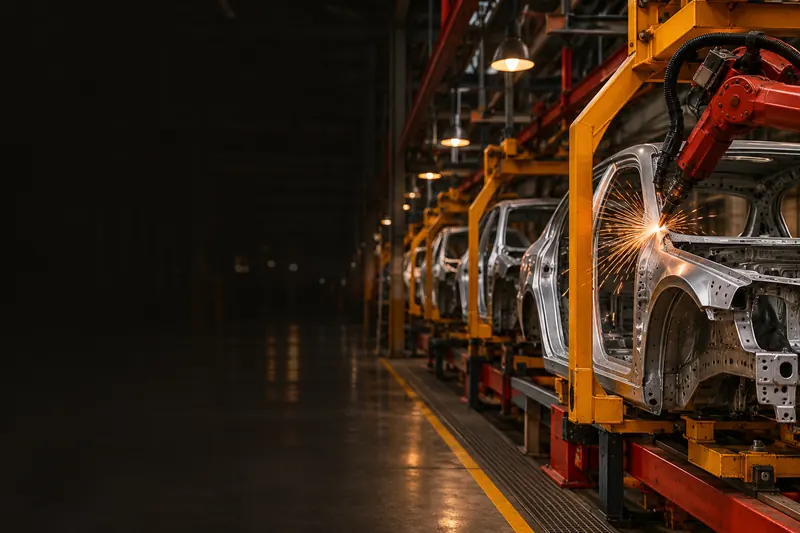
Factory 56 opened in September 2020 with the new S-Class. Mercedes invested about €730 million in the facility as part of a wider €2.1 billion programme at the Sindelfingen site, and said assembly was about 25 percent more efficient than the previous S-Class operation. Mercedes-Maybach S-Class production started there in February 2021, and the electric EQS joined production in Sindelfingen in 2021. The plant’s roof carries more than 12,000 solar modules.
Sindelfingen is one of Mercedes-Benz’s oldest and largest plants, home to the S-Class for decades. Investing there signals a long-term commitment to building top-end models in Germany, supported by the skills of an experienced workforce.
Factory 56 also uses digital tools extensively, from driverless transport systems to data networks that connect machines, an approach often described as Industry 4.0.
Its design has since influenced other Mercedes-Benz plants around the world.
The plant illustrates how investment in flexibility can protect output when the product mix changes.
Key moments
Factory 56 opens with the S-Class.
Mercedes-Maybach S-Class production begins in the factory.
The electric EQS joins production in Sindelfingen.
Source: Mercedes-Benz Group, September 2020.
The trade-offs at the heart of the case
Why sharing final assembly helps only sometimes
A common line performs most convincingly when demand moves in opposite directions. If fewer people buy one type of saloon while more choose another, a shared station can give the growing model the hours freed by the shrinking one. If both models sell poorly in the same recession, there is no volume to move. If demand for both rises together, shared equipment can become a common constraint. The financial value of flexibility therefore depends on the joint pattern of demand, not simply on how uncertain the forecast is for each individual vehicle. The material flow also has to keep up. A car requiring a particular battery, seating option or software configuration can take a very different path through supply and final inspection. A factory may be capable of accepting either car on its assembly line while its suppliers can deliver only one of them that week. Management needs to measure the time and cost of changing the whole production system. Counting minutes at the workstation while critical parts remain weeks away would put a price on a flexibility the customer never experiences.
How to audit the option the factory bought
Our editorial recommendation is to price the ability to change mix separately from improvements present under every production plan. Use a matched group of configurations to assess labour, energy, defects and rework at ordinary volumes. Then repeat the exercise during a genuine change in the mix of orders. Track which supplier or test station constrains the change and how many customers receive their desired vehicle sooner. This provides a practical basis for deciding whether to replicate the design elsewhere. A factory producing in a different market may face a different pattern of demand shifts. The strongest argument for dedicated lines is simplicity. Workers may gain speed and consistency on a narrower set of build tasks. Tooling may be cheaper, quality easier to diagnose and scheduling easier to recover after a disruption. When a single model commands stable high volumes, those benefits can outweigh flexibility. A site director trying to justify a shared line should present the strongest dedicated alternative that the company could really build. Comparing an advanced new plant only with an ageing predecessor bundles technological renewal together with the value of sharing capacity. The board’s most informative visit would be on the morning a schedule changes. Follow one order through component availability, work allocation, the assembly station and final acceptance. Then find the waiting customer it displaced or served. A common line has financial value when a different sequence of real orders generates more contribution after every cost of switching. The robots and machinery make that possible. The orders determine whether the possibility was worth paying for.
For your seminar, paper or interview
- Q1
Which costs fall inside the €730m facility boundary?
- Q2
When does pooling capacity fail to help?
- Q3
How much contribution can ten recovered slots earn over 100 shifts?
- Q4
Which component might prevent an assembly-line mix switch?
- Q5
How would you measure flexibility separately from modernisation?
- Flexible manufacturing
- Capital investment
- Industry 4.0
- Real options
How we would approach it
Simplifying Finance’s opinion, offered as a starting point for debate, not as fact or investment advice.
We think Factory 56’s value lies in its ability to build both conventional and electric luxury cars on one line. When demand moves between drive types, a flexible plant keeps running at a high rate instead of leaving dedicated lines idle.
Track mix flexibility
Measure how quickly the line shifts between models.
Report utilisation
Show output against capacity each year.
Use the energy savings
Publicise lower energy use as part of the investment case.
What this plan gives up
Flexibility costs more to build and can make each product slightly less efficient to assemble than a dedicated line.
The strongest counter-argument
Some engineers argue dedicated electric lines will ultimately be cheaper once volumes are high enough.
Metrics to watch
- Share of electric models built
- Line utilisation
Propose your solution
Pick a discussion question and set out what you would do, why, and what it would cost. Strong, well-argued answers are reviewed and published below with your first name and programme.
Published solutions
Loading published solutions…
- Mercedes-Benz Group: September 2020 · facility opening and capital figures ↗
- Daimler: Green Finance Investor Report 2021 · energy measures ↗
- Mercedes-Benz Group: Electric production network · model mix ↗
- Photo: Factory 56 Sindelfingen IMG 20200902 180741.jpg by Alexander Migl, CC BY-SA 4.0 (cropped and resized) ↗
Figures are as reported by the companies or cited outlets as of 22 November 2026. Check the source before quoting. Corrections: let us know through the solution form.