What happened
A factory can have plenty of empty space and still be unable to build the car a customer wants. Capacity for a petrol vehicle does little good if the waiting list is for a battery-electric model and the assembly stations cannot accept its underbody. In Leipzig, Porsche invested about €600 million in a fifth expansion that helped its existing line accommodate petrol, hybrid and electric powertrains. The investment bought equipment, a new body shop and a different set of choices about what to build next week.
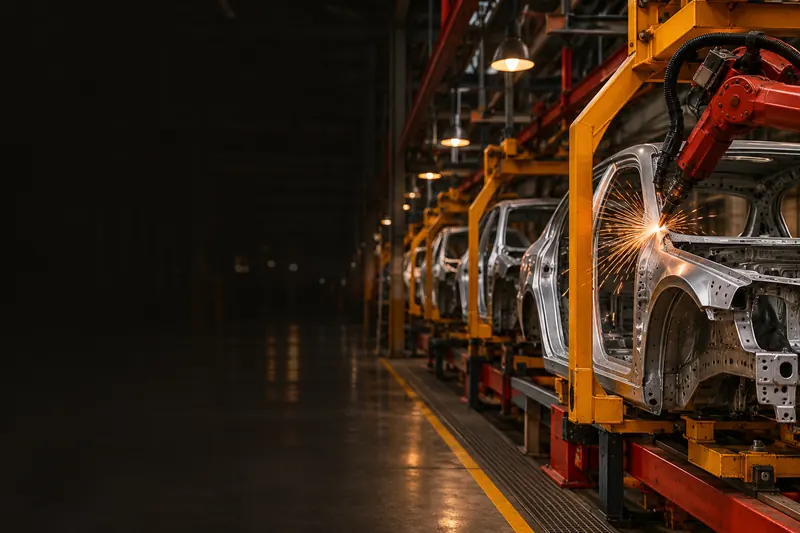
Porsche decided in 2018 to build the second-generation Macan as an all-electric car in Leipzig. It invested about €600 million in the plant’s fifth expansion, including a new body shop of 75,500 square metres, so that petrol, hybrid and all-electric cars could be built on the same production line.
Ramp-up of the electric Macan began in 2024. Porsche says the plant produces around 550 Macan and Panamera models a day on three shifts, and that more than two million cars have been built in Leipzig since production began in 2002. Hybrid models have been built there since the Cayenne S Hybrid in 2010.
The plant began as an assembly site for the Cayenne, of which 738,503 were built there between 2002 and 2017, and became a full factory in 2013 with body construction and paint shops for the first Macan.
For investors, flexible manufacturing is a form of insurance. It costs more upfront but reduces the risk of building expensive capacity for products customers no longer want. The value of that insurance rises when demand is hard to predict, as it has been during the shift to electric cars.
The Leipzig site has also served as a showcase for sustainable production. Porsche has highlighted renewable energy use and modern logistics at the plant, which help reduce the environmental footprint of each car built there.
For the workforce, building several drive types on one line requires broader training, but it also makes jobs less dependent on the fortunes of a single model, which supports stable employment at the site.
The same flexibility also helps when supply of a particular component, such as batteries or engines, is temporarily short. The plant can shift production towards models whose parts are available, keeping workers busy and customers served while the shortage is resolved.
It is a practical example of buying flexibility before it is needed.
Key moments
Decision to build the electric Macan in Leipzig.
Fifth plant expansion begins.
Electric Macan ramp-up starts.
Source: Porsche AG, Leipzig factory. ‘All cars’ = more than two million.
The trade-offs at the heart of the case
Flexibility has a location
Leipzig began assembling cars in 2002. Subsequent expansions added functions including body construction and painting. Production of the second-generation electric Macan began ramping up there in 2024. Porsche integrated axle preassembly on site and changed the assembly stage where the body joins its running gear. A flexible final line still relies on model-specific operations upstream. A shortage of electric bodies or battery assemblies cannot be cured simply by changing the order of cars on the final conveyor. The decision looks different from the perspective of the assembly planner and the finance department. The planner wants to build the cars customers have ordered, in the colours and configurations they chose, without exhausting the workforce at a particular station. Finance sees a chance to avoid building separate facilities that could run below capacity. The €600 million covers an expansion with several functions. It is a mistake to assign the whole number to an isolated option to change the powertrain mix. To estimate the value of flexibility, first describe two dedicated lines that could have been built instead. Give each a practical capacity, a realistic schedule for downtime and a product family. Next specify the cost and feasible mix for a shared line. Both alternatives should face the same demand scenarios. Comparing a modern mixed line with an imaginary dedicated factory that never breaks down will systematically undervalue the investment. Comparing with a dedicated line that cannot change a shift or use overtime will exaggerate it.
What the production planner must know
Different configurations consume different amounts of work at each station. A day’s schedule that averages the correct number of labour minutes can still bunch several difficult vehicles together and cause a queue. Sequencing protects flow, but too many sequencing restrictions weaken the promise of interchangeable capacity. Ask the operating team to identify the binding restrictions and estimate how many customer orders could be added before each becomes binding. The answer tells finance what sort of upside the equipment actually makes possible. A shared line also creates a common point of failure. If the joining station stops, all affected powertrains can be delayed together. Dedicated lines may duplicate expensive equipment but preserve an alternative route when one line has a fault. Maintenance resources, spare components and a repair plan should therefore be priced into both alternatives. An analysis that credits the shared line with every demand advantage while ignoring its common exposure has already chosen its answer.
For your seminar, paper or interview
- Q1
Which constraint binds when the final line becomes flexible?
- Q2
How much contribution is lost when a customer waits one month?
- Q3
What capacity should the planner reserve for late orders?
- Manufacturing flexibility
- Capacity utilisation
- Real options
- Capital investment
How we would approach it
Simplifying Finance’s opinion, offered as a starting point for debate, not as fact or investment advice.
We think the €600 million expansion bought Porsche an option worth having: the ability to shift between petrol, hybrid and electric cars on one line as demand changes. When the pace of electric adoption is uncertain, flexibility protects the plant from being built around the wrong mix.
Track the mix
Report how output splits across drive types each quarter.
Keep changeover fast
Measure how quickly the line can rebalance between models.
Train for all three
Maintain skills for every powertrain on every shift.
What this plan gives up
Flexible lines cost more to build and may run slightly slower than lines designed for a single product.
The strongest counter-argument
A dedicated electric line could be more efficient at high volumes, and flexibility may encourage delay in committing fully to electric production.
Metrics to watch
- Daily output by drive type
- Line utilisation rate
Propose your solution
Pick a discussion question and set out what you would do, why, and what it would cost. Strong, well-argued answers are reviewed and published below with your first name and programme.
Published solutions
Loading published solutions…
- Porsche Leipzig factory history and expansion ↗
- Porsche Leipzig production overview ↗
- Porsche Newsroom: The Porsche factory in Leipzig ↗
- Porsche Newsroom: Start of electromobility at Leipzig (2024) ↗
- Porsche Newsroom: Leipzig fifth expansion (2020) ↗
- Photo: Customer centre at the Porsche Leipzig site, photographed in 2009 by Jörg Blobelt, CC BY-SA 4.0 (cropped and resized) ↗
Figures are as reported by the companies or cited outlets as of 22 November 2026. Check the source before quoting. Corrections: let us know through the solution form.