What happened
A bank’s balance sheet contains deposits and other obligations that make it unsuitable for the ordinary industrial-company method of subtracting all debt from enterprise value. Analysts instead pay close attention to equity, asset quality, earning power and the capital required to support lending. A buyer can have a convincing distribution strategy and still be constrained in extracting cash from the institution.
SBI offered ¥2,000 per share in 2021 and ¥2,800 in the 2023 tender. The latter settled with the group holding 53.74%. Comparing offer prices gives a 40% nominal increase, but it does not establish that either offer was fair on its date. Interest rates, expected earnings, ownership rights and the probability of an eventual restructuring could have changed in the interval.
Public funds add another claim with its own timetable. An arrangement that improves the private buyer’s ability to integrate the bank could also affect how and when public money is recovered. Shareholders being asked to sell need a clear account of value transfers among stakeholder groups. A single headline purchase price is a poor substitute for this reconciliation.
A public-fund repayment can have high political value even if its timing differs from the schedule a purely private creditor would choose. Delaying payment might allow the bank to build a stronger earnings base. It might also leave taxpayers bearing risk longer than necessary. A fairness assessment needs to state both the expected cash amount and who remains exposed if performance deteriorates during the delay. An agreement promising the same nominal repayment at two different dates is not economically identical.
The buyer’s broader financial group may bring clients and products to the bank. Some opportunities can increase genuine lending or fee income. Others may change internal pricing, shifting profit from one regulated entity to another. After a take-private the outside market price disappears, but depositors and public stakeholders still need protection against such shifts. Comparing business with group affiliates against comparable independent transactions is a practical way to audit the economic case for integration.
Give the bank’s risk officer and the party negotiating public-fund repayment the same stressed earnings forecast. Ask each to mark which cash must remain in the bank and when a payment becomes possible. Differences can then be negotiated explicitly. A single group-level earnings target can conceal disagreement until repayment is due and the responsible entity cannot release the cash.
Shinsei Bank was the successor to Long-Term Credit Bank of Japan, which collapsed in 1998. The government injected a total of ¥416.6 billion of public funds in 1998 and 2000. SBI Holdings won control in 2021 through a tender offer at ¥2,000 a share that Shinsei’s board initially opposed, and renamed it SBI Shinsei Bank.
In 2023 SBI launched a second tender at ¥2,800 a share, raising its stake to 53.74% from 50.04%; the government held a further 22.98%. The bank was delisted in September 2023, which gave more flexibility to repay the remaining public funds. After a special dividend of ¥100 billion in March 2025, it repaid the last approximately ¥230 billion on 31 July 2025, with SBI Holdings bearing the cost. Japan’s financial services minister said this meant all public funds injected during that crisis had been repaid.
SBI Shinsei relisted on the Tokyo Stock Exchange’s Prime market on 17 December 2025 at ¥1,450 a share. It opened at ¥1,586 and closed at ¥1,623, giving a market value of about ¥1.45 trillion, the largest IPO in Japan that year. The case shows how a buyer can take a bank private to restructure its obligations to the state, then return it to the market. Minority shareholders, however, had argued during the 2023 offer that the bank was worth more: a special committee suggested at least ¥3,000 a share.
Key moments
SBI’s tender buys Shinsei Bank shares at ¥2,000 each.
The bank adopts the SBI Shinsei Bank name.
Settlement of a further tender at ¥2,800 raises the group’s stake to 53.74%.
Prices are not directly comparable: the bank’s share count changed after its 2023 delisting and share consolidation. Sources: SBI Shinsei Bank; Jiji Press.
The trade-offs at the heart of the case
Three interests
The acquiring group, outside investors and public-fund stakeholders can agree on a stronger bank but have different claims on the timing of its surplus cash.
Group synergies
An internal product or lending arrangement may improve one entity’s reported earnings merely by moving profit from another part of the financial group.
Repayment capacity
Accounting profit available in a good year may need to remain in the bank after a credit shock to protect depositors and support lending.
For your seminar, paper or interview
- Q1
What did the 40% change between tender prices establish, and what valuation question did it leave open?
- Q2
Which trade-offs arise when a strategic shareholder wants to integrate a bank that still has public-fund obligations?
- Q3
Would the party paying the cost accept the allocation in the exhibit, and what transfer or contractual change would alter its decision?
- Q4
From the perspective of a public-fund stakeholder in Shinsei Bank, what evidence would most seriously challenge the recommendation in this case?
- Q5
Which of the three proposed metrics would you prioritise for SBI Holdings and Shinsei Bank, and what could go wrong if management rewarded it in isolation?
- Hostile takeovers
- Bank valuation
- Minority shareholder protection
- State aid repayment
How we would approach it
Simplifying Finance’s opinion, offered as a starting point for debate, not as fact or investment advice.
Prepare separate cash and capital schedules for the bank, the acquirer and public-fund repayment. Test a slower earnings path that still protects depositors and capital adequacy. Explain the consequences of the proposed structure for each class of remaining holder.
Establish the baseline
Bridge earnings to capital available for distribution after credit losses, required retention and stress buffers. Track taxpayer recovery separately.
Test the proposed change
Review a repayment schedule under both normal earnings and an adverse credit cycle without assuming a fresh capital contribution.
Set a condition for reconsidering
Renegotiate the schedule if it depends on dividends that would materially weaken the bank’s ability to absorb losses.
What this plan gives up
Keeping a larger capital buffer can delay cash repayment and lower the near-term return to shareholders.
The strongest counter-argument
A faster integration may strengthen the earnings base enough to repay public funds sooner without reducing resilience.
Metrics to watch
- Capital after proposed distributions
- Progress toward public-fund repayment
- Returns on incremental group-originated lending
- Return on equity after relisting
- Capital adequacy ratio
Propose your solution
Pick a discussion question and set out what you would do, why, and what it would cost. Strong, well-argued answers are reviewed and published below with your first name and programme.
Published solutions
Loading published solutions…
- SBI 2023 tender terms and background ↗
- SBI integrated report and post-tender holding ↗
- SBI Shinsei Bank corporate history ↗
- 2021 tender results and price ↗
- Reuters (via Yahoo): SBI raises stake in Shinsei Bank after tender offer ↗
- SBI Shinsei Bank: Completion of public funds repayment ↗
- Jiji Press: SBI Shinsei Bank returns to stock market ↗
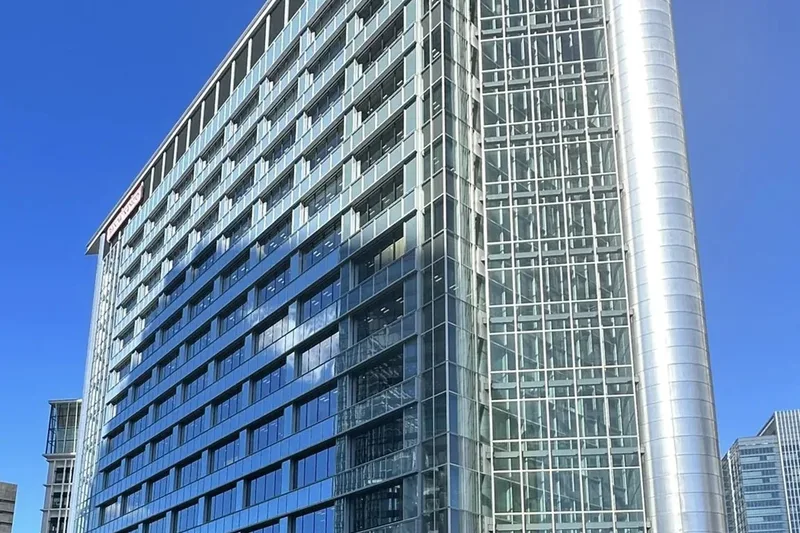
- Photo: Shinsei Bank (head office 1).jpg by Lombroso, Public domain (cropped and resized) ↗
Figures are as reported by the companies or cited outlets as of 22 November 2026. Check the source before quoting. Corrections: let us know through the solution form.