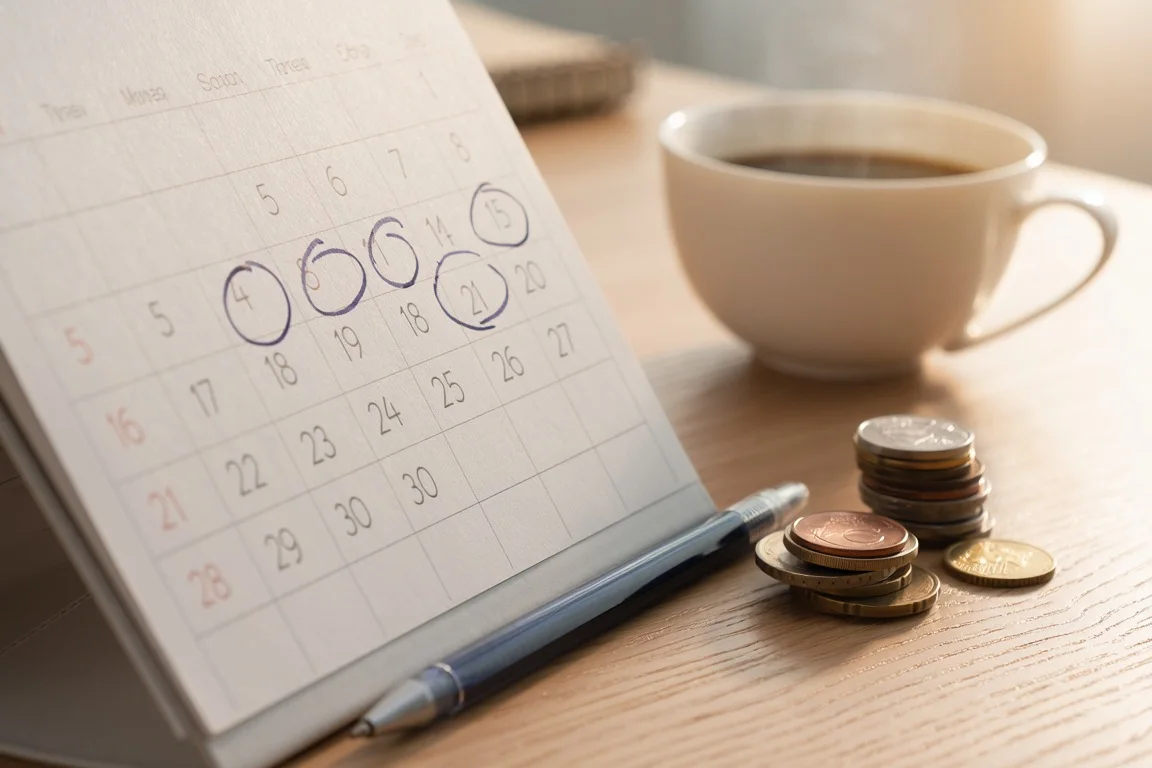
The idea
When a company pays a dividend, it does not simply send money to whoever owns the share on payment day. It follows a timetable with four key dates. Knowing them tells you whether you will receive a dividend if you buy or sell around that time.
The most important date for investors is the ex-dividend date. If you buy the share on or after this date, the dividend goes to the seller. If you own it before this date, the dividend is yours, even if you sell on the ex-date itself.

The four dates
Each dividend follows this sequence. Exchanges and companies publish the dates in advance.
| Date | What happens |
|---|---|
| Declaration date | Board announces the dividend amount and the dates |
| Ex-dividend date | From this day, new buyers do not get this dividend |
| Record date | Company checks its register to see who will be paid |
| Payment date | Cash arrives in shareholders' accounts |
Why the ex-date comes before the record date
When you buy a share, the trade takes time to settle, meaning ownership is formally transferred. Most major markets, including the US since 2024, now settle one business day after the trade. The UAE markets settle two business days after the trade. The ex-date is set so that anyone who buys before it will be on the register by the record date.
Because settlement cycles differ between markets, the gap between the ex-date and the record date can differ too. Your platform will usually show the ex-date directly, which is the only one you need to watch.
The share price drops on the ex-date
On the ex-dividend date, the share price typically falls by roughly the amount of the dividend at the open. That is logical: the company is about to pay out cash, so each share is worth a little less. Other news moves prices too, so the drop is rarely exact.
This means buying just before the ex-date to collect a dividend, sometimes called dividend capture, does not create free money. You receive the dividend but own a share that is worth less by about the same amount. After trading costs, and taxes in countries that tax dividends, the strategy usually loses money.
Dividends and taxes
Many countries withhold tax on dividends paid to foreign investors. US companies, for example, withhold 30% on dividends paid to many non-US residents unless a tax treaty or fund structure reduces it. The UAE does not tax individuals on dividends, but the withholding by the company's home country may still apply.
Funds domiciled in Ireland or Luxembourg are often used by international investors partly because treaties can reduce the withholding on US dividends inside the fund. Check what your platform shows as the net dividend received.
Funds and ETFs
Distributing funds and ETFs also have ex-dates and payment dates, usually quarterly or twice a year. Accumulating funds reinvest dividends inside the fund instead, so there is no payment to you and no price drop on an ex-date, although the dividends are still earned and taxed inside the fund where applicable.
Practical tips
If you rely on dividend income, keep a simple calendar of expected payment dates so you can plan your spending. Expect the cash to arrive weeks after the ex-date. If you are reinvesting, turn on automatic dividend reinvestment so the cash does not sit idle.
Do not let a dividend date drive a buying or selling decision for a long-term investment. A few days either way rarely matters as much as the price you pay and the quality of the business.
Interim, final and special dividends
Many companies pay more than one kind of dividend. An interim dividend is paid partway through the financial year, often after half-year results. A final dividend is paid after the full-year results. In the UAE, the United Kingdom and many other markets, the final dividend is usually proposed by the board and approved by shareholders at the annual general meeting, with the timetable published alongside.
A special dividend is a one-off payment, often made after an unusually profitable year, an asset sale or when the company has more cash than it needs. Special dividends follow the same four-date timetable, but investors should not expect them to be repeated.
Dividend reinvestment and scrip dividends
Some companies and platforms offer dividend reinvestment plans, which use the cash dividend to buy more shares automatically, sometimes without trading fees. This keeps the money invested and adds to compounding.
A scrip dividend is different. The company offers new shares instead of cash. Accepting the scrip increases the number of shares you own, but because new shares are created, it can dilute other shareholders. Companies sometimes offer scrip dividends to preserve cash.
Dividend calendars and announcements
Companies announce dividend dates in their results statements and on the exchange's announcement platform. Financial websites, platforms and exchanges also publish dividend calendars showing upcoming ex-dates and payment dates.
If you rely on dividends for income, it helps to know that payment dates cluster in certain months. Many UAE companies pay after their annual general meetings, which are often held in the first few months of the year. US companies more commonly pay quarterly. A portfolio that mixes markets can produce a more even flow of income through the year.
Dividends and total return
A dividend is a transfer of value from the company to its shareholders, not extra money from nowhere. That is why the share price falls on the ex-date. What matters for long-term investors is total return: the combination of share price changes and dividends received.
A company with no dividend but strong growth can produce a higher total return than one with a generous dividend and no growth. Dividends are valuable for income and as a sign of financial discipline, but they are one part of the picture, not the whole.
Frequently asked questions
Do I get the dividend if I sell on the ex-date?
Yes. If you owned the share before the ex-dividend date, you receive the dividend even if you sell on the ex-date.
Why does the share price fall on the ex-date?
Because the company is about to pay out cash, so each share is worth roughly the dividend less.
Is dividend capture profitable?
Usually not after the price drop, trading costs and any withholding tax.
A realistic scenario
Khalid notices that a bank share he likes will pay a dividend of AED 0.30 next week and plans to buy the day before the ex-date to collect it quickly, then sell. He works through the numbers: the price is likely to drop by about AED 0.30 on the ex-date, and he will pay a spread and commission on both trades.
He realises the quick trade is likely to lose money after costs. Instead he decides whether he wants to own the bank for the long term. He does, buys a holding sized for his portfolio and sets the dividend to reinvest automatically. The exact date he bought no longer matters much to his results.
Questions to ask about a dividend
- When is the ex-dividend date?
- Will I own the share before that date?
- How much tax will be withheld before it reaches me?
- When will the cash actually arrive?
- Am I buying for the business, or only for the dividend?
The short version
Every dividend has a declaration date, an ex-date, a record date and a payment date. You must own the share before the ex-date to be paid. The price usually drops by about the dividend on that day, so trying to capture dividends by timing purchases rarely pays.
Illustration: a share trades at AED 10.00 and will pay a AED 0.40 dividend. If you buy before the ex-date you receive AED 0.40, but the share typically opens around AED 9.60 on the ex-date. Your total is about AED 10.00 either way, before any tax or costs.
You must own the share before the ex-dividend date to receive the dividend. The price usually drops by about the dividend on that day, so timing a purchase around it does not create value.
Primary educational reference
Investor.gov · Ex-dividend dates ↗Reviewed November 28, 2026. Examples are hypothetical illustrations in AED or USD. Educational content, not personalised investment, legal or tax advice.