Nvidia
The engine of the AI boom — now without its founder.
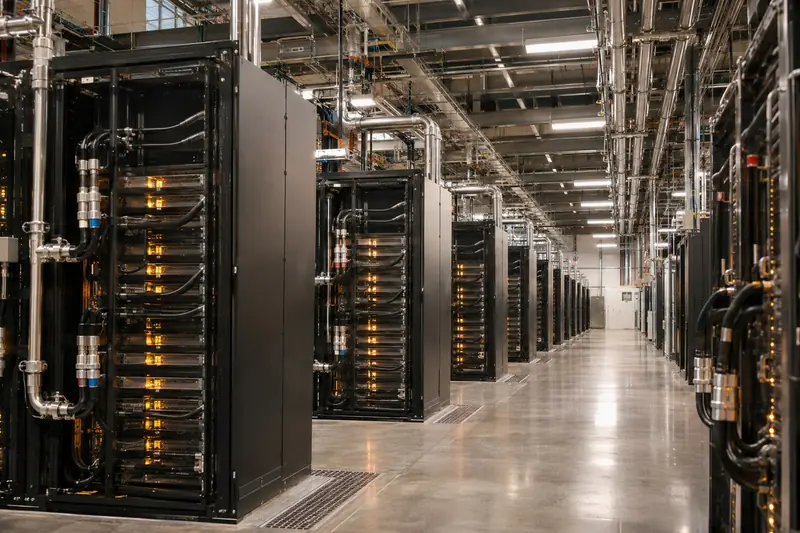
Nvidia designs the graphics processors, networking and software that power most of the world’s AI data centres. Its revenue doubled again in 2026, but its founder and CEO Jensen Huang resigned in November amid a board investigation.
What Nvidia does
Data center
Over 90% of revenue: AI accelerators (Blackwell, now Vera Rubin), complete rack systems and networking.
Networking
High-speed switches and links that connect thousands of chips into one AI system.
CUDA software
The programming platform most AI developers use — a key reason customers stay.
Gaming and graphics
GeForce graphics cards for PCs and laptops.
Automotive and robotics
Chips and software for self-driving cars and robots.
2026 in three points
Revenue doubled
In the quarter to 25 October, revenue rose 103% to $115.8 billion, data center revenue rose 110% and net income reached $65.3 billion. Nvidia guided to about $130 billion next quarter.
Founder out
On 12 November Jensen Huang resigned as CEO and director, days after the board opened an independent investigation. CFO Colette Kress became interim CEO and the board is searching for a permanent leader.
Priced like a peak
Despite record results the shares fell about 19% over the year. At about 10 times expected earnings, the market is pricing in a slowdown in AI spending.
Key figures
| Revenue (last 12 months) | 361.81B |
|---|---|
| Net income (last 12 months) | 226.26B |
| Gross margin | 74.92% |
| Operating margin | 66.08% |
| Net profit margin | 62.54% |
| Free cash flow (last 12 months) | 148.72B |
| Net cash (negative = net debt) | 59.58B |
| P/E ratio (trailing) | 16.22 |
| Forward P/E | 10.41 |
| Dividend yield | 0.66% |
| Return on invested capital | 96.86% |
| Employees | 42,000 |
| Share price, last 52 weeks | -19.10% |
| Analysts’ expected revenue growth (3-year, yearly) | 62.62% |
Company figures from Stock Analysis as of 19 Nov 2026; market value from the 13 Nov 2026 ranking. “Last 12 months” covers the four most recent reported quarters.
What protects the business
CUDA ecosystem
Millions of developers and years of software tools built around Nvidia hardware.
Full-stack systems
Chips, networking and software designed together, sold as complete AI racks.
Scale and supply
Priority access to TSMC’s most advanced manufacturing and to memory supply.
What could push it higher
AI inference
As AI is used more, demand shifts from training to running models — a much larger market.
Vera Rubin
The newest platform began shipping and added nearly $20 billion of revenue in a quarter.
Sovereign and enterprise AI
Governments and companies building their own AI capacity.
Robotics and cars
Physical AI could become a major new market.
What could go wrong
Leadership
Losing a founder-CEO creates uncertainty over strategy and talent; Moody’s cut its credit outlook.
Customer concentration
A few cloud giants buy most of its chips and are designing their own.
AI spending cycle
If hyperscalers cut capital spending, revenue could fall sharply.
China and export controls
Nvidia assumes no China data center compute revenue in its outlook.
Three scenarios for Nvidia
No one can predict where a company will be in 10 years. These scenarios show what different combinations of growth and valuation would mean for the company’s value — a way to test the price, not a forecast.
$2.39 trillion by 2031
AI capital spending peaks, custom chips take share and leadership turmoil hurts execution.
$8.68 trillion by 2031
Earnings level off from a very high base as AI spending matures, but Nvidia keeps its lead.
$17.46 trillion by 2031
Inference and physical AI keep demand growing and the new CEO keeps the roadmap on track.
Starting point: about $378 billion of expected earnings over the next 12 months (market value ÷ forward P/E). Each case grows that at the yearly rate shown for five years, then at half that rate for the next five, and applies the P/E multiple shown. Dividends and buybacks are ignored.
| Case | Yearly earnings growth | P/E in year 5 | Value in ~5 years | Yearly return, 5 yrs | Value in ~10 years | Yearly return, 10 yrs |
|---|---|---|---|---|---|---|
| Bear | -12% | 12× | $2.39 trillion | -9% | $1.76 trillion | -8% |
| Base | +5% | 18× | $8.68 trillion | +17% | $9.82 trillion | +10% |
| Bull | +14% | 24× | $17.46 trillion | +35% | $24.48 trillion | +20% |
Build your own scenario
Starting point: about $378 billion of expected earnings over the next 12 months (market value ÷ forward P/E). Each case grows that at the yearly rate shown for five years, then at half that rate for the next five, and applies the P/E multiple shown. Dividends and buybacks are ignored. Educational tool, not a forecast or a recommendation.
- Appointment of a permanent CEO
- Hyperscaler capital spending plans for 2027
- Gross margin (guided to 71–72%)
- Market share of custom AI chips
Nvidia’s numbers have never been stronger, yet its valuation is lower than the market’s. Investors are weighing record profits against the risk that AI spending — and the company’s leadership — are at a turning point.
- Nvidia — CEO transition announcement ↗
- Nvidia — Q3 fiscal 2027 results ↗
- Stock Analysis — Nvidia Q3 FY2027 earnings ↗
- Stock Analysis — Nvidia statistics ↗
- Visual Capitalist via Yahoo Finance — The world’s 50 most valuable companies (data: CompaniesMarketCap, close 13 Nov 2026) ↗
Educational content, not investment advice. Scenarios are illustrations built from simple assumptions; real outcomes can fall outside all three. Figures can differ between data providers.