Diversification has never been cheaper
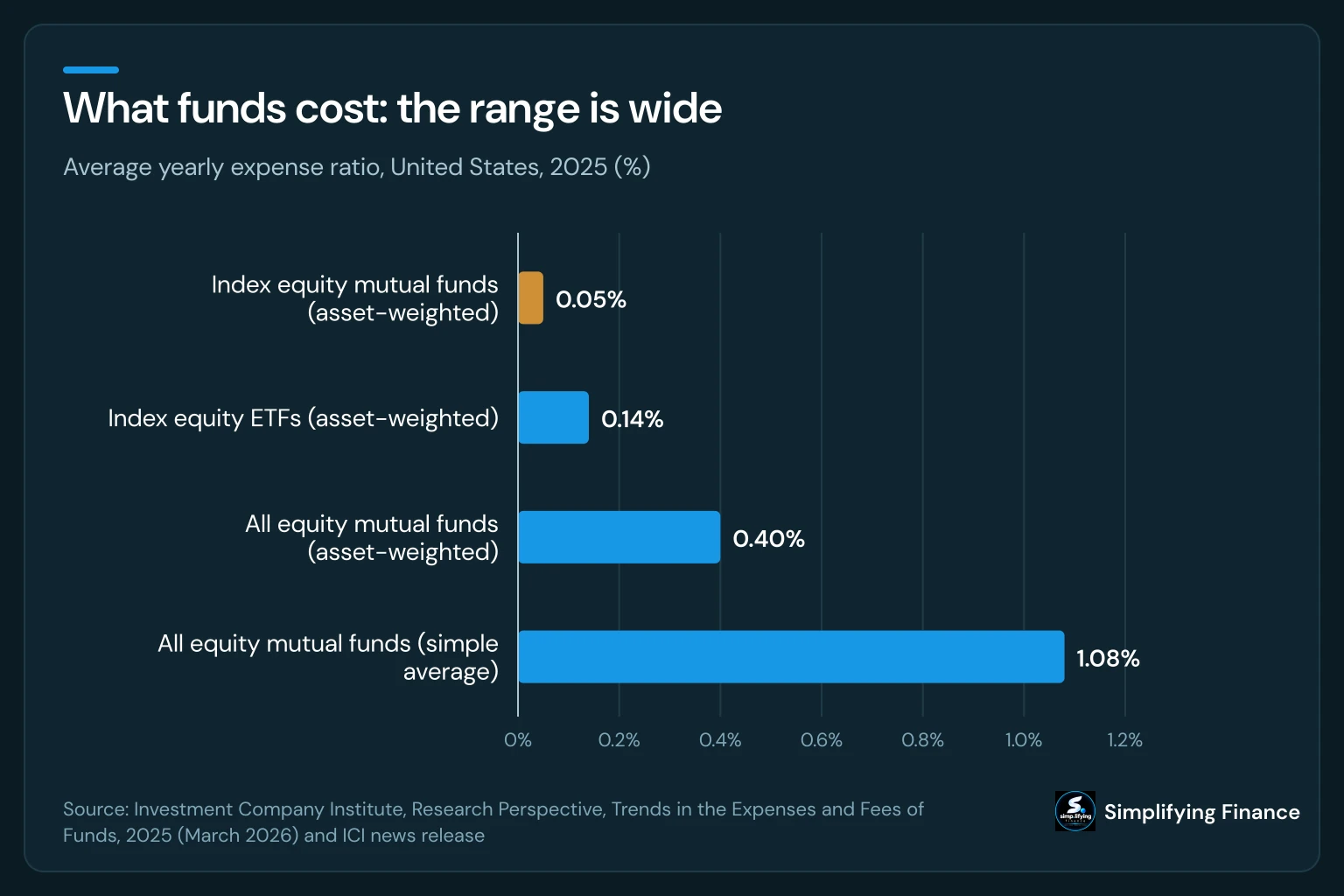
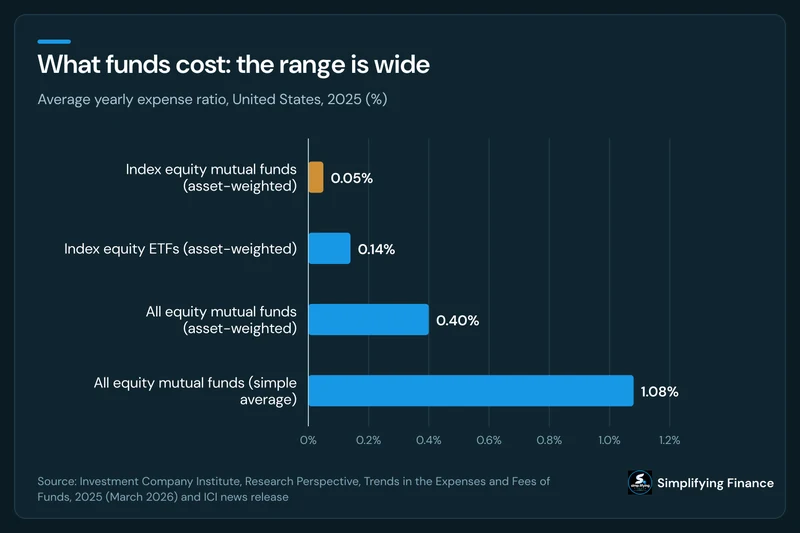
A generation ago, spreading money across thousands of companies and dozens of countries was expensive. Today it can cost very little. The Investment Company Institute (ICI) reports that in 2025 the asset-weighted average expense ratio for index equity mutual funds in the US was 0.05%, and for index equity ETFs 0.14%. The average for all equity mutual funds, as actually paid by investors, was 0.40%, down 62% since 1996.
Costs differ by country, and many markets outside the US have higher fees. But the trend towards cheaper broad funds is global.
That makes cost one of the easiest parts of diversification to get right.
See the numbers behind the chart
| Fund type | Expense ratio |
|---|---|
| Index equity mutual funds (asset-weighted) | 0.05% |
| Index equity ETFs (asset-weighted) | 0.14% |
| All equity mutual funds (asset-weighted) | 0.40% |
| All equity mutual funds (simple average) | 1.08% |
The range is wide
The averages hide a wide spread. ICI reports that the simple average expense ratio of all equity mutual funds offered in 2025 was about 1.08%, far above what most investors actually paid. Its data show that the most expensive tenth of equity mutual funds charged 1.84% or more. Morningstar reports that in 2024 the asset-weighted average for active US equity funds was 0.60%, compared with 0.11% for all passive funds.
In other words, the same broad diversification can cost a few hundredths of a percent a year or more than one and a half percent, depending on the product chosen. The library lesson on investment fees explains how to read a fund's costs.
Why small differences matter
Fees are charged every year on the whole amount invested, so they compound. A difference of one percentage point a year can reduce the final value of a long-term portfolio by a large fraction over decades. Unlike returns, fees are certain: they are paid whether the market rises or falls.
Costs are falling, but not everywhere
ICI reports that average expense ratios for equity mutual funds fell 62% between 1996 and 2025, and that investors increasingly choose lower-cost funds. Investment News, citing ICI, reports that index mutual funds and ETFs made up 51% of all long-term fund assets by the end of 2024, up from 19% in 2010.
In many countries outside the US, however, broad low-cost funds are newer, less widely available or sold alongside higher-cost products through advisers and banks. Savers there may need to look harder for cheap diversification, and may find that local options cost noticeably more.
Other costs
Expense ratios are not the only cost. Buying and selling can involve commissions, the gap between buying and selling prices, and currency conversion charges. Funds that trade a lot inside the fund incur costs that do not appear in the expense ratio. The library lesson on tracking difference shows how to see the total gap between a fund and its index.
Taxes can be the largest cost of all. Selling holdings to rebalance or switch funds may trigger tax on gains in some countries, and foreign dividends may be taxed at source. The lesson on tax drag explains how these build up.
A worked comparison of one point
The example below shows the effect of a 1.3 percentage-point difference in yearly cost over 25 years. The gap grows over time because fees reduce not only the money invested but also all the future growth that money would have earned. That is why cost matters most for long-term savings and for large portfolios.
Where diversification gets expensive
The cheapest way to diversify is usually one or a few broad index funds. Costs rise when diversification is pursued through many specialist funds, actively managed funds, private funds or frequent trading. The pages on diworsification and private markets showed how these can add cost without adding much real spread.
Keeping costs down
Practical steps include choosing broad, low-cost funds for the core of a portfolio, using tax-sheltered accounts where available, rebalancing with new money rather than selling, and avoiding unnecessary switching. Costs are one of the few parts of investing that an investor fully controls.
Paying for advice
Some investors pay for financial advice in addition to fund fees. Good advice can be valuable, especially for complex situations, behaviour in crises or tax planning. The point is to know what you pay in total, including advice, fund fees, platform fees and trading costs, and to judge whether each part is worth it. A total of well over 1% a year deserves close scrutiny for a simple diversified portfolio.
The same mix at two prices
Take a saver in Thailand who invests THB 1,000,000 for 25 years in a diversified mix earning, for illustration, 6% a year before fees. Compare a yearly cost of 0.2% with one of 1.5%.
| Starting amount | THB 1,000,000 |
| After 25 years at 5.8% (0.2% fee) | about THB 4,100,000 |
| After 25 years at 4.5% (1.5% fee) | about THB 3,010,000 |
| Difference | about THB 1,090,000 |
At 0.2% a year the portfolio grows at about 5.8% and ends near THB 4,100,000. At 1.5% it grows at about 4.5% and ends near THB 3,010,000. The higher fee costs about THB 1,090,000, more than the original amount invested, for the same underlying diversification.
Where people go wrong
- Ignoring fees because they look small. One percentage point a year compounds into a large sum.
- Paying active fees for index-like portfolios. Several overlapping active funds can cost a lot for little extra spread.
- Forgetting tax when rebalancing. Selling to rebalance can trigger tax; new money often avoids it.
- Switching funds often. Each switch adds trading costs and possible tax.
- Not knowing your total cost. Fund, platform, advice and trading costs all add up.
Put it to work
- Find your total yearly cost. Add up the expense ratios of your funds, weighted by how much you hold in each.
- Look for cheaper equivalents. Check whether broad, low-cost funds could replace expensive ones.
- Use tax shelters. Hold investments in tax-advantaged accounts where your country allows.
- Ask for a total. Request a single yearly figure for all the costs you pay.
- Read on. Part 8 begins: what past crashes taught savers.
Broad diversification can cost very little. The expensive part is usually complexity, high-fee products and unnecessary trading.
Facts checked against the sources above on 27 November 2026. Figures are as of the dates stated and will change. Worked examples use round illustrative numbers to show the arithmetic, not forecasts. Educational content only, not personal investment advice.