Early career: protect income, start simply
For young workers, the biggest asset is usually future earnings, as the page on your job as an asset explained. Savings are small, so the priorities are an emergency fund, insurance against losing the ability to earn, and a simple, low-cost start to investing. Because the time horizon is long and new savings keep arriving, many young savers hold a high share of growth assets.
Avoiding concentration matters from the start: in an employer's shares, in one sector or in a single property bought with a large loan.
A simple start is enough.
See the numbers behind the chart
| Mix | Value |
|---|---|
| 100% shares | -36.5% |
| 80% shares | -25.2% |
| 60% shares | -13.9% |
| 40% shares | -2.6% |
| 20% shares | +8.8% |
Why stages matter
Two people with the same savings can need very different mixes. A 25-year-old with decades of earnings ahead can recover from a bad year by working and saving; a 65-year-old drawing an income may not. Thinking in stages helps match diversification to the risks you actually face at each point in life.
Building years: balance the big decisions
In mid-career, savings grow and big decisions arrive: a home, children's education, perhaps a business. The home often becomes the largest asset, as the page on your home in your portfolio showed. Diversification now means balancing property, savings and pension, and keeping separate pots for goals with different dates.
Children and family
Family changes bring new goals with fixed dates, such as school fees or university costs, and new dependants who rely on your income. That raises the importance of insurance and of keeping money for near-term goals in steadier assets. Savings for a child's education due in five years usually need a more cautious mix than retirement savings due in thirty.
Approaching retirement: reduce the damage a bad year can do
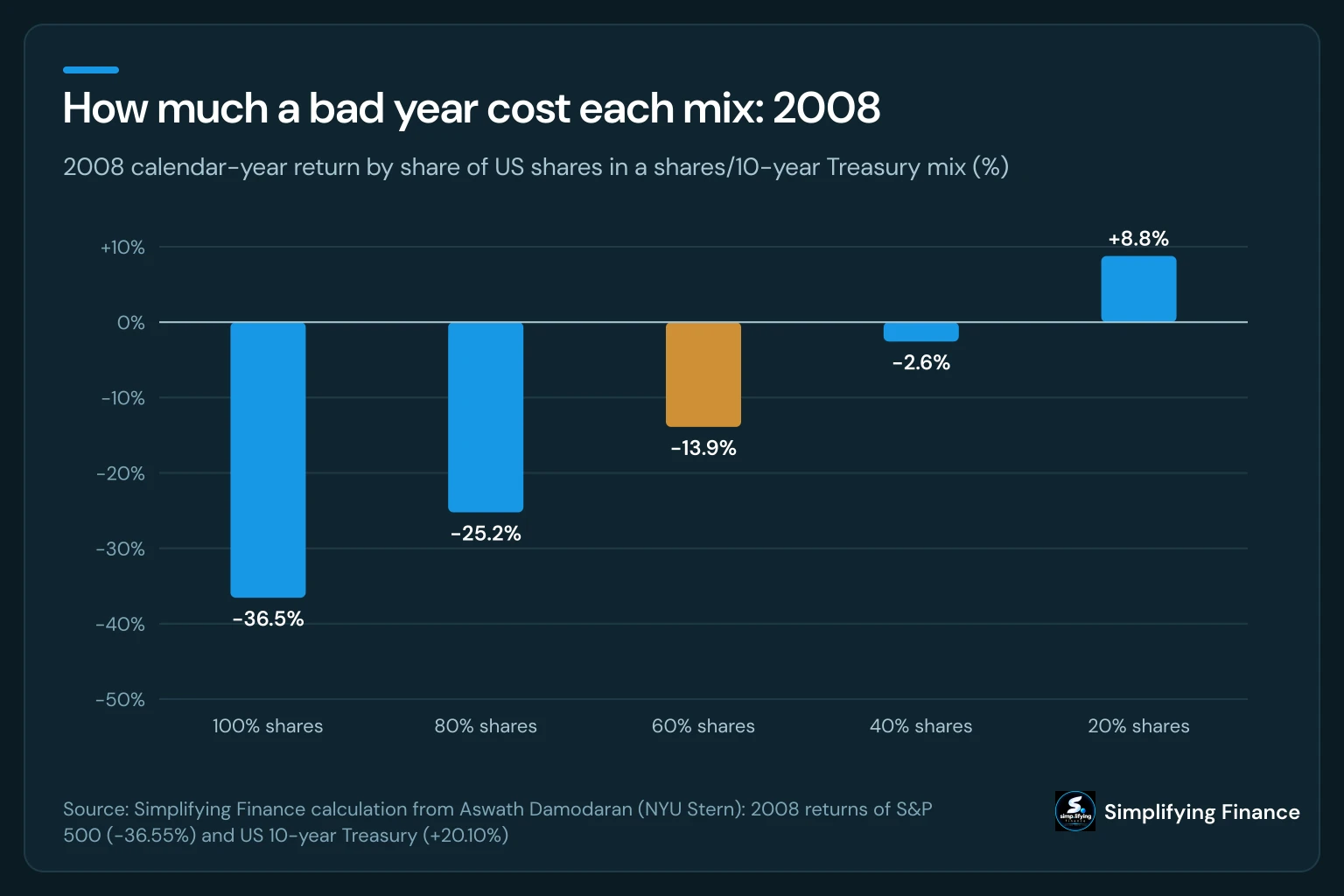
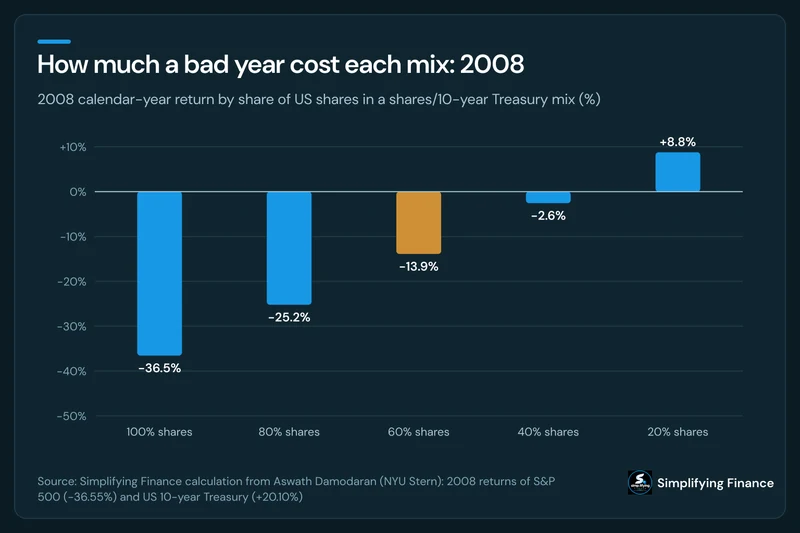
As retirement nears, the time left to recover from a fall shrinks, and the amount at stake is usually at its largest. The chart shows how much difference the mix made in 2008: all in shares lost about 36.6% in Damodaran's US data, while 60% shares lost about 13.9% and 40% shares about 2.6%.
Many people therefore shift gradually towards steadier assets over the years before retirement. The library lessons on retirement glide paths and target-date funds describe common approaches.
In retirement: income, inflation and order of returns
Retirees face new risks. Withdrawals mean that falls early in retirement do more damage than later ones, a problem called sequence-of-returns risk, explained in the library. Inflation erodes fixed incomes over decades. And people may live longer than expected.
Diversification in retirement often combines a cash buffer for the next year or two of spending, bonds for the medium term, inflation protection, and some growth assets for later years. Pensions and annuities, covered earlier, can provide a bond-like base.
2022 as a warning
The 2008 example shows bonds cushioning a fall. But in 2022, as the page on that year showed, all of these mixes lost about 18%, because bonds fell with shares. For people near or in retirement, that is a reason to hold a range of defences, including cash and inflation-linked assets, rather than relying on government bonds alone.
Change is gradual, and personal
There is no single correct mix for any age. A 60-year-old with a large secure pension may sensibly hold more shares than a 40-year-old with an unstable income. What changes with age is the balance of risks you face; the right response depends on your whole situation, not just your birthday.
One principle throughout
Across every stage, the core principle stays the same: avoid letting any single company, asset, place or source of income decide your future. What changes is how that principle applies, as your biggest risks move from your earning power, to your home and family commitments, to the sustainability of your retirement income.
Review at life events
Beyond the yearly check, it is worth reviewing your mix at major life events: a new job, marriage, children, buying a home, an inheritance, a business sale or retirement. Each changes your income, your goals or your other assets, and so changes what good diversification looks like for you.
Passing it on
Later in life, many people also think about what they will leave to their families. Diversification remains relevant here: a single property or business left to heirs can create its own concentration risks. The library lesson on wills and estate planning covers the practical side.
Same fall, different stages
Take two savers in India, each with a 2008-style year ahead: one aged 30 with ₹5 lakh invested, one aged 60 with ₹80 lakh. Both hold 100% shares. Use the 2008 figures from the chart.
| Age 30, ₹5 lakh, 100% shares | about -₹1.8 lakh |
| Age 60, ₹80 lakh, 100% shares | about -₹29 lakh |
| Age 60, ₹80 lakh, 40% shares | about -₹2 lakh |
The 30-year-old loses about ₹1.8 lakh but has decades of earnings and contributions ahead. The 60-year-old loses about ₹29 lakh just as withdrawals begin. With 40% shares instead, the 60-year-old's loss in a 2008-style year would have been about ₹2 lakh.
Where people go wrong
- Using one mix for life. Risks change as earnings, savings and time horizons change.
- Becoming too cautious too early. Young savers with long horizons may hold too little growth.
- Relying on bonds alone near retirement. 2022 showed bonds can fall with shares.
- Following age rules blindly. Your pension, home and job matter as much as your age.
- Mixing short and long goals in one pot. Each goal needs a mix suited to its own date.
Put it to work
- Name your stage. Decide which stage best describes you and its main risks.
- Check your mix against it. Ask whether your current mix fits the time you have left.
- Plan the next shift. Decide how your mix will change over the coming years.
- Separate your pots. Keep money for near-term goals apart from long-term savings.
- Read on. The final page brings everything together: a checklist and ten myths.
Diversification is not one fixed mix for life. As your earning years shrink and your savings grow, the balance between growth and safety usually shifts.
Facts checked against the sources above on 27 November 2026. Figures are as of the dates stated and will change. Worked examples use round illustrative numbers to show the arithmetic, not forecasts. Educational content only, not personal investment advice.