An old idea with a long memory
Long before anyone measured volatility, people knew that one bad event should not be able to ruin them. The Babylonian Talmud, compiled many centuries ago, records the advice of Rabbi Yitzchak that a person should divide wealth into three parts: a third in land, a third in merchandise and a third kept at hand. Land was slow but sturdy, trade was risky but rewarding, and cash met emergencies.
Shakespeare gave the same instinct to a merchant. In The Merchant of Venice, written in the 1590s, Antonio explains that he is not worried about one cargo because "my ventures are not in one bottom trusted, nor to one place". In other words, his goods sailed on several ships to several ports. A storm could sink one ship, not all of them.
See the numbers behind the chart
| Year-end | Index fund share |
|---|---|
| 2010 | 19% |
| 2015 | 28% |
| 2020 | 40% |
| 2025 | 52% |
From proverb to mathematics
For centuries the idea stayed a proverb. The change came in 1952, when Harry Markowitz, then a 24-year-old graduate student at the University of Chicago, published "Portfolio Selection" in the Journal of Finance. His insight was that you cannot judge an investment on its own. What matters is how it moves with everything else you own.
Markowitz showed that two risky assets which do not move in step can be combined into a portfolio that swings less than either one alone. That relationship, measured by correlation and covariance, is the engine of every page in this guide. In 1990 he shared the Nobel memorial prize in economics with William Sharpe and Merton Miller for this body of work.
The index fund makes it cheap
Theory alone did not help a family with a modest savings account. Owning hundreds of shares one by one was expensive. On 31 August 1976, John Bogle's young firm launched the First Index Investment Trust, which aimed to track the S&P 500. It hoped to raise as much as $150 million and raised only about $11.3 million. Critics called it "Bogle's folly".
The idea survived. A single fund could hold a whole market for a small yearly fee, so diversification stopped being a privilege of the rich. Exchange-traded funds followed in the 1990s, and similar index products are now sold on exchanges from London and Frankfurt to Mumbai, Johannesburg, São Paulo and Tokyo.
Where things stand today
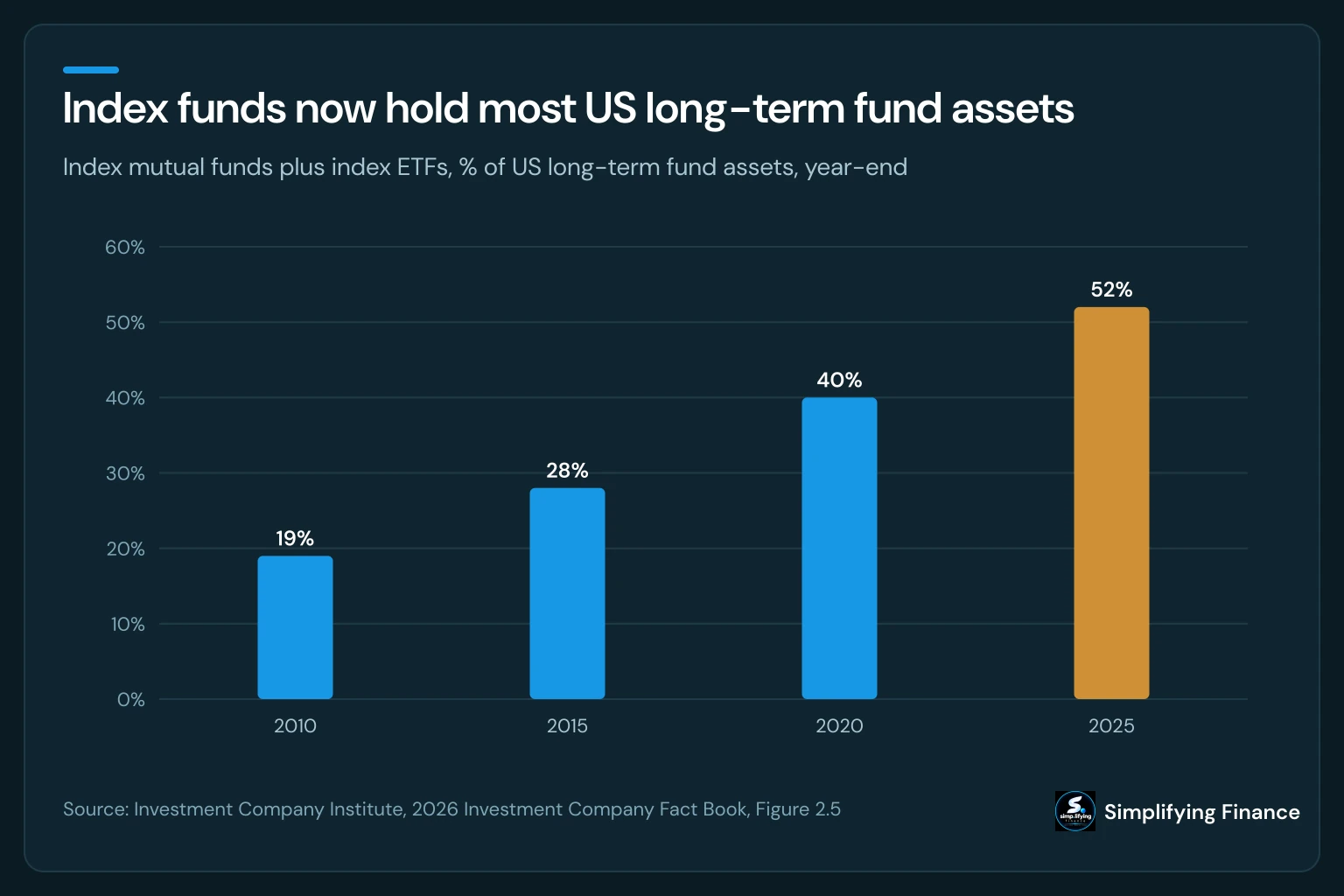
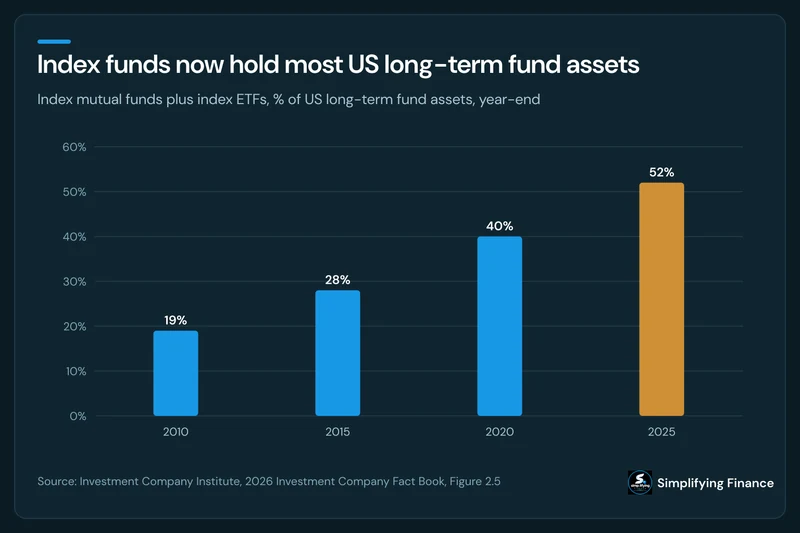
The chart shows how far the shift has gone in the United States, the market with the longest fund records. According to the Investment Company Institute, index mutual funds and index ETFs held about 19% of long-term fund assets in 2010 and 52% by the end of 2025, a total of about $19.1 trillion.
That does not mean index funds are always the right choice, or that everyone who owns one is well diversified. Many people own several funds that hold the same giant companies. Later pages look at that problem in detail. But the history is clear: spreading risk moved from proverb, to proof, to a product almost anyone can buy.
Why the modern version is stronger
Old advice split money between a few broad buckets. Modern diversification can go much further, because one fund can hold thousands of companies across dozens of countries. A saver in Kenya or Chile can own a slice of firms in Japan, Germany and the United States for the same yearly fee as one local fund. The idea has not changed; the reach has.
What has not changed
Every version of the idea, from the Talmud to the index fund, rests on the same three points. No one can know which single investment will fail. Losses that are spread out are easier to survive than losses that arrive all at once. And spreading money only helps if the parts really behave differently.
That last point is where most mistakes happen, and it is why this guide spends so much time on correlation, hidden overlap and the risks in your own life, such as your job and your home.
Three ships or one?
Use round illustrative numbers. A merchant in Europe can send goods worth €30,000 on one ship, or split them into three cargoes of €10,000 on three separate ships. Assume each ship has a 10% chance of sinking and the ships sink independently.
| One ship: chance of losing everything | 10% |
| Three ships: chance of losing everything | 0.1% |
| Expected loss in both cases | €3,000 |
With one ship, there is a 1-in-10 chance of losing everything. With three ships, the chance of losing everything is 0.1 × 0.1 × 0.1, or 0.1%: one in a thousand. The most likely bad outcome is losing one cargo, €10,000. Expected loss is the same in both cases. What changes is the chance of ruin. The catch is the word "independently". If all three ships sail into the same storm, splitting them helps far less.
Where people go wrong
- Thinking diversification is modern. The idea is ancient. What is new is the ability to measure it and to buy it cheaply. Old wisdom still applies: never let one event decide your future.
- Confusing many holdings with real spread. Ten ships in the same storm are one bet. Ten funds that own the same companies are one bet too.
- Treating "index fund" as a magic word. An index fund is only as diversified as the index it follows. A single-country or single-sector index can still be very concentrated.
- Forgetting costs. Bogle's point was cost as much as spread. High fees can quietly cancel out a large part of the benefit.
Put it to work
- Read on in order. The next page shows why one share on its own is closer to a lottery ticket than most people think.
- List what you own. Write down every fund, share, property and savings account you hold. That is your starting map.
- Ask the ship question. For each item, ask what single event could hurt it. If the same event appears again and again, you have found a concentration.
- Look at fees. Note the yearly charge on each fund. You will use it on the page about the cost of diversifying.
Diversification began as common sense, became a theory in 1952, and is now built into the cheapest funds in the world.
Facts checked against the sources above on 27 November 2026. Figures are as of the dates stated and will change. Worked examples use round illustrative numbers to show the arithmetic, not forecasts. Educational content only, not personal investment advice.