What a world index holds
A global share index such as the MSCI ACWI IMI covers thousands of companies across developed and emerging markets. MSCI says it covers 47 markets and about 99% of the world's investable share market. Like most indices, it weights each company by its market value, so countries with the most valuable companies get the biggest share.
The library lessons on global index families and market indices explain how these indices are built. This page looks at one consequence: how much a "world" fund overlaps with a US fund.
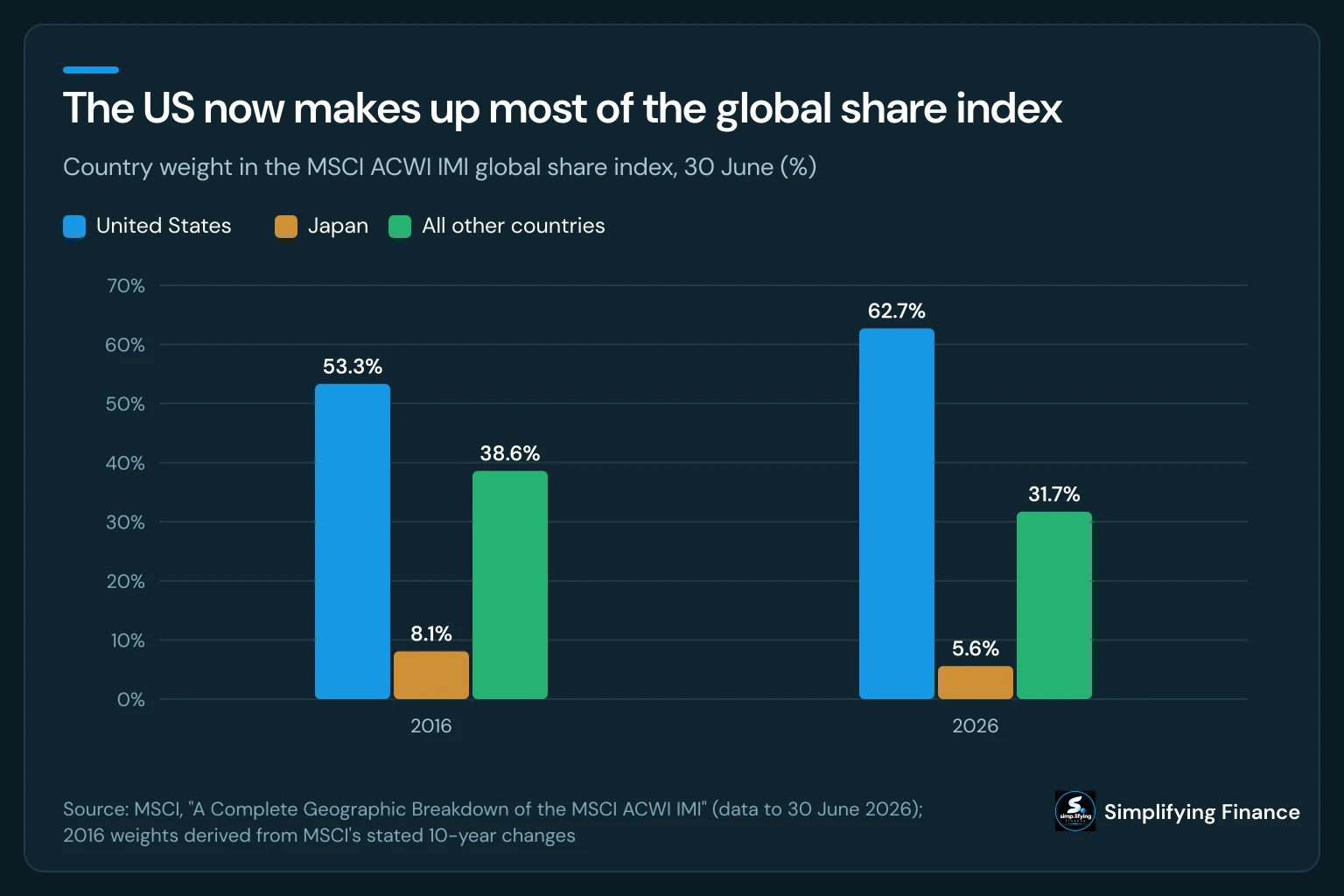
See the numbers behind the chart
| Year | United States | Japan | All other countries |
|---|---|---|---|
| 2016 | 53.3% | 8.1% | 38.6% |
| 2026 | 62.7% | 5.6% | 31.7% |
The US share keeps growing
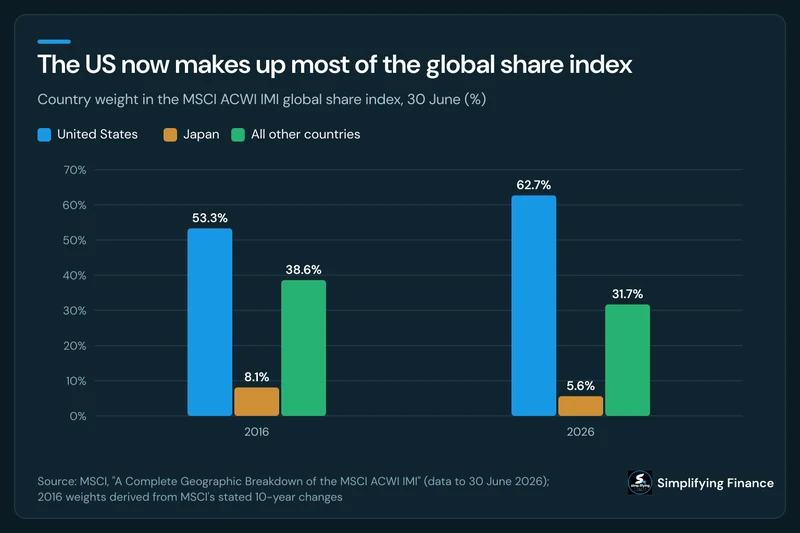
According to MSCI, the United States made up about 62.7% of the ACWI IMI at 30 June 2026, up 9.4 percentage points over ten years. Japan's share fell 2.5 points to about 5.6% over the same period. In other words, roughly three dollars in every five in a global index fund are invested in US companies.
That reflects the strong growth in value of large US companies, especially in technology. It is not a forecast, and the US share has risen and fallen in earlier decades. But it shapes what a world fund actually contains today.
Where the overlap comes from
Suppose you own a US fund and a world fund. The world fund already holds the same large US companies, usually as its biggest holdings. Adding it to a US fund therefore increases your exposure to those companies rather than replacing it with something different.
The same applies to the largest companies by name. The earlier page on the top 10 showed how a handful of firms dominate the US index. Because those firms are also the largest in the world index, a saver can end up with a large share of all their shares in the same few companies.
Why US companies are still global
MSCI also notes that while US companies dominate the index, their revenues come from around the world. A US-listed company may sell in Europe, Asia and Africa. So a heavy US weight is not the same as betting only on the American economy.
Even so, US-listed shares share common risks: US interest rates, the US dollar, US regulation and the valuations that US investors are willing to pay. Those common drivers are why the overlap matters.
Your home market in a world fund
For savers outside the US, a world fund often holds only a small slice of their home country. Japan, the second-largest market in the index, is about 5.6%. Most other countries are a few percent or less. A saver in Kenya, Peru or Malaysia who buys only a world fund owns very little of the economy they live and spend in.
That is not necessarily a problem: a home economy is already part of your life through your job, your home and your local spending. But it is worth knowing, because it explains why many investors combine a world fund with some home-market holdings, and why the right balance differs from country to country.
What other markets add
The rest of the world still makes up close to two-fifths of the global index, and its sector and style mix differs. Many markets outside the US lean more toward banks, industrials and resources and less toward technology. Holding them adds companies, currencies and business cycles that a US-only fund does not include. The library lessons on home bias and international diversification look at this from the viewpoint of investors in different countries.
How to check your own overlap
Look at the country breakdown on each fund's fact sheet. Multiply each fund's US weight by the amount you hold in it and add the results. Do the same for the top 10 holdings. The library lesson on fund overlap shows a step-by-step method. The answer tells you how much of your share money really depends on one country and a few companies.
Is the US weight too high?
There is no agreed answer. Supporters of market weights say the index simply reflects what investors around the world are willing to pay for each company, and that deviating from it is a bet like any other. Others worry that the US share is high by historical standards and prefer to hold less.
Either view is reasonable. What matters is choosing deliberately, rather than discovering by accident that most of your shares sit in one country.
Two funds, one country
Take a saver in South Africa with R 200,000: R 120,000 in a world fund and R 80,000 in a US fund. Use the MSCI figure of about 63% US weight for the world fund, and 100% for the US fund.
| World fund R 120,000 at about 63% US | about R 75,600 |
| US fund R 80,000 at 100% US | R 80,000 |
| Total in US companies | about R 155,600 (78%) |
US exposure from the world fund is about R 75,600, plus R 80,000 from the US fund: about R 155,600, or 78% of all the saver's shares. The saver might have thought of the split as 60% world and 40% US, but the real split is closer to four-fifths US.
Where people go wrong
- Assuming "world" means evenly spread. A market-value world index gives most of its weight to the US today.
- Adding a US fund to "balance" a world fund. It usually deepens the US weight instead of balancing it.
- Ignoring currency. A large US weight also means a large exposure to the US dollar for non-US savers.
- Looking only at fund names. The country breakdown on the fact sheet is what counts.
- Counting fund names as diversification. Three funds can still hold the same few hundred companies.
Put it to work
- Add up your US weight. Use fact sheets to work out how much of your shares are in US companies.
- Decide if that matches your plan. Choose whether you want the market weight, more, or less.
- Check your home market too. Note how much sits in your own country, which may be very small in a world index.
- Repeat once a year. Index weights shift as markets move, so check again annually.
- Read on. The next page looks at markets dominated by one giant company.
Owning a world fund and a US fund is often less diversified than it looks, because about three-fifths of the world fund is already American.
Facts checked against the sources above on 27 November 2026. Figures are as of the dates stated and will change. Worked examples use round illustrative numbers to show the arithmetic, not forecasts. Educational content only, not personal investment advice.