Lesson 1: give your money a purpose and a horizon
Every endowment exists to pay for something specific, year after year, for as long as the institution exists. Its investments follow from that purpose. For a household, the same thinking applies: name each pot of money and when it will be needed. Money for a home deposit in two years should be invested very differently from money for retirement in 25 years.
See the numbers behind the chart
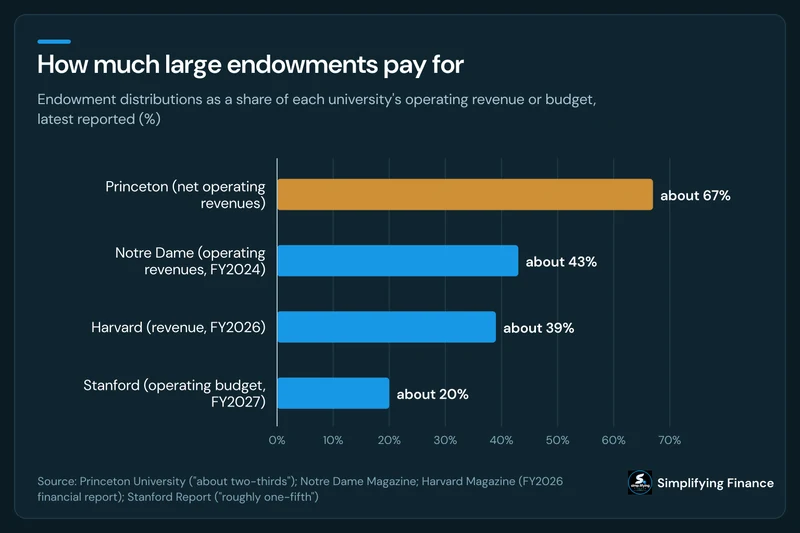
| University | Share |
|---|---|
| Princeton (net operating revenues) | about 67% |
| Notre Dame (operating revenues, FY2024) | about 43% |
| Harvard (revenue, FY2026) | about 39% |
| Stanford (operating budget, FY2027) | about 20% |
Why endowments are worth studying
University endowments are among the most closely watched long-term investors in the world. They publish their results every year, they have to fund real budgets from their returns, and many have done so for generations. That makes them a useful model for anyone trying to turn savings into a reliable source of income without running out.
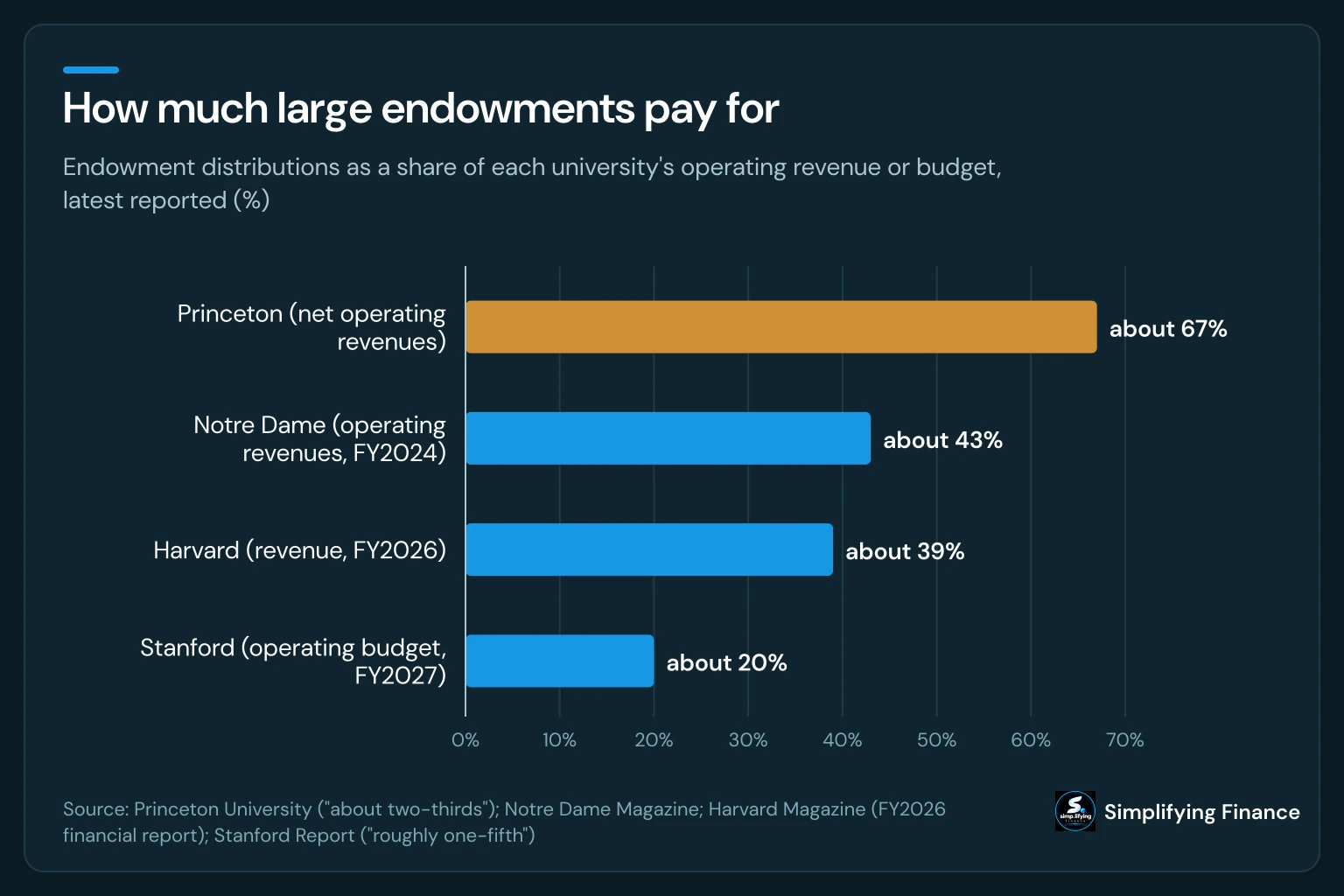
The chart above shows how much some universities rely on their endowments: about two-thirds of Princeton's net operating revenues and about two-fifths of Notre Dame's and Harvard's. When so much depends on the payout, every decision about investing and spending is made with care.
Lesson 2: set a spending rule
Endowments spend a set share of their value each year, usually around 4% to 5%, often based on an average of past values to smooth the payout. Texas caps its fund's distributions at 7% of average value; Cambridge aims to distribute about 4%. A rule like this stops good years from being spent too freely and bad years from forcing deep cuts.
If you will one day live off your savings, decide now what percentage you will draw each year and how you will smooth it. The library lesson on the retirement number shows how the rate you choose affects how much you need to save.
Lesson 3: aim for a real return
Oxford and Cambridge aim for returns of about 5% above inflation. Princeton plans on 8% a year in nominal terms, below its long-run record. Endowments think in real terms because their costs, from salaries to scholarships, rise with inflation. Households should too: a return that only keeps pace with inflation leaves you no better off.
Lesson 4: separate short-term and long-term money
Oxford keeps long-term capital in its endowment fund and expendable money in a separate account with a cautious objective. Large endowments keep a stable core of bonds, cash or absolute return strategies so that they can keep paying out in a downturn. For individuals, that is the emergency fund and the short-term savings account: money you will not have to sell investments to raise.
Lesson 5: judge results over decades
MIT returned 10.3% in fiscal 2026, behind many peers, yet its ten-year return of 11.7% a year is among the strongest. Princeton lost money in 2022 and 2023 and then earned 23.7% in 2026. Endowment leaders repeatedly warn against giving any single year undue weight. Review your own plan once a year, against a sensible benchmark, and resist the urge to switch after a disappointing year.
Lesson 6: do not copy the illiquid parts
The private equity, venture capital and hedge fund allocations of the largest endowments depend on scale, staff, manager access and the ability to lock money away for a decade. Yale's own former chief investment officer, David Swensen, advised individual investors to use low-cost index funds instead. The previous page shows that a simple 60/40 portfolio remains a demanding benchmark.
Lesson 7: keep money coming in
Endowments grow not only from returns but from steady new gifts, and in Texas's case from oil and gas royalties. That flow of new money lets them keep investing through downturns, buying assets when prices are low. For a household, the equivalent is regular saving from income. A monthly contribution, set up automatically, keeps the plan moving forward in every market and spreads your purchases over time.
Putting it together
A family endowment does not need private equity or a staff of analysts. It needs a written purpose, a sensible mix of low-cost global share and bond funds, a cash buffer for emergencies, a target return above inflation, a rule for how much to withdraw and a date each year to review it all. Those habits are what have allowed the world's great university endowments to support students for generations. They work at any scale, in any currency.
A family endowment in four rules
Suppose a family has US$300,000 in long-term savings and US$30,000 in an emergency fund. They write four rules: invest the long-term money in a low-cost 60/40 global portfolio; aim for inflation plus 3% to 4%; in retirement, draw no more than 4% a year, based on a three-year average value; review once a year in January.
| Long-term savings | US$300,000 |
| Emergency fund | US$30,000 |
| Draw at 4% a year | US$12,000 |
| Effect of a 20% fall on next payout (3-year average) | about -7% |
At 4%, US$300,000 supports US$12,000 a year. Because the draw is based on a three-year average, a 20% market fall in one year reduces the next year's payout by only about 7%, not 20%, giving the family time to adjust.
Where people go wrong
- Copying the asset list instead of the habits. The discipline is what makes endowments resilient.
- Spending a fixed share of this year's value. Averaging past values smooths the payout.
- Investing short-term money for growth. Money needed soon should not depend on markets.
- Changing course after one bad year. Endowments judge themselves over decades.
- Stopping contributions in a downturn. Endowments keep investing new money through bad years.
Put it to work
- Write your purpose and horizon. One line for each pot of savings.
- Set a spending and review rule. Choose a draw rate and a yearly review date.
- Build the stable core first. Hold an emergency fund before investing for growth.
- Automate saving. Set a fixed monthly transfer into your long-term pot.
- Explore further. Return to the Portfolios & Diversification hub for the next sections.
Copy the endowment discipline, not the endowment portfolio. A spending rule, a real-return target, separate pots for short- and long-term money and patience through bad years matter more than private equity.
Facts checked against the sources above on 27 November 2026. Figures are as of the dates stated and will change. Worked examples use round illustrative numbers to show the arithmetic, not forecasts. Educational content only, not personal investment advice.