A country's long-term savings account
A sovereign wealth fund is an investment fund owned by a government. Instead of spending all of a surplus at once, a country sets part of it aside and invests it, usually for many years. The money can come from selling natural resources such as oil and gas, from foreign currency reserves built up through trade, from the sale of state companies or from budget surpluses.
What makes these funds distinctive is their time horizon. A household may plan for a retirement 30 years away. A national fund may be planning for generations that are not yet born. That long view shapes almost every decision it makes, from what it buys to how it judges its own results.
See the numbers behind the chart
| Region | Share of top-10 wealth |
|---|---|
| Asia | 40% |
| Middle East | 40% |
| Europe | 20% |
How big they have become
According to Bain & Company, sovereign wealth funds reached about US$15 trillion in assets under management in 2025, after growing at around 10.3% a year, faster than any other type of institutional investor. The data firm Global SWF also reported a record of about US$15 trillion for 2025.
Bain found that about three-quarters of that growth came from investment returns, with the rest from new capital injected by governments. Because most funds pay out relatively little and borrow little, they can reinvest their gains year after year, the same compounding that the library lesson on time in the market describes for individuals. Bain projects that sovereign wealth fund assets could reach about US$30 trillion by 2035.
Five common types
Funds are often grouped by the job they do. Stabilisation funds smooth a government budget when commodity prices swing, so they hold more cash and short-term bonds. Savings funds turn a temporary resource, such as oil, into lasting financial wealth for future generations. Reserve investment funds manage part of a central bank's foreign reserves to earn more than cash would. Development funds invest at home to build new industries and infrastructure. Pension reserve funds set money aside to help pay future state pensions.
Many real funds combine several of these roles, and some countries run more than one fund, each with a different mandate. The job a fund is given decides how much risk it can take and how much it keeps in easy-to-sell assets.
Concentrated at the top
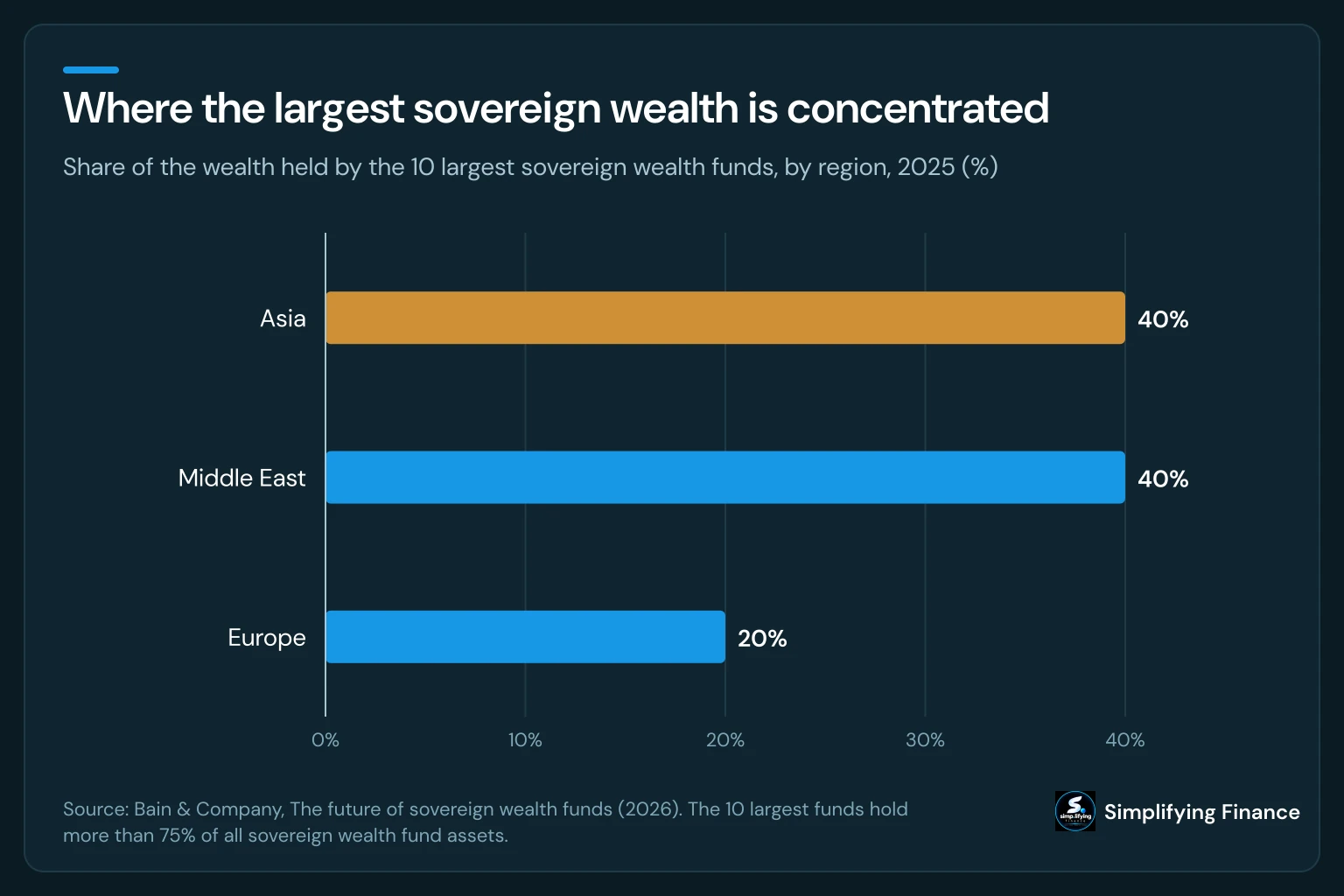
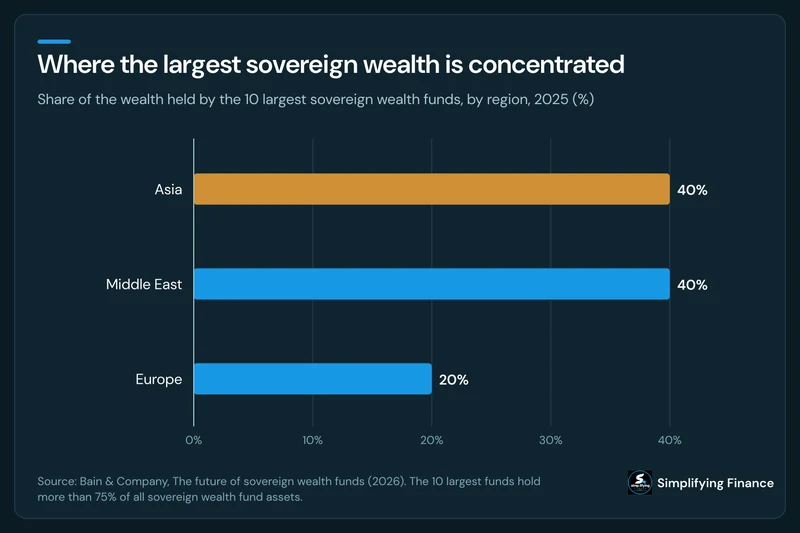
Although there are well over a hundred state investment funds around the world, the wealth is concentrated. Bain reports that the 10 largest hold more than 75% of the total, and that this top group is split roughly 40% in Asia, 40% in the Middle East and 20% in Europe. The pages that follow look at many of these funds one by one, using each fund's own published reports.
Why their diversification is different
Large sovereign funds can spread money across dozens of countries and asset types: listed shares and bonds, but also property, infrastructure, private companies and private credit. Their scale and patience let them hold assets that are hard to sell quickly, because they rarely need cash in a hurry. This is a very different position from a household, which may need to sell to pay for a home, school fees or an emergency.
Many of the largest funds are also designed to diversify away from their home economy. A country whose income depends on one commodity gains most by owning assets that do not depend on that commodity. Bain notes that only about a third of global sovereign wealth fund assets is allocated to local assets or development goals, and that many of the largest funds face limits on investing at home. The library lesson on home bias explains why the same idea matters for individuals.
Rules and transparency
Because these funds are so large, how they are governed matters to markets everywhere. In 2008, a group of sovereign funds agreed the Santiago Principles, a voluntary set of 24 generally accepted principles and practices covering governance, accountability and investment behaviour. The International Forum of Sovereign Wealth Funds now promotes them. Disclosure still varies widely: some funds publish every holding, while others report mainly long-term returns and target ranges for each asset type.
How to read the pages that follow
Each fund page in this section is built from the fund's own published reports, with the date of every figure shown. Funds report in different ways: some give a total value and a full list of holdings, some give long-term returns and target ranges, and some give only selected figures. Where a fund does not publish a number, these pages do not estimate it.
Why a commodity exporter saves abroad
Imagine a country that earns US$100 billion a year from oil and decides to save 20% of it in a fund invested outside the country, spread across world shares and bonds. Each year US$20 billion goes into assets whose value does not depend on the oil price.
| Annual oil income | US$100 billion |
| Saved in a global fund (20%) | US$20 billion a year |
| Oil income if prices halve | about US$50 billion |
| Fund assets | not tied to the oil price |
If oil prices halve, the country's oil income falls to about US$50 billion, but the fund still holds its global shares and bonds. In a bad year for oil, that savings pot can help pay for the budget without forcing sharp spending cuts. The principle is the same one behind an emergency fund: savings held in a different place from your main income.
Where people go wrong
- Thinking every fund invests the same way. A stabilisation fund and a savings fund have very different jobs and risk levels.
- Copying a fund's illiquid holdings. A fund that never needs cash quickly can hold assets a household cannot.
- Assuming bigger means riskier. Many funds hold large bond and cash buffers alongside their shares.
- Ignoring the mandate. A fund's results only make sense next to the goal it was given.
Put it to work
- Name your own mandate. Write down what your savings are for and when you will need them.
- Separate your pots. Keep an emergency fund apart from long-term investments, as many countries do.
- Look beyond home. Check how much of your wealth depends on one economy or one employer.
- Read on. Next: Norway's Government Pension Fund Global.
Sovereign wealth funds are national savings pots invested for decades. Their size and patience let them diversify in ways few others can, but their goals differ from yours.
Facts checked against the sources above on 27 November 2026. Figures are as of the dates stated and will change. Worked examples use round illustrative numbers to show the arithmetic, not forecasts. Educational content only, not personal investment advice.