What happened
Ford arranged substantial secured borrowing at the end of 2006. Domestic assets, including rights associated with its famous oval, backed the package. In 2012 an investment-grade upgrade helped Ford recover the pledged assets. The economic role of collateral is clearest when considering what funding is available before conditions deteriorate.
In 2006 Ford arranged a $23.5 billion credit package by pledging most of its US assets as collateral, CNNMoney reported.
The collateral included factories, the Blue Oval logo and the F-150 and Mustang trademarks, according to WardsAuto, which also said the package included $5 billion of unsecured convertible debt.
The loan agreements said the collateral would be returned once Ford was upgraded to investment grade by two of the three major rating agencies, AOL reported.
The money helped Ford avoid the bankruptcies that hit General Motors and Chrysler, CNNMoney noted.
Ford rebuilt its finances. By the end of 2011 it had reduced debt by more than $20 billion compared with the end of 2009, and in September 2011 it completely paid back the loan, Ford said.
Fitch upgraded Ford to investment grade in April 2012, NPR reported, and Moody’s followed on 22 May 2012, which triggered the release of the collateral.
Executive chairman Bill Ford said that when Ford pledged the Blue Oval it was not just pledging an asset but its heritage.
At the end of March 2012 Ford still had $16.6 billion of automotive debt, alongside about $23 billion of cash in its auto business, UPI reported.
The exhibit shows the size of Ford’s 2006 credit package and how its finances improved by 2012.
Debt covenants are conditions in a loan agreement, such as rules about collateral or when assets must be returned.
Capital structure is the mix of debt and equity a company uses to fund itself.
Secured debt is backed by assets, which makes lenders more willing to lend but limits what the borrower can do with those assets.
Borrowing before a crisis is usually cheaper and easier than borrowing during one.
Ford used the cash to keep investing in new products while sales fell.
Credit ratings affect the cost of borrowing, so regaining investment grade lowered Ford’s future funding costs.
Students can ask when a company should raise money in advance and how much it should borrow.
Key concept: capital structure and control. Capital structure describes how a company is financed and owned, through debt, equity and stakes in other businesses. Changing ownership of a subsidiary or joint venture alters what appears in a company’s accounts.
Under international accounting rules, a company that controls another must consolidate it fully, showing all its revenue and costs, while the share owned by others is shown as non-controlling interests.
Key concept: opportunity cost. Opportunity cost is the value of the best alternative given up when making a choice. Money and time spent on one project cannot be spent on another.
Good decisions compare options against each other, not just against doing nothing.
Key concept: risk and return. In business and investing, higher potential returns usually come with higher risk. Entering a new market or launching a new kind of product can bring large rewards, but the chance of failure is also greater.
Managers weigh the size of the possible gain against the likelihood and cost of failure, and they often reduce risk by testing ideas on a small scale before committing large sums.
Key concept: unit economics. Unit economics looks at the revenue and costs linked to a single unit, such as one car or one customer. If each unit earns more than it costs to make and sell, growth adds profit; if not, growth adds losses.
Fixed costs such as development and tooling are spread across all units, so the cost per unit falls as volume rises. That is why low-volume products need high prices, and why volume matters so much in the car industry.
Key moments
Ford arranges secured borrowing
Liquidity and collateral become strategic resources
Credit upgrade supports collateral release
Sources: CNNMoney; Ford; UPI.
The trade-offs at the heart of the case
A closer look
Collateral raises another question after the loan has been drawn. Can Ford still sell an asset, licence a brand or arrange additional finance against the same rights? Map the lender’s consent rights alongside cash available under the facilities. Financing secured in advance can preserve room to act in a downturn while limiting the particular assets the company can use for a second round of funding.
The alternative on the table
For comparison, consider the option to seek financing only once the downturn becomes visible. The related case “When could Ford resume a regular dividend?” supplies a useful reference point. Ford’s board declared a quarterly dividend of five cents per share in December 2011. Collateral can buy access to funding before market conditions worsen. A recurring dividend uses some of that flexibility. Compare the liquidity buffer after both commitments, not just the immediate cash amount.
For your seminar, paper or interview
- Q1
Which future decisions could be constrained by the collateral underpinning Ford’s financing?
- Q2
At what annual net loss rate does this lender stop covering funding and servicing costs?
- Q3
Which finding in the records on cash actually drawn and collateral available after the pledge would persuade you to seek financing only once the downturn becomes visible?
- Q4
Compare this decision with “When could Ford resume a regular dividend”. Which difference between the cases would change your recommendation?
- Secured financing
- Liquidity planning
- Turnaround strategy
- Credit ratings
How we would approach it
Simplifying Finance’s opinion, offered as a starting point for debate, not as fact or investment advice.
We think Ford’s decision to borrow heavily in 2006, before the financial crisis, was one of the best calls in its history. Pledging almost everything, even the Blue Oval, was painful, but it gave Ford the cash to survive 2008 and 2009 without a government bailout or bankruptcy. The lesson is that the best time to raise money is before you desperately need it.
Borrow before the storm
Raise cash while lenders are still willing.
Use it to fix products
Invest the money in a turnaround plan.
Set a path to release collateral
Agree terms that return assets once credit improves.
What this plan gives up
Secured borrowing gives cash but ties up the company’s most valuable assets.
The strongest counter-argument
Some argue pledging the brand was a dangerous gamble that could have cost Ford its identity.
Metrics to watch
- Liquidity in months of spending
- Credit rating
Propose your solution
Pick a discussion question and set out what you would do, why, and what it would cost. Strong, well-argued answers are reviewed and published below with your first name and programme.
Published solutions
Loading published solutions…
- US Securities and Exchange Commission • Corporate filing — What did Ford borrow against before the financial crisis ↗
- latimes.com • Ford credit rating upgrade wins it control of famous oval logo - Los Angeles Times ↗
- bigthreeauto.procon.org • | FORM 10-K ↗
- CNNMoney • Ford gets its iconic Blue Oval logo out of hock ↗
- WardsAuto • Ford regains control of Blue Oval ↗
- Ford Motor Company • Statement on Ford investment grade rating by Moody’s ↗
- NPR • Fitch Ratings upgrades Ford’s junk status ↗
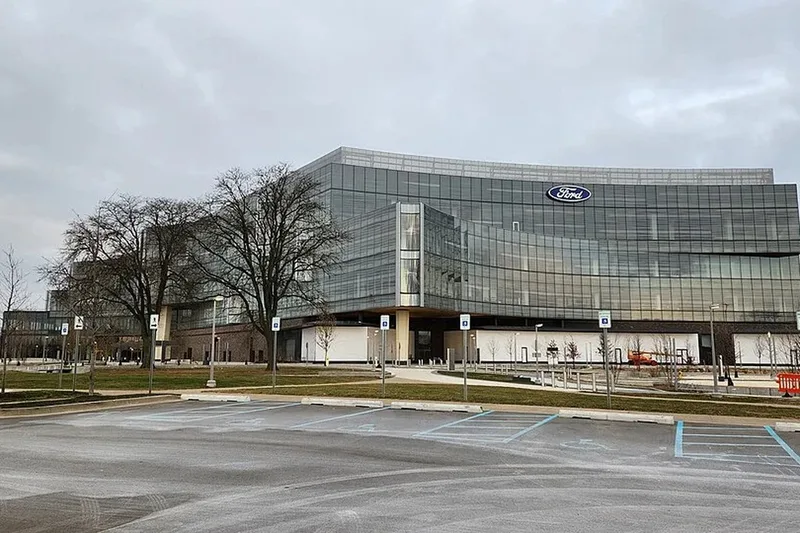
- Photo: Ford World Headquarters from sidewalk, against sun by 42-BRT, CC BY 4.0 (cropped and resized) ↗
Figures are as reported by the companies or cited outlets as of 22 November 2026. Check the source before quoting. Corrections: let us know through the solution form.