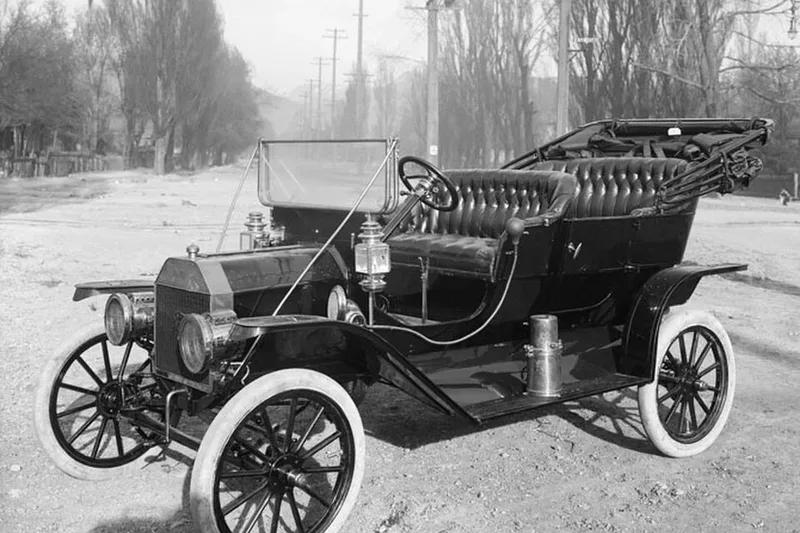
What happened
Ford Credit was established to finance Ford vehicles and support dealers. Floorplan credit lets a dealer offer a selection of vehicles before a retail customer has paid for them. It also makes the finance company sensitive to dealer solvency, wholesale prices and the time each vehicle spends unsold.
Ford’s first move into car finance was a US Weekly Purchase Plan in 1923. In 1928 it set up the Universal Credit Company to help sell the Model A, but it sold that company in 1933, according to Ford.
Ford Motor Credit Company was incorporated on 20 August 1959 as Ford’s finance subsidiary, F&I and Showroom reports.
The new company opened three US branches in 1959 and financed its first vehicle, a 1960 Mercury Monterey, in Indianapolis.
Ford says the aim was to consolidate its financing operations around the world and ensure dealers and customers had enough affordable financing.
Ford Credit’s business includes retail financing, buying customer instalment and lease contracts from dealers, and wholesale financing, which means loans to dealers to buy vehicle inventory, also known as floorplan financing.
It also lends to dealers for working capital, facility improvements and dealership real estate, according to Ford.
Ford says independent US studies show that Ford Credit customers are more loyal to Ford and Lincoln and their dealers than customers who use other financing.
Ford Credit marked its 65th anniversary in 2024. Ford notes that it had earlier set up a financial services subsidiary in Germany in 1926 that still operates today.
The exhibit traces Ford’s steps into car finance before Ford Credit was founded.
Banks and finance companies make money by lending at a higher rate than they pay to borrow.
Floorplan financing lets dealers hold stock without paying for every car upfront, which supports their working capital.
A captive finance company can keep lending to its brand’s dealers when other lenders become cautious.
The risk is concentration. If many dealers or customers struggle at once, losses can be large.
Finance arms also earn interest income, which can smooth a carmaker’s profits.
Most large carmakers run their own finance companies for similar reasons.
Students can ask how a finance arm should balance supporting sales with keeping credit risk low.
Key concept: working capital. Working capital is the money tied up in day-to-day operations: stock, money owed by customers and money owed to suppliers. A business must fund materials and wages before customers pay.
When cash is short, managing working capital carefully, through deposits, faster collection or longer supplier terms, can decide whether a company survives.
Key concept: opportunity cost. Opportunity cost is the value of the best alternative given up when making a choice. Money and time spent on one project cannot be spent on another.
Good decisions compare options against each other, not just against doing nothing.
Key concept: risk and return. In business and investing, higher potential returns usually come with higher risk. Entering a new market or launching a new kind of product can bring large rewards, but the chance of failure is also greater.
Managers weigh the size of the possible gain against the likelihood and cost of failure, and they often reduce risk by testing ideas on a small scale before committing large sums.
Key concept: unit economics. Unit economics looks at the revenue and costs linked to a single unit, such as one car or one customer. If each unit earns more than it costs to make and sell, growth adds profit; if not, growth adds losses.
Fixed costs such as development and tooling are spread across all units, so the cost per unit falls as volume rises. That is why low-volume products need high prices, and why volume matters so much in the car industry.
Key concept: economic moats. An economic moat is a lasting advantage that protects a company’s profits from competitors, much as a moat protects a castle. Sources include strong brands, patents, cost advantages, networks and high switching costs for customers.
Key moments
Ford Credit established
A wholesale advance finances a vehicle
The dealer repays the related inventory advance
Source: Ford Motor Company.
The trade-offs at the heart of the case
A closer look
A dealer ships a trade-in to auction but keeps a new truck unsold for a month. The two vehicles create different financing and collateral exposures. A floorplan lender should identify the individual vehicle financed, confirm when it sold and reconcile the loan repayment to that event. A busy dealership can generate substantial traffic and still tie up increasing amounts of credit in slow-moving new stock.
The alternative on the table
For comparison, consider the option to let dealers borrow from local banks without Ford sponsorship. The related case “What did Ford borrow against before the financial crisis?” supplies a useful reference point. Ford arranged substantial secured borrowing at the end of 2006. The corporate facility supported Ford itself, while floorplan loans fund individual dealers’ inventory. In either case collateral affects recovery, but the repayment source and monitoring interval are quite different.
For your seminar, paper or interview
- Q1
How should a floorplan lender reconcile a financed vehicle with its sale and repayment?
- Q2
At what annual net loss rate does this lender stop covering funding and servicing costs?
- Q3
Which finding in the records on age of financed vehicles and repayment on retail sale would persuade you to let dealers borrow from local banks without Ford sponsorship?
- Q4
Compare this decision with “What did Ford borrow against before the financial crisis”. Which difference between the cases would change your recommendation?
- Captive finance
- Dealer financing
- Credit risk
- Sales support
How we would approach it
Simplifying Finance’s opinion, offered as a starting point for debate, not as fact or investment advice.
We think owning a finance company has been a strong advantage for Ford, because it keeps credit available to dealers and buyers even when banks pull back. Floorplan loans let dealers stock a wide range of cars. The cost is that Ford takes on credit risk tied to its own dealers and customers, so its lending standards must stay consistent through the cycle.
Support dealers in downturns
Keep floorplan credit steady when banks retreat.
Lend consistently
Keep standards stable across the cycle.
Use finance to build loyalty
Link financing to repeat purchases.
What this plan gives up
Captive finance supports sales but concentrates credit risk on one brand.
The strongest counter-argument
Some argue independent banks can provide credit without tying up Ford’s capital.
Metrics to watch
- Dealer loan losses
- Share of sales financed by Ford Credit
Propose your solution
Pick a discussion question and set out what you would do, why, and what it would cost. Strong, well-argued answers are reviewed and published below with your first name and programme.
Published solutions
Loading published solutions…
- US Securities and Exchange Commission • SPONSOR AND SERVICER (https://www.sec.gov/Archives/edgar/data/1159408/000000000015044739/filename1.pdf) ↗
- US Securities and Exchange Commission • form424b3.htm ↗
- US Securities and Exchange Commission • SPONSOR AND SERVICER ↗
- Ford Motor Company • Ford Motor Credit Company marks 50 years ↗
- F&I and Showroom • Ford Motor Credit marks 50th anniversary ↗
- Ford Motor Company • Ford Credit sustainability report ↗
- Ford Motor Company • Ford Credit at 65 ↗
- Photo: 2010 Ford Taurus Limited 2 -- 10-31-2009 by IFCAR, Public domain (cropped and resized) ↗
Figures are as reported by the companies or cited outlets as of 22 November 2026. Check the source before quoting. Corrections: let us know through the solution form.