What happened
The first phase of Jakarta’s north–south MRT opened in March 2019. Its thirteen stations linked Lebak Bulus with Bundaran HI over a route the operator describes as approximately sixteen kilometres. The operator’s annual report discusses pedestrian access and interchange alongside its plans for development around the stations . Construction milestones show the work needed just to establish the corridor .
The terminus itself was once a planning choice. MRT Jakarta’s chronology records discussion of extending the first phase beyond Dukuh Atas to Bundaran HI . Choosing where a line ends and choosing where a station entrance opens both change the set of people within practical walking distance.
The ridership record explains why access, not trains, became the binding question. Before the pandemic phase one carried 24.41 million passengers in 2019. The total fell to 9.92 million in 2020 and 7.18 million in 2021, then climbed back to 19.7 million in 2022, or about 50,000 riders a day.
By 2023 the line carried more than 33 million people, about 91,000 a day, well above the 70,000 daily target set when it opened. The operator credited 99.44 percent on-time performance and its tie-ups with feeder services, including TransJakarta buses and app-based motorcycle taxis. In 2024 ridership rose another 21.87 percent to 40.82 million.
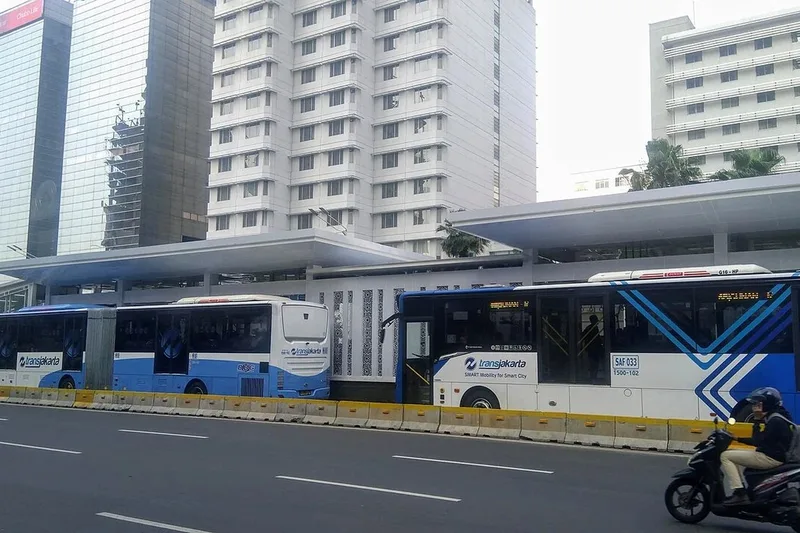
Growth on that scale changes the arithmetic of an entrance. A station that was comfortably uncrowded in 2019 can become a queue at the stairs five years later, and every extra minute at the access point is paid by tens of thousands of people a day. It also means the operator can no longer assume that a new entrance mainly reshuffles existing riders. Feeder partners already account for a large share of trips, so the walking route from a bus stop or drop-off point is now part of the railway’s product.
Key moments
Phase one opens between Lebak Bulus and Bundaran HI with 13 stations
Ridership falls to 9.92 million as pandemic restrictions bite
Ridership recovers to 19.7 million, about 50,000 a day
More than 33 million passengers, about 91,000 a day against a 70,000 target
Ridership reaches 40.82 million
2019 counts from the March 2019 opening. 2020–21 reflect pandemic restrictions. Sources: Katadata (Databoks), citing PT MRT Jakarta; Kompas; Databoks for 2024.
The trade-offs at the heart of the case
Follow the person who turns back
Gate entries reveal who boarded. They omit the shopper who crossed twice last week and took a motorbike today. A count at the station exit also mixes local users with passengers who transferred from another service. An entrance serving an office tower might attract many existing riders and few new fares. That distinction matters differently to the operator, which receives fares, and the city, which may want safer crossings even if railway receipts stay flat. A second opening can also move the queue. Passengers may reach the paid area faster only to wait longer for a lift or a full train. A property owner benefiting from a direct connection has reason to help pay. It also has reason to restrict access outside its trading hours. A public access covenant has economic value when an evening commuter depends on that shortcut.
What belongs in the approval paper
Show the station plan with a line from the nearest bus stop to the platform, then mark every place a wheelchair user needs assistance. Put the crossing-only option beside the new entrance with the same hours of access. A landowner willing to contribute capital but unwilling to keep the route open after closing time is offering a different project. Approval should specify who retains the key, who pays for the lift on Sundays and how riders report a locked gate.
Who benefits from a shorter walk
Most of the value of a better entrance goes to people the railway cannot charge for it: pedestrians who no longer cross a dangerous road, drivers who face fewer people crossing, shops that gain footfall. That is why such projects are often funded jointly by the city, the operator and nearby landowners.
For your seminar, paper or interview
- Q1
How would you identify a rider who moved from another entrance?
- Q2
Which benefits belong in the city’s account and which can pay the operator’s bills?
- Q3
What should the property owner promise in return for a direct connection?
- Q4
What access rights would you require from a contributing landlord?
- Q5
Which benefit belongs in the city appraisal and which can service the operator’s debt?
- Catchment and access cost
- Public versus operator benefits
- Option value of staged investment
- Partnership and access covenants
How we would approach it
Simplifying Finance’s opinion, offered as a starting point for debate, not as fact or investment advice.
Fund the cheaper crossing and wayfinding improvements first, measure how many people complete the walk, and commit to a second entrance only where the remaining barrier is structural and the landowner signs a permanent public-access covenant. With ridership more than double its 2022 level, the case for spending on access is strong; the question is which access.
Pilot the crossing
Improve signals, signage and a protected walking route, then count completed street-to-platform journeys on both sides of the road.
Price access with the landowner
Ask a contributing developer for a binding opening-hours covenant and maintenance duties, not just a one-off payment.
Rank stations by walking burden
Use gate and feeder data to put the entrance where the most riders face the longest detour.
What this plan gives up
A cheap crossing fix can be done quickly but may leave the hardest barrier in place; a new entrance solves it for decades but locks capital into one station.
The strongest counter-argument
The best counterargument is timing. Civil works near a busy road get more expensive and disruptive every year that traffic grows, so waiting for perfect evidence can cost more than it saves.
Metrics to watch
- Daily ridership at the constrained station versus the line average
- Share of trips arriving by feeder services
Propose your solution
Pick a discussion question and set out what you would do, why, and what it would cost. Strong, well-argued answers are reviewed and published below with your first name and programme.
Published solutions
Loading published solutions…
- MRT Jakarta: 2019 annual report ↗
- MRT Jakarta: company profile and construction milestones ↗
- Databoks: MRT carries over 40 million passengers in 2024 ↗
- Databoks: Jakarta MRT passenger numbers 2019–2021 ↗
- Kompas: MRT ridership 19.7 million in 2022 ↗
- Antara: MRT Jakarta targets for 2024 ↗
- Image: Passengers wait at Lebak Bulus for an MRT train to Bundaran HI, Jakarta. Photograph credit: © VulcanSphere / Wikimedia Commons / CC BY 4.0. Original photograph · CC BY 4.0. ↗
Figures are as reported by the companies or cited outlets as of 22 November 2026. Check the source before quoting. Corrections: let us know through the solution form.