What happened
Jakarta’s first bus rapid transit corridor combined a dedicated lane with raised boarding platforms. A contemporary transport study places the start of revenue service on 1 February 2004 and reports an initial route of 12.9 kilometres . An Asian Development Bank case describes early travel-time improvements and subsequent operational challenges . Early counts tell us that the corridor attracted riders. They do not tell a present-day planner how many seconds an accessible gate or a second boarding position will save.
The contemporary corridor study reports a 59-minute reduction in end-to-end peak travel time after the early BRT intervention . That gain bundled several changes. Assigning all 59 minutes to a later boarding proposal would use the wrong comparison and greatly overstate what a single platform can deliver.
Accessibility is part of the same calculation. A gate or ramp that is hard to use slows every boarding, not only for wheelchair users.
The 2004 design choices still shape the system. Raised platforms and dedicated lanes made boarding faster than on ordinary buses, but they also fixed the number of doors and boarding positions at each stop. As the network spread to more corridors and connected with the MRT, LRT and commuter rail, the busiest transfer stops became the places where those fixed limits bind first. Upgrading a handful of them may unlock more capacity than adding buses across the whole fleet.
The scale of the system today makes platform seconds valuable. TransJakarta carried about 16 million passengers in its first year. By 2019 the total was 264.6 million. After falling to 191 million in 2022, ridership reached 285 million in 2023 and a record 371 million in 2024, according to its president director.
The fleet has grown with demand. Statistics Indonesia counted 4,563 TransJakarta buses operating in November 2024, 4.44 percent more than a year earlier, and 31.6 million passengers in June 2024 alone. In July 2026 the system carried 40.32 million passengers, against 4.64 million on the MRT.
The company’s own measure of efficiency points in the same direction as faster boarding. Subsidy per passenger fell from Rp16,800 in 2022 to Rp11,400 in 2023 and Rp9,831 in 2024 as more riders spread the fixed costs of the network. A boarding improvement that lets the same buses carry more people per hour would push that number down further, but only if dispatchers can turn the saved seconds into extra departures or steadier headways.
Key moments
First corridor begins operating
Revenue service starts on the 12.9 km corridor
264.6 million passengers
191 million passengers after pandemic restrictions
Record 371 million passengers
2024 was the highest in the company’s history. Subsidy per passenger fell from Rp16,800 (2022) to Rp9,831 (2024). Sources: Wikipedia citing TransJakarta (2019); Berita Jakarta, quoting TransJakarta’s president director (2022–2024).
The trade-offs at the heart of the case
What the dispatcher should sign off
Ask dispatchers to take the measured seconds saved at the busiest stop and fit them into one actual vehicle duty. A few seconds recovered on twenty separate buses do little if each still spends its layover waiting for the same departure slot. If the saved time prevents bunching, show its value in the gap between successive buses and the passengers exposed to that gap. That is a defensible return even before the operator can remove a vehicle.
Where the seconds go
On a busy bus rapid transit corridor, the slowest part of a trip is often not the road but the stop. Every bus that waits behind another bus at a platform loses time that cannot be recovered later in the route, and every extra second of dwell at a crowded stop is multiplied across hundreds of departures a day. With ridership now above its 2019 level and still rising, the same seconds matter more each year. That is why platform design, gate layout and boarding rules can add capacity more cheaply than new vehicles.
Who pays for capacity
TransJakarta’s fares are subsidised by the Jakarta provincial government, so the cost of running more buses falls largely on the city budget. Falling subsidy per passenger, from Rp16,800 in 2022 to Rp9,831 in 2024, shows how much the system gains when more riders share the same fixed costs. Spending that recovers capacity from existing buses protects that trend; buying buses that sit in the same queue works against it.
For your seminar, paper or interview
- Q1
How would half-empty buses affect your estimate of useful capacity?
- Q2
Where should the timing clock start and stop?
- Q3
What evidence would favour purchasing buses over changing the platform?
- Q4
Which vehicle duty could use the recovered minutes?
- Q5
How would you measure the benefit to people waiting downstream?
- Bottleneck analysis
- Headway regularity
- Fleet productivity
- Subsidy per passenger
How we would approach it
Simplifying Finance’s opinion, offered as a starting point for debate, not as fact or investment advice.
Fix the platform before buying more buses at the busiest stations. With ridership at a record 371 million and the fleet already above 4,500 buses, the cheapest capacity is the time lost at doors, gates and ramps. Measure it stop by stop and spend where the seconds recur.
Time the dwell
Record boarding and alighting seconds at the ten busiest stops before choosing any physical change.
Add a second boarding position
Where dwell time is the constraint, let two buses load at once rather than adding more buses to the queue.
Manage headways actively
Use real-time control to space buses, so saved seconds reduce bunching instead of creating gaps.
What this plan gives up
Platform upgrades are cheap per rider but slow to deliver and disruptive; extra buses are quick but add cost and can queue behind the same bottleneck.
The strongest counter-argument
Platform works disrupt service while they are built, and the benefits can disappear if buses bunch upstream for other reasons, so extra vehicles may be the more reliable fix in the short run.
Metrics to watch
- Average dwell time at the busiest stops
- Subsidy per passenger
Propose your solution
Pick a discussion question and set out what you would do, why, and what it would cost. Strong, well-argued answers are reviewed and published below with your first name and programme.
Published solutions
Loading published solutions…
- Asian Development Bank: Jakarta’s bus rapid transit system ↗
- Transportation Research Record: initiating bus rapid transit in Jakarta ↗
- Berita Jakarta: Transjakarta customers reach 371 million in 2024 ↗
- BPS Jakarta: transport growth, November 2024 ↗
- The Jakarta Post: Jakarta transit grows ↗
- Transjakarta (Wikipedia) ↗
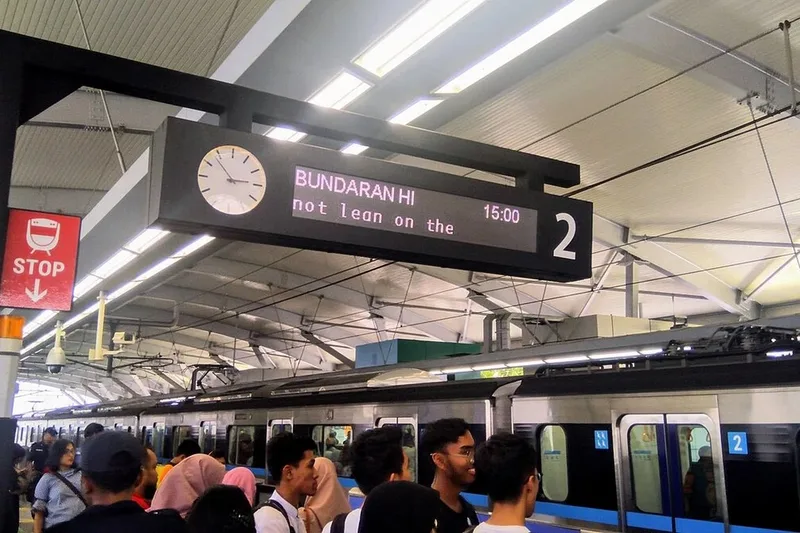
- Image: Two TransJakarta buses at the Bundaran HI shelter in Jakarta. Photograph credit: © VulcanSphere / Wikimedia Commons / CC BY 4.0. Original photograph · CC BY 4.0. ↗
Figures are as reported by the companies or cited outlets as of 22 November 2026. Check the source before quoting. Corrections: let us know through the solution form.