What happened
School can be free at the gate and expensive on the morning a child has outgrown a uniform. A family deciding whether to replace it must find cash now, while the benefit of another term lies in the future. The ordinary nature of the purchase makes it easy to overlook in an education budget.
In a school-level experiment in western Kenya, one program covered uniforms during the final years of primary school. The researchers followed cohorts across schools offered different interventions. Their evidence lets a reader isolate the uniform subsidy from a separate intervention delivered in some schools. The practical choice was whether to absorb one predictable household expense before pupils faced it.
After three years, about 16 in every 100 girls in the uniform group had dropped out, compared with about 19 in the comparison group. A difference of around three percentage points is meaningful in a cohort, even though most girls stayed in school in both groups. The study measured continued participation. It did not turn an extra year registered into a guaranteed qualification or salary.
The uniform was an expense that could recur while the same child was still in primary school. The program provided two uniforms over three years. The corresponding rounded dropout figures for boys were 13 percent in the comparison group and 10 percent in the uniform group. A similar difference in points started from a different level of dropout.
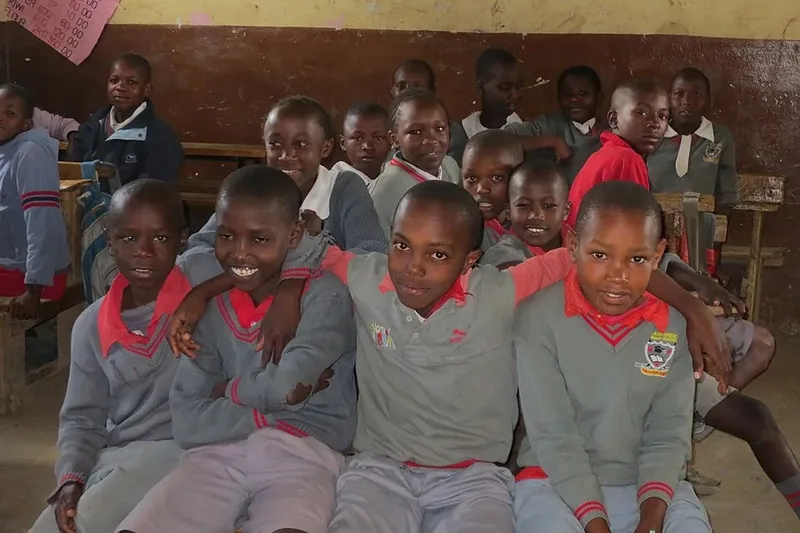
The evaluation, run with Kenya’s Ministry of Education, the National AIDS Control Council and the non-profit ICS Africa, covered 328 primary schools in Western Province and followed about 9,500 girls and 9,800 boys who were in sixth grade in 2003. Each pupil in the subsidy schools received two free uniforms over the last three years of primary school, removing the largest out-of-pocket cost of schooling at a time when fees had just been abolished.
The seven-year results showed that the uniforms reduced dropout, teen marriage and teen pregnancy among girls. A government HIV-education curriculum, tested in other schools, did not reduce pregnancy on its own, and the combination of both programmes cut dropout and pregnancy by less than the uniforms alone, although it did reduce sexually transmitted infections among girls.
The case shows why the timing of a cost matters as much as its size. A uniform is a lumpy expense that arrives when a child outgrows the last one. Families with irregular income can find that moment hard even if the yearly cost of schooling is small. Programmes in many countries, from school-supply grants to transport passes, work on the same principle of removing a specific, well-timed barrier.
For a ministry or a donor, the useful measure is cost per additional pupil kept in school, compared with other options. That comparison needs the full cohort that started, including pupils who left, so that the denominator is not flattered by counting only those who stayed.
The findings have been cited widely in debates about how to keep adolescent girls in school, and they illustrate how removing a modest cost at the right moment can influence decisions with long-lasting consequences for health and earnings.
For families, the uniform decision is a small-scale version of a choice every investor faces: pay a known cost today for an uncertain benefit later. When cash is tight, even a good long-term investment can be postponed, which is why reducing the upfront cost can change behaviour so much.
The study’s long follow-up is also notable, because effects on marriage and childbearing could only be seen years after the uniforms were handed out.
Key moments
Study begins with sixth-graders in 328 schools in Western Province.
Pupils in the subsidy schools receive two free uniforms.
Seven-year results published in the American Economic Review.
Source: Duflo, Dupas and Kremer, ‘Education, HIV, and Early Fertility’. Rounded.
The trade-offs at the heart of the case
Reading the result
Put the two dropout rates on the same base. Out of 100 girls in each group, roughly 81 remained in the comparison group and 84 in the uniform group. The gap is three girls for every hundred offered the intervention. As a fraction of the original dropout rate, three divided by nineteen is about sixteen percent. The two descriptions answer different questions. A head teacher planning seats would use the first. A researcher comparing reductions across places with different dropout rates might use the second. Both need the observation period alongside the figure.
The financing decision
Compare buying spare uniforms for pupils at risk of interruption with providing one to an entire eligible class. Targeting can stretch a procurement budget, but someone must identify who qualifies before they miss school. Universal provision changes that administrative task. Track how quickly the replacement actually reaches a child in each arrangement.
For your seminar, paper or interview
- Q1
Which people would be missed by measuring only additional pupils still enrolled after three years?
- Q2
Who carries the cost of procurement and distribution of usable uniforms?
- Q3
What could the evidence on who leaves school after the next uniform must be replaced change?
- Cost barriers
- Randomised evaluation
- Targeting
- Cost-effectiveness
How we would approach it
Simplifying Finance’s opinion, offered as a starting point for debate, not as fact or investment advice.
We think a modest, well-timed subsidy for a predictable cost such as a uniform is one of the more practical tools an education budget has. It keeps more girls and boys in school during the years when leaving is most likely, and it does so with an item families already understand and value.
Time the support
Provide uniforms just before the upper-primary years when dropout rises.
Track the cohort
Follow every pupil who starts, not only those who finish.
Combine carefully
Test how subsidies interact with other programmes before bundling them.
What this plan gives up
Universal provision is simple to run but spends money on families who would have bought a uniform anyway.
The strongest counter-argument
Some argue cash transfers give families more flexibility than a specific item such as a uniform.
Metrics to watch
- Dropout by grade and gender
- Cost per additional pupil retained
Propose your solution
Pick a discussion question and set out what you would do, why, and what it would cost. Strong, well-argued answers are reviewed and published below with your first name and programme.
Published solutions
Loading published solutions…
- Education, HIV, and Early Fertility • Duflo, Dupas and Kremer ↗
- 12 Years of Quality Education for All Girls • Commonwealth perspectives ↗
- World Bank • summary of the school-uniform evaluation ↗
- Photo: Pupils at Kaurine school (3504698564) by SuSanA Secretariat, CC BY 2.0 (cropped and resized) ↗
Figures are as reported by the companies or cited outlets as of 22 November 2026. Check the source before quoting. Corrections: let us know through the solution form.