Inside Nvidia’s supply chain
Nvidia earns the profits, but it makes almost nothing itself. Its chips depend on a handful of companies in Taiwan, South Korea, the Netherlands, Germany, Japan and the US. A disruption at any one of them can delay output and raise costs for the whole chain.
From a design in California to a rack in a data centre
Tap any company to see its role. ! marks a supplier with no real substitute.
- 01
Design
Nvidia designs the GPU in California and outsources almost all physical work. Even design relies on others.
- 02
Making the chip
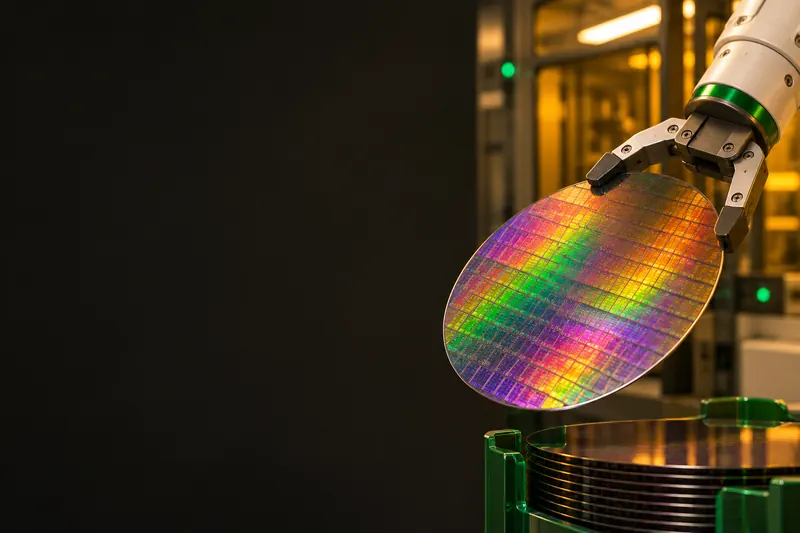
TSMC turns the design into silicon. Blackwell uses TSMC’s custom 4NP process; Rubin moves to 3nm.
19%of TSMC’s 2025 revenue came from Nvidia — its largest customer - 03
Memory (HBM)
High-bandwidth memory is stacked DRAM placed right beside the GPU. Without it, the GPU starves for data.
50%SK Hynix33%Samsung18%MicronHBM revenue share, Q2 2026 (Counterpoint; may not sum to 100% due to rounding)
- 04
Packaging (CoWoS)
GPU and HBM stacks are joined on one silicon base. This is the tightest bottleneck in the chain.
~60%of TSMC’s 2026 CoWoS capacity booked by Nvidia (Morgan Stanley estimate) - 05
Servers & racks
Contract manufacturers build the finished servers and full racks that ship to data centres.
Equipment makers
TSMC and the memory makers cannot produce anything without these machines.
ASML’s own suppliers
One level deeper: three suppliers inside ASML’s EUV machines have no practical substitute.
Materials (mostly Japan)
Wafers, masks, photoresist and films — a quiet near-monopoly for Japanese firms.
Select a company to see what it does.
Who holds the power
Nvidia contributed about $23.4bn and Apple about $20.5bn. Nvidia’s share rose from about 12% in 2024. Source: Analyst Dan Nystedt, via Wccftech and ThinkComputers.
The last bar is the midpoint of industry estimates of 125,000–130,000 wafers a month; some estimates are lower. Source: TSMC statements and industry trackers, via INDmoney and TipRanks.
Where each step happens
United States
10 companiesJapan
10 companiesTaiwan
8 companiesSouth Korea
2 companiesGermany
2 companiesUnited Kingdom
1 companyNetherlands
1 companyThe weak links
Taiwan concentration
Chipmaking, advanced packaging and server assembly are all concentrated on one island.
Single sources
ASML’s EUV machines, Zeiss optics, Trumpf lasers, Lasertec inspection and Ajinomoto film each have no real substitute.
Capacity
CoWoS packaging and HBM memory have been oversubscribed; Nvidia secures supply by booking most of it in advance.
Geopolitics
US and Dutch export controls already limit who can buy ASML tools and Nvidia chips.
The single sources
- Manufactures the GPU dies. Nvidia was 19% of TSMC’s 2025 revenue — its largest customer, ahead of Apple.
- Advanced packaging. Nvidia has booked more than half — about 60% by Morgan Stanley’s estimate — of 2026 capacity.
- A food company whose ABF insulating film is in almost every advanced substrate.
- The only maker of EUV lithography machines, which print the smallest circuit patterns.
- The only supplier of EUV optics. ASML bought a 24.9% stake in 2016 to secure it.
- Makes the CO₂ laser that hits tin droplets to create EUV light.
- Effectively the only maker of machines that inspect EUV mask blanks.
Nvidia’s advantage is real, but it is built on other companies’ monopolies. The risk to investors is not only demand for AI — it is any one of these links failing, from a Taiwan crisis to a single German laser supplier.
The infographics
Tap to enlarge. Free to share with credit to Simplifying Finance.
Why the supply chain matters for investors
Nvidia designs its chips but does not manufacture them. It relies on a chain of specialist partners: Taiwan Semiconductor Manufacturing Company to fabricate the chips, memory makers such as SK Hynix, Samsung and Micron for high-bandwidth memory, advanced packaging capacity to combine chips and memory, and server makers to assemble finished systems.
This asset-light model lets Nvidia focus on design and software while earning high margins, but it also means its growth depends on partners' capacity. Bottlenecks in any part of the chain, such as advanced packaging or memory, can limit how many chips Nvidia can sell, regardless of demand.
Concentration risks
Much of the world's most advanced chip manufacturing is concentrated in Taiwan, and a few companies dominate key steps such as lithography equipment and high-bandwidth memory. This concentration creates risks from natural disasters, geopolitical tensions and trade restrictions.
Governments in the United States, Europe, Japan and elsewhere are investing heavily to build more chip manufacturing capacity in their own countries, while export controls limit sales of the most advanced AI chips to some countries. These policies affect where Nvidia can sell and how its supply chain develops.
Frequently asked questions about Nvidia's supply chain
Does Nvidia make its own chips?
No. Nvidia designs its chips, and they are manufactured mainly by TSMC in Taiwan.
What is high-bandwidth memory?
Specialised memory stacked close to the processor, essential for AI chips, supplied mainly by SK Hynix, Samsung and Micron.
Why are AI chips in short supply?
Demand has grown faster than capacity in key steps such as advanced packaging and high-bandwidth memory.
- Wccftech: Nvidia overtakes Apple as TSMC’s largest customer (19%, 2025) ↗
- ThinkComputers: Nvidia $23.4bn vs Apple $20.5bn at TSMC ↗
- Counterpoint Research: global DRAM and HBM market share ↗
- TipRanks: Nvidia secures about 60% of TSMC CoWoS capacity for 2026 ↗
- INDmoney: CoWoS capacity 2024–2026 ↗
- ASML: 2025 Annual Report (5,100 suppliers) ↗
Shares and capacity figures are estimates from the cited research firms and analysts and may differ between sources. Facts as of 18 November 2026.