What happened
A USDA agricultural report described a severe episode affecting about 130,000 hectares, roughly 40% of the planted area in its assessment. Peruvian public records describe the coffee renovation programme and Agrobanco’s financing role. Hectares affected are not the same as total crop losses, hectares replanted or loans successfully repaid. A grower might renovate part of a farm while harvesting another part, and the period before the new area earns income changes the household’s capacity to service debt.
Build a cash budget for the household as well as one for the plot. Land preparation, inputs and ordinary household spending may draw cash at the same time. A loan with a low stated annual rate can still produce arrears if principal falls due before saleable output returns. A grace period can solve a timing mismatch, but interest accumulated during it increases the balance to be repaid later. The best schedule depends on the expected harvest path and other income.
A lender inspecting the new coffee plots may be satisfied that they will become productive. The household, meanwhile, has regular food, education and transport costs before the next material harvest. A realistic repayment schedule begins with the leanest month in that budget. Compare the result when renovation is phased across plots and when it occurs all at once. Phasing may preserve short-run harvest income but leave the household exposed for longer to weak old trees. For the lender, borrower groups in the same region can all face stress together. Diversification by borrower count will therefore give less protection than it appears to if all members need credit extensions at the same point in a weak harvest cycle.
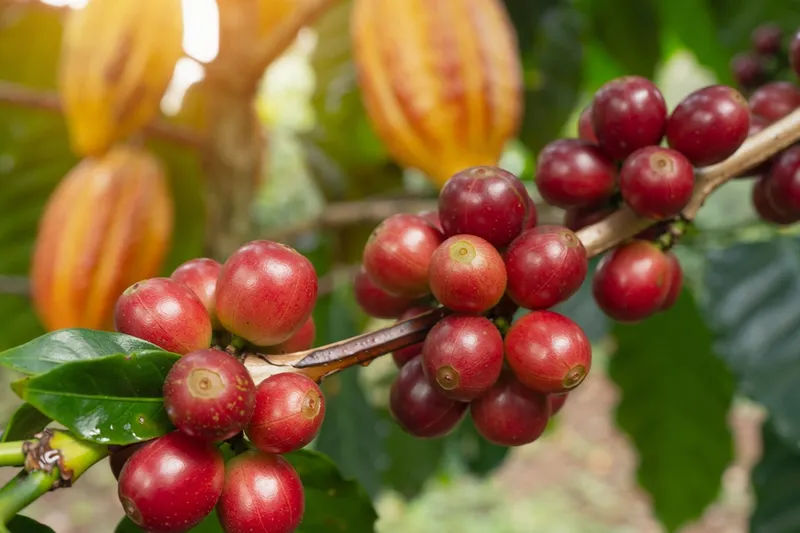
Coffee is one of Peru’s most important agricultural exports and a main source of income for many smallholder families in the highland and jungle regions of Junín, Cajamarca, San Martín and Cusco. Peru is a leading supplier of organic and certified coffees.
In 2012 and 2013, coffee leaf rust, a fungal disease known locally as roya amarilla, spread across Central America and Peru. It causes leaves to fall, weakening plants and cutting yields.
A USDA report described the outbreak in Peru as affecting about 130,000 hectares, roughly 40 percent of the planted area in its assessment.
Many affected farms needed to replace old, susceptible plants with new, more resistant varieties. That process, called renovation, means removing productive trees and waiting several years for new plants to bear fruit.
The government launched a renovation programme, with Agrobanco, Peru’s state agricultural bank, providing financing to farmers.
Renovation credit is difficult to design. Farmers need money to plant and maintain trees but earn little until the new plants mature. Loans therefore need grace periods and long repayment terms.
When repayment schedules do not match the crop cycle, borrowers may fall behind. Agrobanco later faced significant problems with loan quality, which led to reviews of its lending.
Coffee-producing countries worldwide, from Colombia to Ethiopia, face similar challenges in financing replanting as climate change increases disease risks.
Coffee prices add another layer of risk. When world prices are low, farmers earn less from each harvest and find it harder to repay loans. Prices for arabica coffee, the type Peru mainly grows, are set in international markets and can swing widely.
Smallholders often have limited collateral, since many lack formal land titles. That makes commercial banks reluctant to lend and increases the importance of public lenders and cooperatives.
Cooperatives play a central role in Peru’s coffee sector. They collect beans, process them and sell to exporters, and they sometimes act as intermediaries for credit and technical assistance.
Renovation programmes elsewhere have combined credit with training in pruning, fertilising and disease control. Without these practices, new plants may still suffer from rust or produce low yields.
The case shows the importance of matching financial products to the realities of farming. A loan that suits a shop or factory may not suit a farmer whose investment pays off only after several years.
Climate change is expected to increase the risks, since warmer temperatures and changing rainfall patterns can favour the spread of diseases such as rust.
Over the long term, the success of renovation is measured by whether yields recover and whether farmers can repay their loans.
Key moments
Agricultural reporting identified widespread coffee rust damage.
Public documents set out financing arrangements involving Agrobanco.
Source: USDA report cited in the case; ‘not affected’ is 100 minus the reported share.
The trade-offs at the heart of the case
Finance two different biological clocks
An unusual flowering season reduced the volume blueberry exporters expected within a marketing year. Coffee renovation can delay receipts across several harvests. The relevant lender question in both cases is when saleable output returns relative to payments already committed.
Our assessment
I would appraise phased renewal and ask whether the household can tolerate one more weak harvest after the scheduled recovery. Compare repayments with cash after essential expenses instead of using gross farm revenue. For the lender, distinguish a viable renovation that needs a longer repayment profile from a project that remains uneconomic at realistic yields and coffee prices.
For your seminar, paper or interview
- Q1
Why does affected acreage differ from acreage needing credit?
- Q2
When would a principal grace period merely postpone a shortfall?
- Q3
How could phased renovation change default risk without changing the coffee price?
- Q4
How far before the projected low point must a funding commitment become unconditional?
- Q5
Which payment could be rescheduled without weakening the receipts expected later in the forecast?
- Agricultural credit
- Crop disease
- Public development banks
- Investment horizons
How we would approach it
Simplifying Finance’s opinion, offered as a starting point for debate, not as fact or investment advice.
We think the coffee rust crisis showed why renovation credit must match the life cycle of the crop. New coffee plants take years to produce, so loans with short repayment periods can push farmers into default even when the investment is sound.
Match loan terms
Allow grace periods for new plantings.
Use resistant varieties
Reduce future rust risk.
Provide technical support
Combine credit with advice.
What this plan gives up
Renovation restores productivity but delays income for years.
The strongest counter-argument
Some argue public lenders took excessive credit risk.
Metrics to watch
- Yields of renovated farms
- Repayment rates
Propose your solution
Pick a discussion question and set out what you would do, why, and what it would cost. Strong, well-argued answers are reviewed and published below with your first name and programme.
Published solutions
Loading published solutions…
- USDA FAS — Peru coffee production and rust assessment ↗
- Congress of Peru — National coffee renovation and financing programme ↗
- Agrobanco — Debt consolidation application under the coffee renovation plan ↗
- Photo: Coffee plantations in Peru by Kızıldeniz, CC BY-SA 4.0 (cropped and resized) ↗
Figures are as reported by the companies or cited outlets as of 22 November 2026. Check the source before quoting. Corrections: let us know through the solution form.