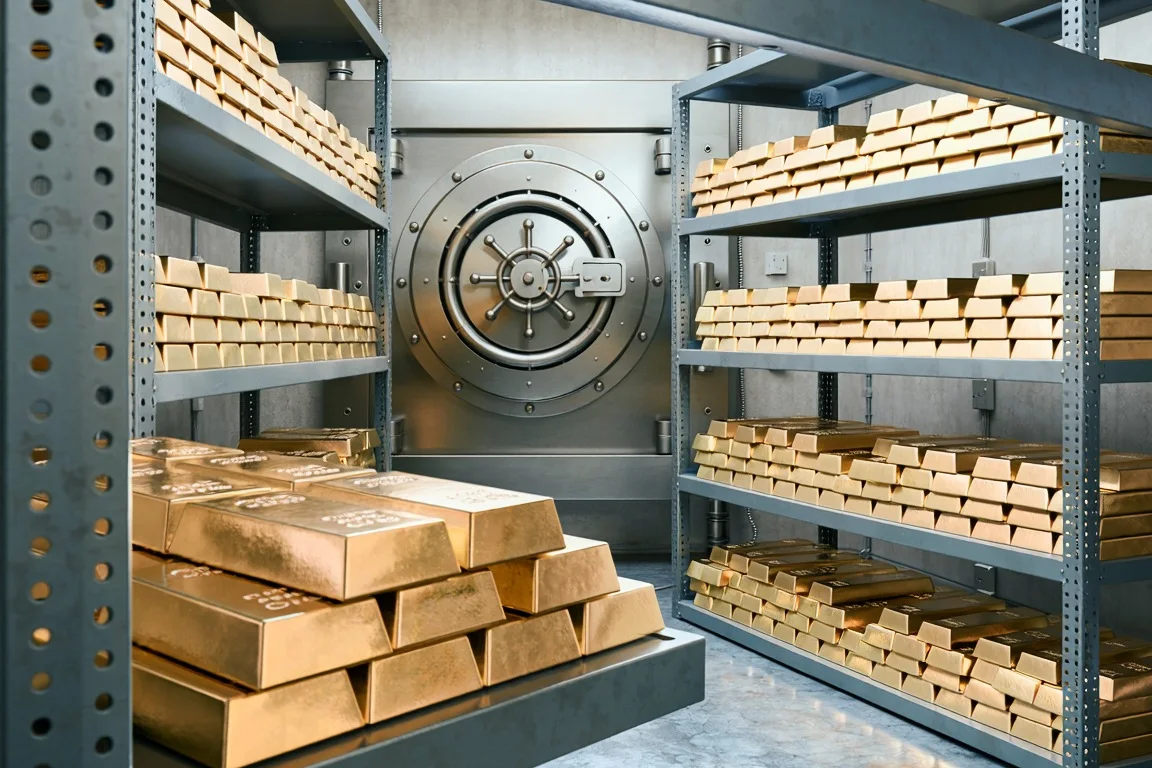
The idea
Central banks hold reserves to defend their currencies, pay for imports in a crisis and show financial strength. For decades most reserves have been held in US dollars, euros and government bonds. Gold has always been part of the mix, and since 2022 many central banks have been buying it at the fastest pace in more than half a century.
This buying has become one of the most important forces in the gold market, alongside jewellery, investment and technology demand.

Why central banks want gold
Gold has no default risk: it is not anyone else's debt. It cannot be printed. It can be stored at home, out of reach of foreign governments. After Russia's foreign reserves were frozen in 2022, many countries looked again at how much of their savings depended on other countries' financial systems.
Gold also tends to hold value during crises and periods of high inflation, and it diversifies reserves away from the dollar. Surveys of central bankers by the World Gold Council show most expect global gold reserves to keep rising.
Who has been buying
Buying has been led by emerging-market central banks.
| Buyer | Pattern |
|---|---|
| China | Regular reported purchases; total believed by some analysts to be higher |
| Poland | Among the largest buyers in 2023–2024 |
| Turkey | Large buyer, also sells when it needs cash |
| India | Steady additions and repatriation of gold |
| Others | Many smaller buyers across Asia, the Middle East and Europe |
How this affects the gold price
Central bank demand is less sensitive to price than jewellery buying. When gold rises, jewellery demand often falls, but central banks have kept buying. This helps explain why gold rose strongly in 2023–2024 even while higher interest rates would normally have weighed on it.
Official buying also puts a floor under the market in some periods. However, central banks can slow or reverse purchases, and some sell gold when they need to support their currency.
Holdings in context
The United States holds the largest official gold reserves, about 8,100 tonnes, followed by Germany, Italy, France and the IMF. Many emerging economies hold a much smaller share of reserves in gold, which gives them room to keep buying for years if they choose.
Reported figures may not capture all official buying, as some purchases are made through other state entities.
What it means for investors
For an individual investor, central bank buying is a reason gold has become more widely held as a long-term diversifier, not a reason to buy at any price. Gold still has no income and can fall sharply, as it did between 2011 and 2015.
A modest allocation, often 5% to 10% of a portfolio, held through physical gold or a physically backed fund, is a common approach. In the UAE, investment-grade gold has favourable VAT treatment, which makes physical gold relatively cheap to buy.
Gold, the dollar and sanctions
The US dollar remains by far the largest reserve currency, and central banks are not abandoning it. But many have decided to hold a little less in dollars and a little more in assets they control directly. Gold stored at home is the most obvious choice, because it does not depend on any foreign bank, clearing system or government.
This shift accelerated after major economies froze Russia's central bank reserves in 2022. Whatever one thinks of that decision, it showed central banks that reserves held abroad can be blocked. Some have also brought gold stored in London or New York back to their own vaults, a process called repatriation, for the same reason.
A realistic scenario
Layla reads that central banks are buying record amounts of gold and considers putting 30% of her savings into it. She checks gold's history, sees long periods of falling prices, and settles on 8%, held in a physically backed ETF and a few bars bought from a reputable dealer, rebalanced yearly.
Questions to ask before following the central banks
- Am I buying gold as insurance or chasing a rising price?
- Could I hold it through a several-year decline?
- What share of my portfolio is appropriate?
- Which form of gold has the lowest total cost for me?
- Do I understand that central banks can also sell?
The short version
Central banks, especially in emerging markets, have been buying gold at record rates for safety, independence and diversification. That demand has supported prices, but gold remains volatile and pays no income. For individuals, it argues for a modest, deliberate allocation rather than a large bet.
Illustration: central banks bought more than 1,000 tonnes of gold a year in 2022, 2023 and 2024, roughly double the average of the previous decade. With total yearly demand of around 4,500 to 5,000 tonnes, that is about a fifth of the market.
Central banks buy gold for safety and independence, not short-term profit. Their steady demand has become an important support for the gold market.
Primary educational reference
World Gold Council · Central bank gold reserves ↗Reviewed November 21, 2026. Examples are hypothetical illustrations in AED or USD. Educational content, not personalised investment, legal or tax advice.