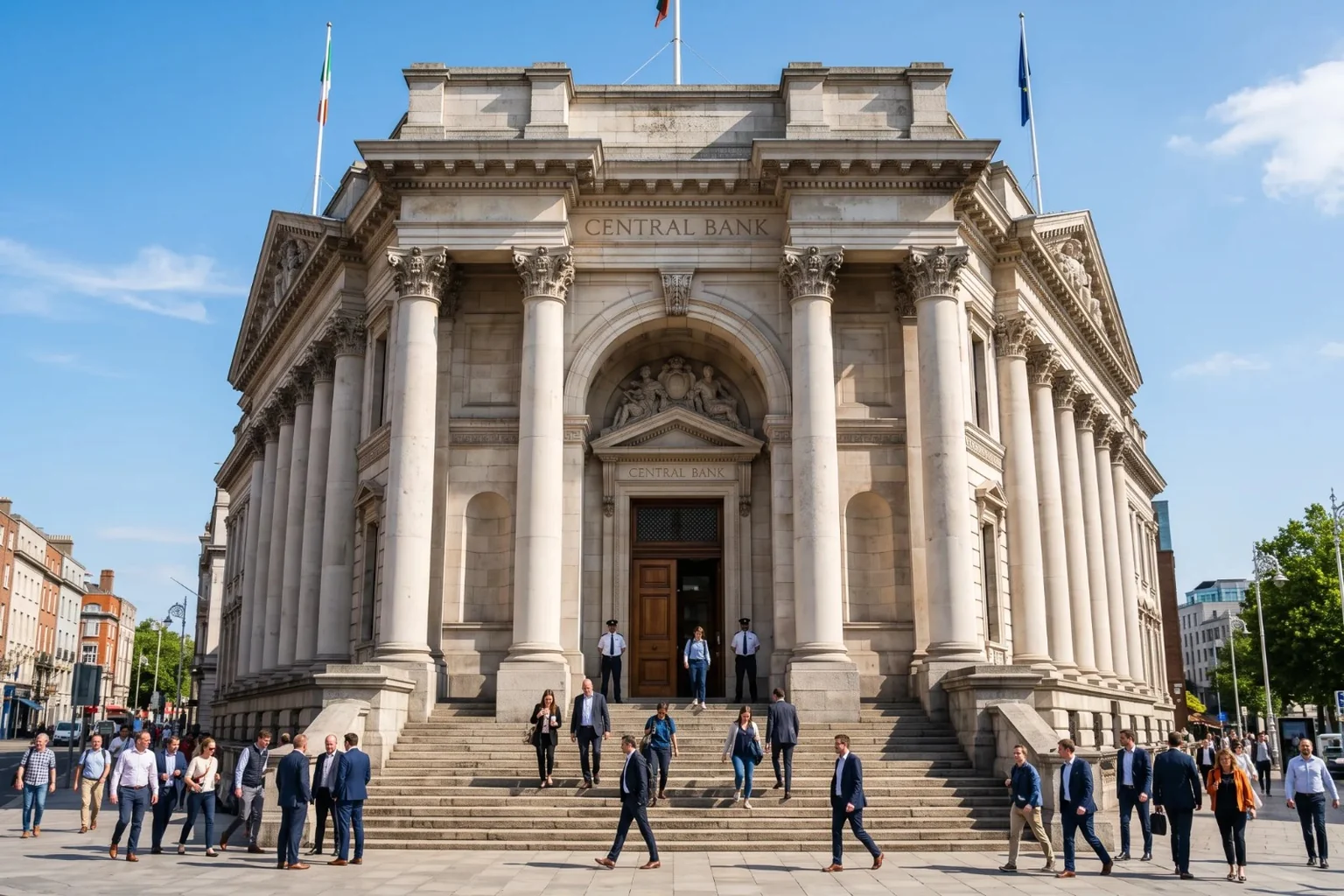
Their job
Central banks such as the Federal Reserve, European Central Bank and Bank of England aim to keep inflation low and stable, often around 2%, and support jobs and financial stability.
The main tool
They set a short-term policy interest rate. Higher rates make borrowing dearer, cool spending and slow inflation. Lower rates do the opposite.
Set the policy rate
Compare the policy rate with inflation to find the real rate.
Lags and independence
Rate changes take a year or more to have full effect. Central banks are usually independent of governments so decisions are not driven by elections.
A brief history
Central banks have existed for centuries. Sweden's Riksbank, founded in 1668, and the Bank of England, founded in 1694, are among the oldest. Early central banks mainly managed government finances and issued banknotes. Over time, they took on responsibility for the stability of the banking system and the value of money.
The US Federal Reserve was created in 1913 after a series of banking panics. The European Central Bank began operating in 1998, setting a single monetary policy for the countries that adopted the euro. Today, almost every country has a central bank or a similar monetary authority.
The Central Bank of the UAE
The Central Bank of the UAE was established in 1980, succeeding the UAE Currency Board that had issued the dirham since 1973. It issues the currency, manages the country's foreign reserves, supervises banks and other financial institutions and oversees payment systems.
Because the dirham has been pegged to the US dollar at 3.6725 since the late 1990s, the Central Bank's main monetary goal is to maintain the peg. Its key interest rate, the base rate, generally moves in line with the US Federal Reserve's policy rate. The Central Bank has also led major initiatives in financial infrastructure, digital payments and financial innovation.
Different mandates
Central banks have different official goals, known as mandates. The US Federal Reserve has a dual mandate: maximum employment and stable prices. The European Central Bank's primary objective is price stability. The Bank of England targets inflation set by the government, currently 2%.
Countries with fixed exchange rates, such as the UAE, Saudi Arabia and Hong Kong, focus on maintaining the currency peg. This means their interest rates follow the anchor currency's central bank, and they rely more on other tools, such as fiscal policy and bank regulation, to manage the domestic economy.
How a rate decision is made
Most central banks make rate decisions at scheduled meetings, often eight times a year. A committee reviews economic data, including inflation, employment, growth, wages and financial conditions, and forecasts how these will develop. Members then vote on whether to raise, hold or cut rates.
After the decision, central banks publish statements explaining their reasoning, and many hold press conferences. Some also publish minutes and forecasts of where members expect rates to go. Markets pay close attention to all of this, because guidance about future policy can matter as much as the decision itself.
Beyond interest rates
Central banks have other tools besides the policy rate. They can buy assets, as with quantitative easing, lend to banks against collateral, set reserve requirements for banks and use forward guidance, which means signalling their future intentions to influence expectations.
Many central banks also act as bank supervisors, setting capital and liquidity rules and running stress tests. In a crisis, they serve as lender of last resort, providing emergency liquidity to solvent banks to prevent panic from spreading.
Why independence matters
Most modern central banks are independent of day-to-day political control. The reasoning is that governments facing elections may be tempted to keep rates low or finance spending by creating money, which could lead to high inflation. An independent central bank can focus on long-term stability.
Research has generally found that countries with more independent central banks have had lower and more stable inflation. Independence comes with accountability: central banks publish their decisions and reasoning and often report to parliaments.
How rate changes reach your wallet
When a central bank raises its policy rate, banks' funding costs rise, and they usually increase rates on loans and, more slowly, on deposits. Variable-rate mortgages and loans become more expensive, while savers may earn more on deposits. Bond yields and the currency can move too.
These changes affect spending, investment and hiring over time. Economists estimate that the full effect of a rate change on inflation can take one to two years. For borrowers in the UAE, changes in US rates feed through to local lending rates, including the reference rates used for many variable-rate mortgages.
Reading central bank signals
Investors watch central bank statements for changes in language. A shift from saying rates will stay high for some time to saying the committee is monitoring conditions can signal that cuts are coming. Projections of future rates, such as the Federal Reserve's dot plot, show what officials expect.
Markets also price expected rate changes through futures contracts. When a central bank surprises markets, by moving more or less than expected, prices of bonds, shares and currencies can move sharply.
Central banks and the currency peg
Maintaining a currency peg requires a central bank to hold large foreign currency reserves and to stand ready to exchange local currency for the anchor currency at the fixed rate. The UAE's substantial foreign reserves, built over many years, support confidence in the dirham's long-standing peg to the dollar.
The peg has provided stability for trade, investment and planning, since businesses and households know the dirham's value against the world's main trading currency. The trade-off is that monetary policy follows US conditions rather than being set purely for the UAE economy.
Common misunderstandings
Central banks do not control all interest rates directly. They set a short-term policy rate, and market forces determine longer-term rates, though central bank actions and guidance have a strong influence. Nor do central banks control inflation precisely; they influence it with a lag and in the face of shocks they cannot prevent.
A rate cut is not automatically good news for markets, and a rise is not automatically bad. What matters is why the central bank is acting and whether the decision was expected.
Frequently asked questions
Who sets interest rates in the UAE?
The Central Bank of the UAE sets its base rate, which generally follows the US Federal Reserve because of the dirham's peg.
How often do central banks change rates?
Most meet around eight times a year, with extra meetings in emergencies.
Why are central banks independent?
To keep decisions focused on long-term stability rather than short-term political pressures.
Illustration: with a policy rate of 5% and inflation of 3%, the real policy rate is (1.05 ÷ 1.03) − 1 = 1.9%.
Central banks raise rates to cool inflation and cut them to support growth. Their decisions ripple through every loan and asset price.
Written by Simplifying Finance. Figures in the worked example are illustrative.
Reviewed November 28, 2026. Examples and lab figures are hypothetical. Educational content, not personalized investment advice.