The largest manager
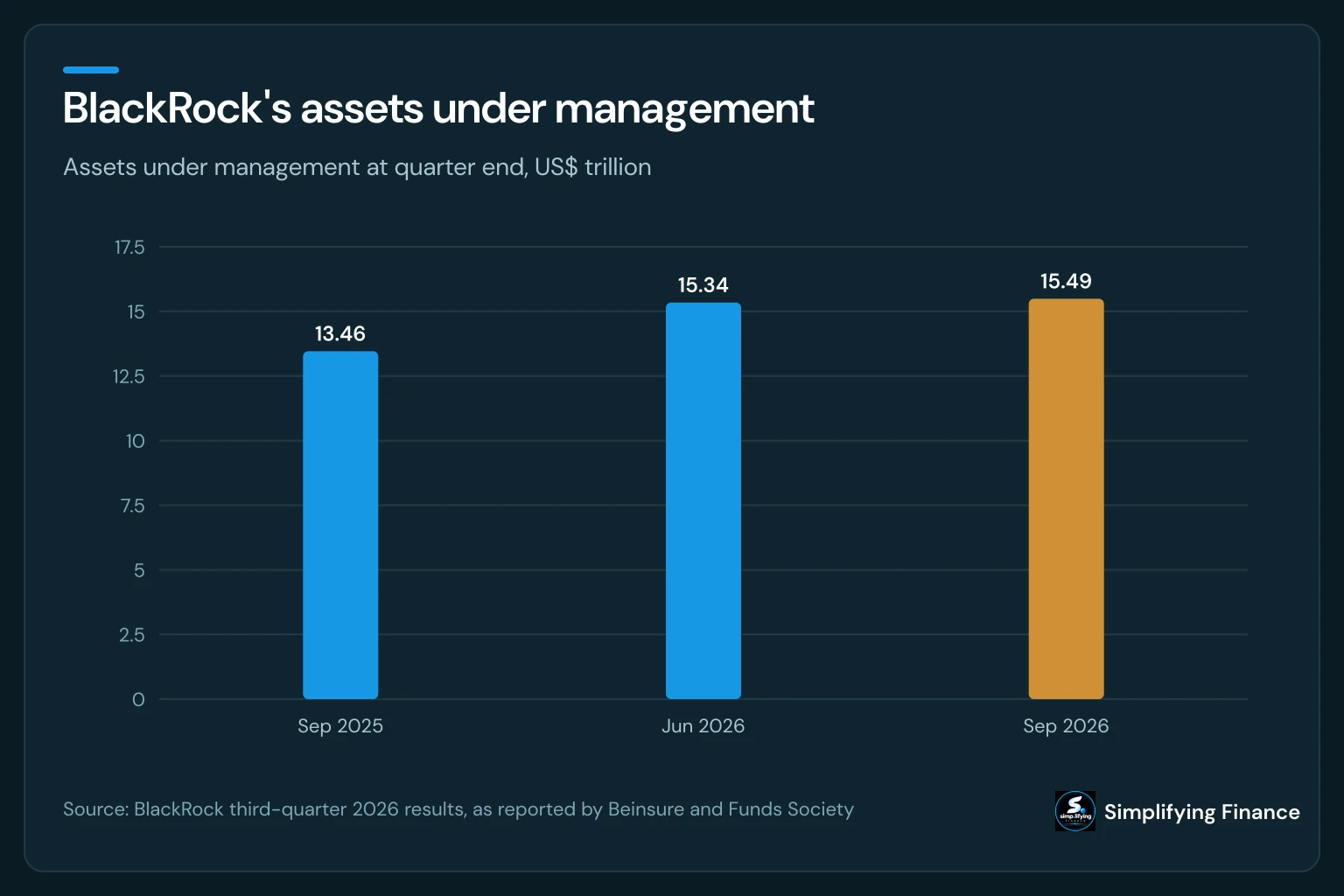
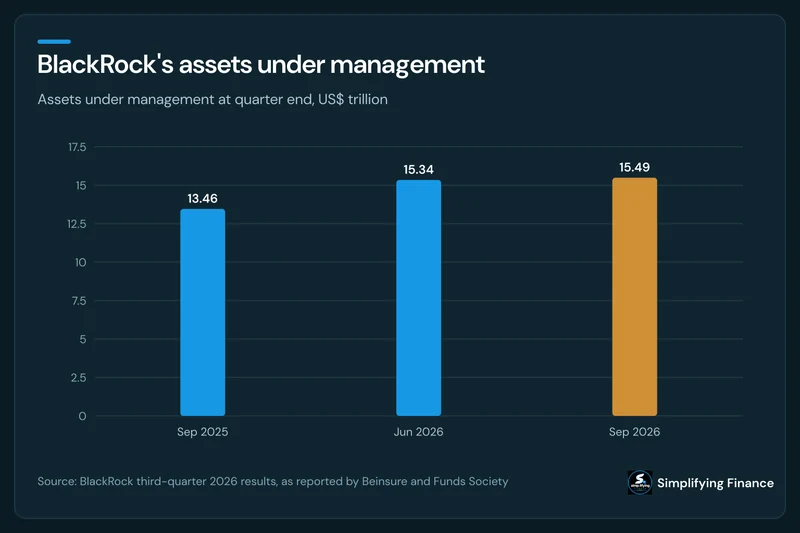
BlackRock reported assets under management of about US$15.49 trillion at the end of September 2026, up from US$13.46 trillion a year earlier and US$15.34 trillion at the end of June. In the third quarter alone it attracted about US$205 billion of net new money, and about US$869 billion over the previous twelve months.
Its chief executive, Larry Fink, said the results reflected net inflows across all asset classes, client types and regions, and in both active and index management.
See the numbers behind the chart
| Quarter end | US$ trillion |
|---|---|
| Sep 2025 | 13.46 |
| Jun 2026 | 15.34 |
| Sep 2026 | 15.49 |
iShares and index funds
BlackRock's iShares range of exchange-traded funds is its largest growth engine. In the third quarter of 2026, iShares attracted about US$135 billion of net inflows. ETFs let investors buy a whole index, such as a broad market of shares or bonds, in a single fund traded on a stock exchange, usually at low cost.
For diversification, this is significant: a single broad-market ETF can hold hundreds or thousands of companies across many countries. The guide's page on world index overlap shows how two broad funds can overlap more than investors expect.
Active, cash and private markets
BlackRock is not only an index manager. In the third quarter of 2026, its active strategies attracted about US$66 billion of net inflows, led by fixed income and systematic strategies, and its cash management products about US$31 billion. By asset class, fixed income gathered about US$78 billion and equities about US$52 billion.
BlackRock has also expanded into private markets, such as infrastructure and private credit, raising about US$68 billion in private markets over the year to September 2026, according to the firm. These assets are less liquid and usually more expensive than index funds, and they are mainly used by institutions and wealthy investors.
Technology
BlackRock sells investment and risk-management technology, known as Aladdin, to other institutions. The firm reported growth in technology services revenue in 2026 as more clients used its systems. This business means BlackRock's influence extends beyond the money it manages to the tools that many other investors use to measure and manage risk.
What its size means for savers
BlackRock's scale has helped push down the cost of index investing. At the same time, as a manager of index funds that hold nearly every listed company, it is among the largest shareholders in many companies worldwide. Like other large managers, it votes on behalf of its funds and has introduced options that let some fund investors express their own voting preferences.
For an individual, BlackRock is best understood as a provider of building blocks. What matters is not the brand but the specific fund: what index or strategy it follows, how diversified it is and what it costs.
Where the growth came from
BlackRock's quarterly results separate growth from market movements and growth from net new money. Over the year to September 2026, both helped: rising share and bond markets lifted the value of existing holdings, and clients added about US$869 billion. The firm also reports organic base-fee growth, which measures how much its fee revenue is growing from new money alone. It reported 10% over twelve months.
This matters for understanding any manager. A firm whose assets rise only because markets rose will see them fall when markets fall. Steady net inflows show that clients are choosing the firm's funds.
Reading a fund factsheet
Every iShares ETF, like every fund from any manager, publishes a factsheet listing its index, number of holdings, top ten holdings, sector and country weights and yearly cost. These few numbers tell you most of what you need to know about how diversified a fund is. Two ETFs with similar names can track quite different indexes, so the factsheet, not the name, is the starting point.
A building-block provider
Institutions such as pension funds and sovereign wealth funds often use BlackRock's index funds and ETFs as building blocks: they decide their own mix of assets, then use low-cost funds to fill each part. Individuals can follow the same logic. Decide first how much to hold in shares, bonds and cash, and in which regions, and only then choose funds to fill each slot. The order matters: the mix drives most of the result, and the choice of provider comes second.
A note on this page
This page describes these firms as fund managers for educational purposes. It is not a recommendation of any firm, fund or service. Figures are taken from each firm's own reports or from named data providers, as of the dates stated.
What one broad ETF can hold
Suppose an investor puts US$10,000 into a broad global equity index ETF holding about 2,000 companies across developed and emerging markets. On average, each company accounts for about US$5 of the investment, although the largest companies have much bigger weights because the index is weighted by market value.
| Investment | US$10,000 |
| Companies held (example) | about 2,000 |
| Average per company | about US$5 |
| Weighting | by market value, so the largest dominate |
If one company in the fund collapsed, the loss would be small relative to the whole. That is the diversification benefit. But because the index is weighted by size, the largest companies and the largest country, the United States, still have a big influence on the result.
Where people go wrong
- Choosing a fund because the manager is big. Size does not tell you what a specific fund holds or costs.
- Assuming all ETFs are diversified. Some ETFs track a narrow sector or theme.
- Treating private-market funds like ETFs. Private assets are less liquid and usually cost more.
- Ignoring market-value weighting. The largest companies dominate a cap-weighted index.
- Reading the name, not the index. Similar fund names can hide different indexes.
Put it to work
- Read the fund factsheet. Check the index, number of holdings, top 10 weights and cost.
- Compare like with like. Compare funds that track similar indexes.
- Watch concentration. See how much of a fund sits in its ten largest holdings.
- Check the index rules. Read how the fund's index selects and weights companies.
- Read on. Next: Vanguard.
BlackRock grew mainly through low-cost index funds and ETFs, and now also manages active, cash and private-market strategies. Its size shows how much of the world's diversified investing now runs through a few platforms.
Facts checked against the sources above on 27 November 2026. Figures are as of the dates stated and will change. Worked examples use round illustrative numbers to show the arithmetic, not forecasts. Educational content only, not personal investment advice.