An unusual owner
Vanguard is owned by its funds, which are in turn owned by the people who invest in them. Vanguard describes this investor-owned structure as central to its purpose: to take a stand for all investors, treat them fairly and give them the best chance of investment success. Because there are no outside shareholders, the firm says it can pass the benefits of scale back to fund investors in the form of lower costs.
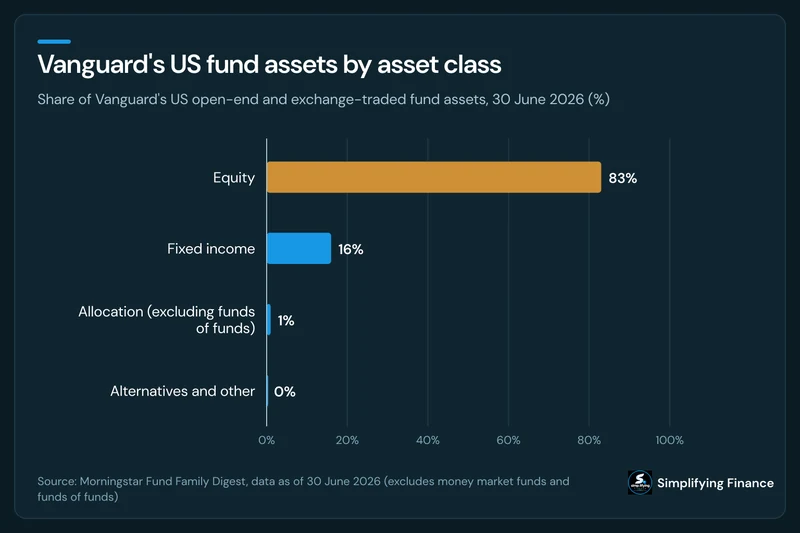
See the numbers behind the chart
| Asset class | Share of assets |
|---|---|
| Equity | 83% |
| Fixed income | 16% |
| Allocation (excluding funds of funds) | 1% |
| Alternatives and other | 0% |
The first index fund for individuals
Vanguard was founded by John Bogle, and in August 1976 it launched the First Index Investment Trust, later renamed the Vanguard 500 Index Fund, one of the first index funds offered to individual investors. The idea, simply owning a whole market at low cost rather than paying managers to pick shares, was widely doubted at the time. It has since become one of the most important ideas in personal investing.
The size and the mix
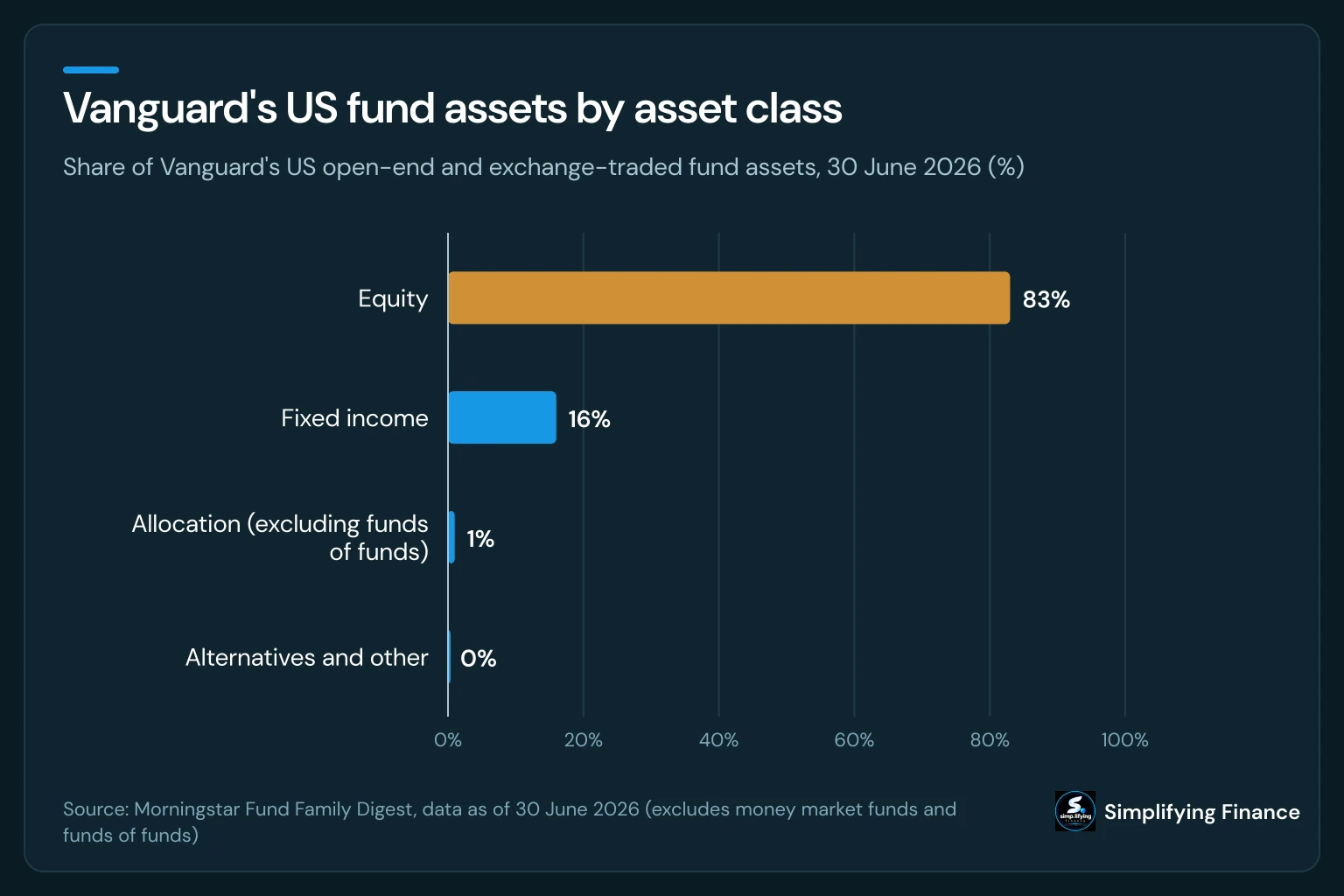
According to Morningstar, Vanguard's funds held about US$11.0 trillion in US assets and US$11.8 trillion globally in June 2026, ranking first in both. By assets, about 88% was in passive funds and 12% in active funds, although the number of active and passive funds was nearly equal. About 83% of US fund assets were in equity funds and 16% in fixed income.
Vanguard also reported more than 50 million investors at the end of 2025, and assets outside the United States passed US$1 trillion for the first time in early 2026, according to the Financial Times as reported by Reuters.
ETFs and target-date funds
In June 2026, data compiled by Bloomberg showed Vanguard overtaking BlackRock as the largest ETF issuer in the United States, with about US$4.39 trillion across its US-listed ETFs. Vanguard is also the largest provider of target-date funds, the all-in-one retirement funds that shift from shares towards bonds as a chosen retirement year approaches. Morningstar reported that Vanguard oversaw US$1.8 trillion, or about 37%, of target-date assets in 2025.
Index investing beyond the United States
Vanguard also runs funds in Europe, Asia and Australia, often tracking global or regional indexes in local currencies. Its assets outside the United States doubled over five years to pass US$1 trillion, according to its international head, as reported by Reuters. This growth shows that low-cost index investing has spread well beyond its American origins, giving savers in many countries access to broad global diversification.
Active management too
Although best known for indexing, Vanguard also runs active funds, some managed in-house and some by outside firms that it selects. It reports that a large majority of its actively managed funds outperformed their average competitors over ten years, which it attributes partly to low costs. Low costs help any fund, active or passive, because fees are deducted from returns every year.
Why ownership structure matters
Most asset managers are owned by outside shareholders or partners who expect a profit. Vanguard's structure removes that layer, which the firm says allows it to keep costs low. Other managers have cut their own fees sharply in response, so investors in many firms' index funds now pay far less than a generation ago. This competition on cost is one of the biggest benefits of the giant managers for ordinary savers.
Low cost, however, is only part of the picture. An index fund still carries the full ups and downs of its market. A total-market equity fund can fall by a third or more in a severe bear market, whatever it costs.
Vanguard and target-date funds
Many workplace retirement plans in the United States use target-date funds as the default choice, and Vanguard is the largest provider. Its target-date funds combine its own broad index funds in a mix that becomes more cautious with time. The final page of this section explains how target-date funds work and what to compare when choosing one.
The lesson for individual savers
Vanguard's growth reflects a simple idea that any investor can use: own broad markets, keep costs low and stay invested for the long term. These three habits do not depend on any one provider. They can be followed with index funds from many managers, as long as the funds are broad, cheap and held with discipline through good and bad markets.
A note on this page
This page describes these firms as fund managers for educational purposes. It is not a recommendation of any firm, fund or service. Figures are taken from each firm's own reports or from named data providers, as of the dates stated.
Diversification at very low cost
An investor who puts US$20,000 into a broad total-market index fund owns a small slice of thousands of companies. At a yearly cost of, say, 0.05%, that diversification costs about US$10 a year.
| Investment | US$20,000 |
| Yearly cost at 0.05% | about US$10 |
| Yearly cost at 1.00% | about US$200 |
| Companies held in a broad index | thousands |
Building the same spread by buying individual shares would require thousands of purchases and far higher trading costs. This is the core of what index funds offer: wide diversification for a very small fee.
Where people go wrong
- Assuming every index fund is the same. Indexes differ in what they include and how they weight companies.
- Ignoring the equity share. Most index fund assets are in shares, which can fall sharply.
- Treating "passive" as "risk-free". An index fund carries the full risk of the market it tracks.
- Overlooking costs in active funds. Lower fees help active funds as well as index funds.
- Assuming low cost means low risk. A cheap equity fund can still fall sharply.
Put it to work
- Check what your index includes. Find out which countries and company sizes it covers.
- Balance shares with bonds. Decide how much of your money should be in less volatile assets.
- Compare total costs. Look at the ongoing charge or expense ratio for every fund.
- Match risk to time. Keep money needed within a few years out of volatile funds.
- Read on. Next: State Street.
Vanguard's funds are about 88% passive by assets and mostly invested in shares. Its ownership structure and focus on low costs shaped the whole fund industry and made broad diversification cheap.
Facts checked against the sources above on 27 November 2026. Figures are as of the dates stated and will change. Worked examples use round illustrative numbers to show the arithmetic, not forecasts. Educational content only, not personal investment advice.