Amundi
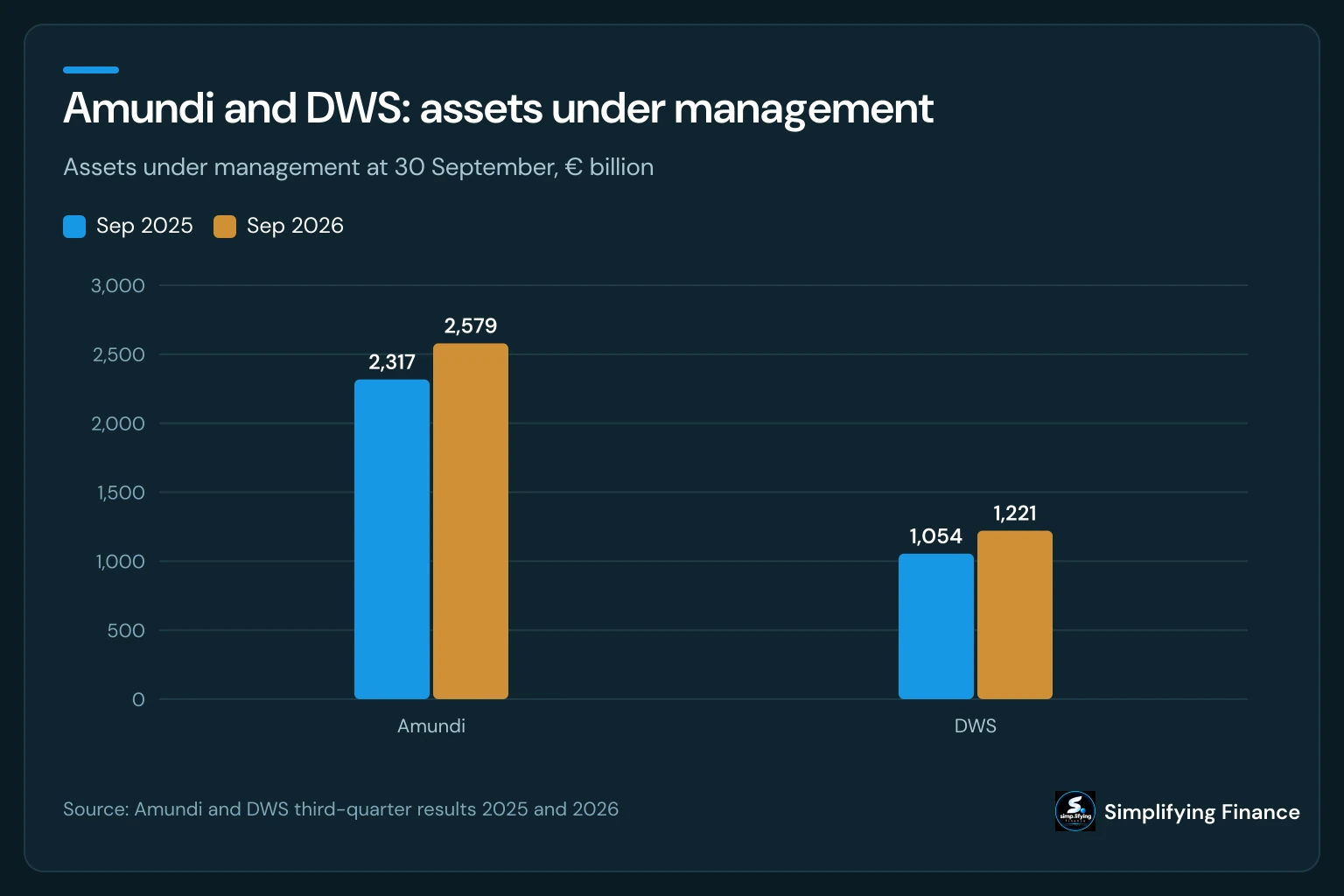
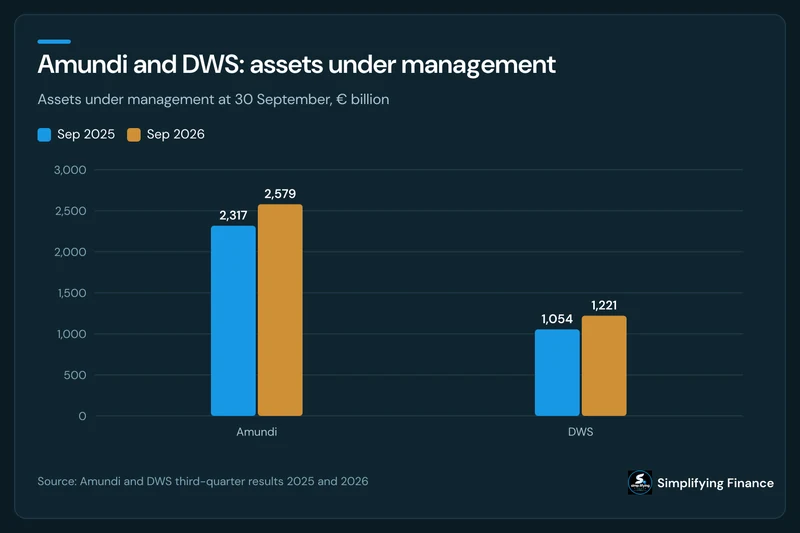
Amundi, a listed subsidiary of the French banking group Crédit Agricole, is Europe's largest asset manager. It reported assets under management of €2,579 billion at 30 September 2026, up 11% in a year, and net inflows of €102 billion over the first nine months of 2026. In 2025 Amundi said it had become the second-largest ETF provider in Europe, with ETF assets above €300 billion.
Amundi serves retail savers through partner banks across Europe and Asia, as well as institutions. Its range spans active funds, index funds and ETFs, and treasury products.
See the numbers behind the chart
| Manager | Sep 2025 | Sep 2026 |
|---|---|---|
| Amundi | 2,317 | 2,579 |
| DWS | 1,054 | 1,221 |
DWS
DWS, majority-owned by Deutsche Bank, reported record assets under management of €1,221 billion at 30 September 2026, up 16% in a year, after record net flows of €30.9 billion in the third quarter. Its Xtrackers ETF range drove much of the growth: passive asset management, including Xtrackers, gathered a record €15.8 billion in the quarter.
DWS announced plans to introduce Deutsche Asset Management as a new global umbrella brand, keeping the DWS and Xtrackers product brands.
L&G
Legal & General (L&G), a UK insurer and asset manager established in 1836, reported £1.2 trillion of global assets under management in its asset management business in the first half of 2026. Private markets assets rose 22% to £79 billion. L&G is a major manager of UK workplace pension money, with total UK defined contribution assets of £236 billion.
L&G's model links asset management with its pensions and annuities businesses: around 90% of its annuity assets are managed by its own asset management division, according to the company.
What European investors should know
European funds are often sold in multiple currencies and countries, and many are structured under the EU's UCITS rules, which set standards for diversification, liquidity and investor protection. For investors outside the United States, these funds can offer broad global diversification in a local currency, sometimes with currency hedging.
The guide's pages on currency risk and currency hedging explain how to think about which currency your funds are priced in and whether hedging is worth the cost.
Banks, insurers and asset managers
Unlike the US giants, Europe's largest managers are often part of, or closely tied to, banking and insurance groups. That can give them large distribution networks through branches and pension schemes. For savers, it is worth checking whether a fund recommended by a bank or insurer is from the group's own manager, and comparing its cost and diversification with alternatives.
The growth of European ETFs
All three firms report strong growth in ETFs and index products. Amundi described itself in 2025 as Europe's second-largest ETF provider by assets and inflows. DWS reported record flows into passive products, including Xtrackers, in 2026. L&G's index funds are widely used in UK workplace pensions. The trend mirrors the United States: savers and institutions are moving towards low-cost funds that hold whole markets.
For European investors, this has widened the choice of low-cost global funds available in local currencies and under local rules, making broad diversification easier to achieve than a decade ago.
Pensions and annuities
L&G's model shows how asset managers can be tied into the retirement system. As a pension provider and annuity insurer, it invests the money behind those products through its own asset management business. When savers retire and buy an annuity, the insurer must invest premiums for decades to pay incomes, often in bonds and long-term assets such as infrastructure. This is the same long-term, liability-driven investing that the guide's pension pages describe.
Comparing across borders
Funds from European managers often appear in several countries under the same name but with different share classes, currencies and costs. When comparing them, check the fund's ongoing charge, the index it tracks and whether income is paid out or reinvested. The key information document that European funds must publish sets these out in a standard format, making side-by-side comparison easier.
A note on scale
Although Amundi, DWS and L&G are smaller than the largest US managers, each manages more than a trillion euros or pounds. Their size gives them low costs and broad ranges of funds, which benefits investors who use them.
A note on this page
This page describes these firms as fund managers for educational purposes. It is not a recommendation of any firm, fund or service. Figures are taken from each firm's own reports or from named data providers, as of the dates stated.
Choosing a share class in your currency
An investor in Germany with €30,000 wants global shares. A global equity index fund may offer an unhedged euro share class and a euro-hedged share class. The unhedged class rises and falls with exchange rates as well as markets; the hedged class aims to remove most currency effects, usually at a small extra cost.
| Investment | €30,000 |
| Unhedged class | exposed to currency moves |
| Hedged class | most currency effect removed, small extra cost |
| Effect of a 10% dollar fall (unhedged) | roughly -6% to -7% |
If the US dollar fell 10% against the euro in a year while global shares were flat, the unhedged class would lose roughly 6% to 7% from currency, because about two-thirds of a global index is in US dollar shares; the hedged class would be roughly flat before costs.
Where people go wrong
- Ignoring the share-class currency. The same fund can behave differently in different currency classes.
- Assuming a bank's own fund is the cheapest. Compare costs with similar funds from other managers.
- Overlooking UCITS protections. Know the rules that govern your fund.
- Double counting European exposure. A global fund already holds European shares.
- Assuming European funds hold only Europe. Many European-domiciled funds invest globally.
Put it to work
- Check the currency of each fund. Note whether each holding is hedged or unhedged.
- Compare like-for-like funds. Look at similar indexes across several managers.
- Check for overlap. See whether regional and global funds hold the same companies.
- Check where a fund invests. Look at the country weights, not where the fund is registered.
- Read on. Next: Capital Group, J.P. Morgan and Invesco.
Europe's giants are often owned by, or linked to, banks and insurers, and they serve savers across many countries and currencies. Their growth in ETFs mirrors the US trend towards low-cost diversification.
Facts checked against the sources above on 27 November 2026. Figures are as of the dates stated and will change. Worked examples use round illustrative numbers to show the arithmetic, not forecasts. Educational content only, not personal investment advice.