Capital Group: patient active management
Capital Group, home of the American Funds range, was founded in Los Angeles in 1931 and is privately owned. It says it manages more than US$3.6 trillion and describes itself as the world's largest active fund manager, based on Morningstar data as of June 2026.
Capital Group divides most portfolios among several managers, each running a portion independently, an approach it calls the Capital System. Morningstar notes that Capital Group's equity assets are managed through three investment groups that make decisions independently, and that its fixed income and multi-asset units each manage more than US$500 billion. The idea is to combine several independent views within one fund, a form of diversification by manager.
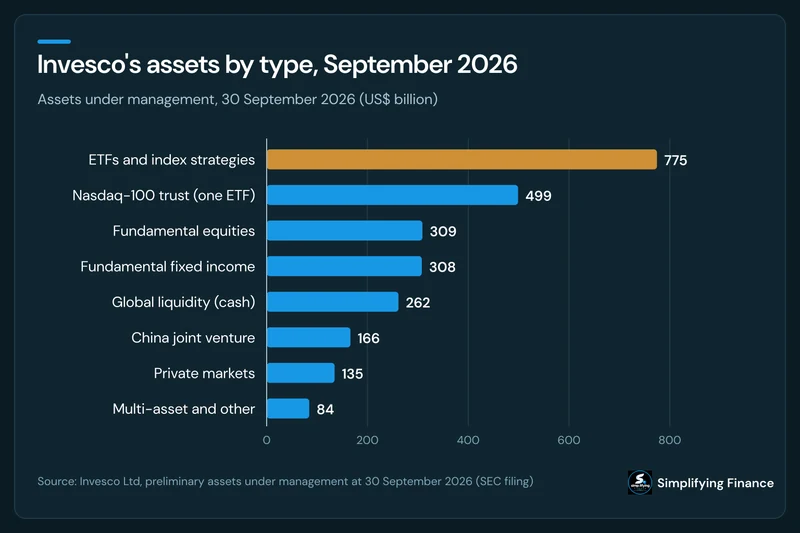
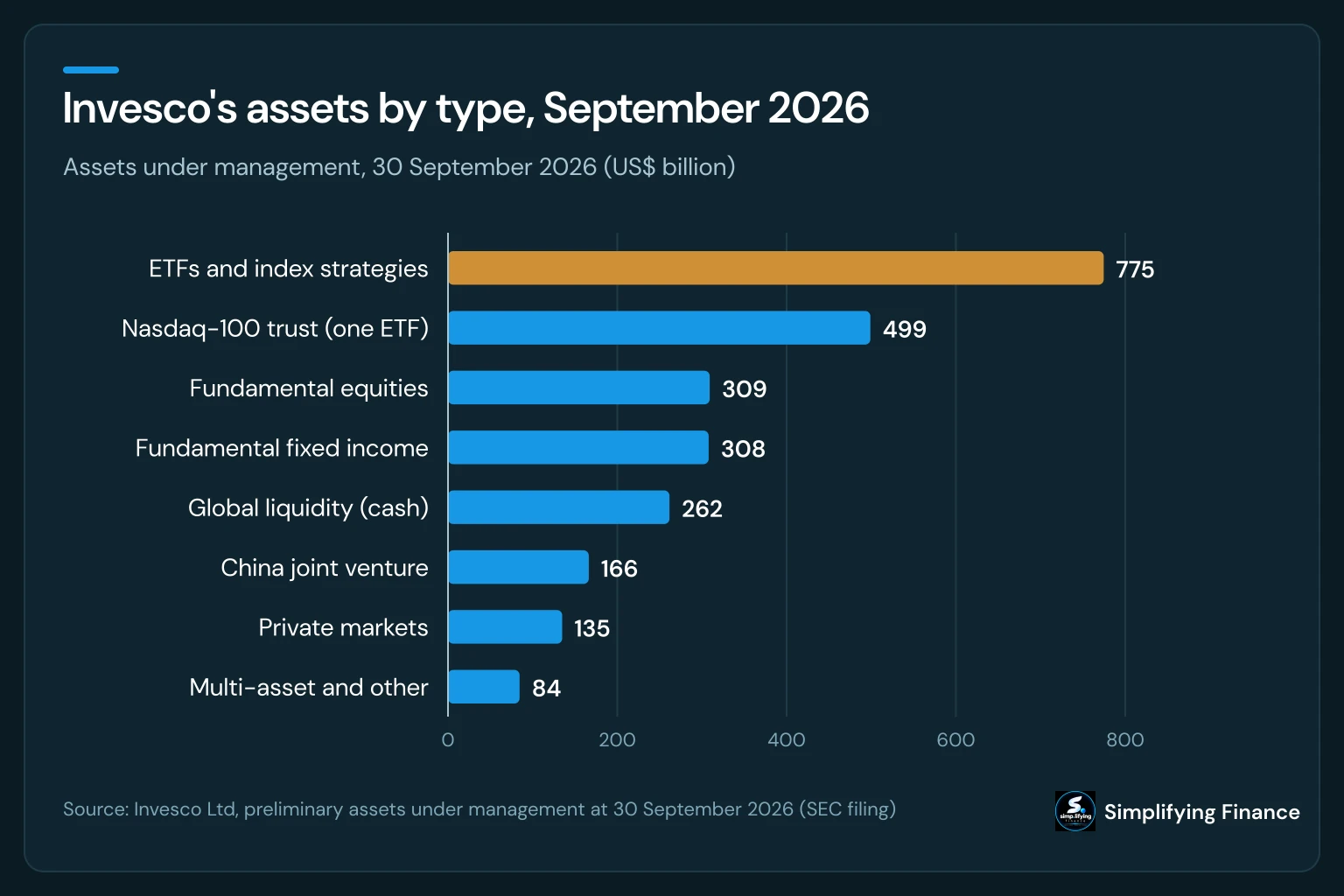
See the numbers behind the chart
| Type | US$ billion |
|---|---|
| ETFs and index strategies | 775 |
| Nasdaq-100 trust (one ETF) | 499 |
| Fundamental equities | 309 |
| Fundamental fixed income | 308 |
| Global liquidity (cash) | 262 |
| China joint venture | 166 |
| Private markets | 135 |
| Multi-asset and other | 84 |
J.P. Morgan: an asset manager inside a bank
JPMorgan Chase's asset and wealth management business reported US$5.2 trillion in assets under management at the end of September 2026, up 13% in a year, and US$7.9 trillion in client assets. It serves institutions, wealthy families and individuals worldwide, offering active funds, ETFs, alternatives and advice.
Being part of a large bank gives the business global reach and links to other banking services. For investors, as with Europe's bank-owned managers, the key questions remain what each fund holds and what it costs.
Invesco: ETFs and active funds
Invesco, based in Atlanta, reported preliminary assets under management of about US$2.54 trillion at 30 September 2026. About US$775 billion was in ETFs and index strategies, and a further US$499 billion in a single exchange-traded trust that tracks the Nasdaq-100 index, one of the most traded ETFs in the world. Active fundamental equities and fixed income together accounted for about US$617 billion.
The concentration in one Nasdaq-100 product is a reminder that some popular ETFs are not broadly diversified. The Nasdaq-100 holds about 100 of the largest non-financial companies on that exchange and is heavily weighted towards technology.
Narrow versus broad index funds
An index fund is only as diversified as the index it tracks. A total-market or global fund may hold thousands of companies across many sectors and countries. A Nasdaq-100 fund holds about 100, mostly large US technology and related companies. Both are "index funds", but their risks are very different. The guide's page on sector concentration explains why this matters.
Choosing among giants
For an individual, the choice is not really between managers but between funds: a broad, low-cost index fund; a narrow or thematic index fund; or an active fund with a clear process and reasonable cost. Each giant offers all three. Looking at a fund's holdings, concentration and cost tells you far more than the name on the door.
Diversifying across managers
Capital Group's approach of dividing a fund among several independent managers is a way of diversifying within a single fund. If one manager has a poor period, the others may offset it. Large institutions do something similar by hiring several managers for each part of their portfolio. For an individual, holding a broad index fund achieves a similar effect even more simply, because it does not depend on any manager's choices at all.
Cash and money-market funds
Several giants manage very large money-market funds, which invest in short-term, high-quality debt and aim to keep a stable value. Invesco reported about US$262 billion in global liquidity at the end of September 2026, and BlackRock and J.P. Morgan also run large cash businesses. Money-market funds are useful for cash that may be needed soon, but over long periods they have usually grown more slowly than shares and bonds, and their yields change with interest rates.
Including cash in your portfolio is a diversification decision too: it reduces the size of falls but also the long-term growth rate.
Different routes to the same goal
Whatever their structure, all three firms offer ways to hold diversified portfolios. Capital Group spreads decisions across independent managers, J.P. Morgan combines asset management with advice and banking, and Invesco offers both broad and narrow index funds alongside active strategies. The investor's task is the same in each case: understand what a fund holds, what it costs and how it fits the rest of the portfolio.
A note on this page
This page describes these firms as fund managers for educational purposes. It is not a recommendation of any firm, fund or service. Figures are taken from each firm's own reports or from named data providers, as of the dates stated.
Broad versus narrow index in practice
Suppose an investor puts US$10,000 into a broad global index fund and another US$10,000 into a Nasdaq-100 fund, thinking both are "diversified index funds".
| Broad global index fund | US$10,000; thousands of companies |
| Nasdaq-100 fund | US$10,000; about 100 companies |
| Overlap | largest US technology companies in both |
| Result | higher concentration than expected |
The global fund spreads money across thousands of companies and dozens of countries. The Nasdaq-100 fund holds about 100 companies, mostly US technology-related. Many of the Nasdaq-100's biggest companies are also among the largest holdings of the global fund, so the combined portfolio is more concentrated in a few large US technology companies than the investor may realise.
Where people go wrong
- Treating every index fund as diversified. A narrow index can be highly concentrated.
- Equating manager size with fund quality. Judge each fund on its own holdings and costs.
- Ignoring overlap between funds. Broad and narrow funds may hold the same big companies.
- Forgetting that active funds vary widely. Process, cost and consistency differ between active funds.
- Holding too much cash for too long. Cash is steady but usually grows more slowly than shares over decades.
Put it to work
- Count your fund's holdings. Check how many companies each fund owns.
- Check sector weights. See how much sits in the largest sector.
- Look for overlap. Compare the top ten holdings across your funds.
- Size your cash buffer. Hold enough cash for near-term needs and emergencies, and invest the rest.
- Read on. Next: model portfolios and target-date funds.
These firms show that scale can be built in different ways: through long-term active management, through a bank's global reach, or through ETFs. For investors, the structure of each fund matters more than the size of its manager.
Facts checked against the sources above on 27 November 2026. Figures are as of the dates stated and will change. Worked examples use round illustrative numbers to show the arithmetic, not forecasts. Educational content only, not personal investment advice.