Custody: the plumbing of investing
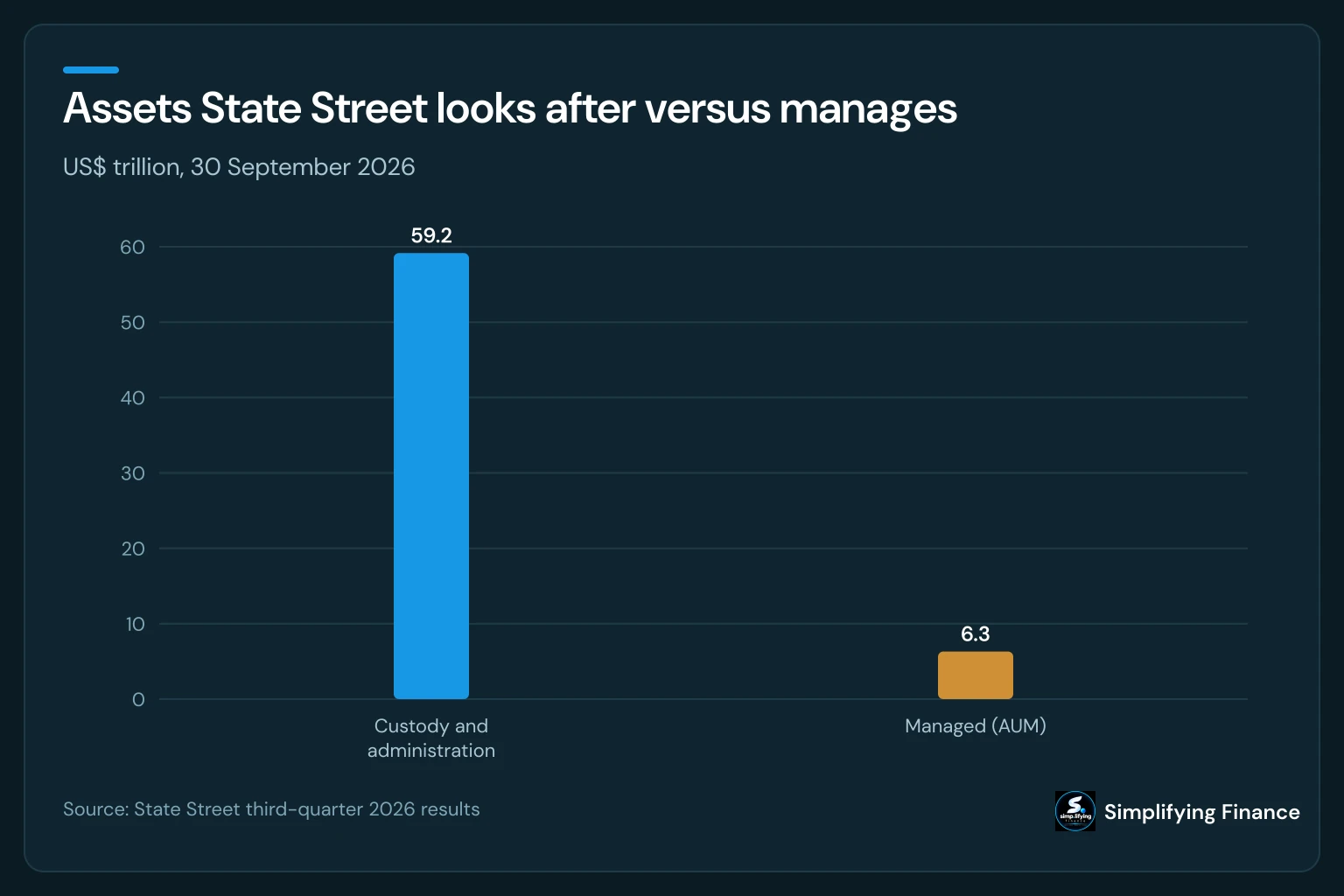
State Street is one of the world's largest custody banks. A custodian holds and safeguards securities for other investors, such as pension funds, mutual funds and insurers, settles their trades, collects dividends and keeps records. State Street reported a record US$59.2 trillion of assets under custody and/or administration at the end of September 2026, up about 15% in a year.
Those assets do not belong to State Street, and it does not decide how they are invested. They belong to its clients, many of whom use other managers. Custody is the behind-the-scenes infrastructure that lets the investment system work.
See the numbers behind the chart
| Measure | US$ trillion |
|---|---|
| Custody and administration | 59.2 |
| Managed (AUM) | 6.3 |
Asset management
State Street's investment arm, now called State Street Investment Management, reported a record US$6.31 trillion of assets under management at the end of September 2026, up about 16% in a year. That figure includes about US$172 billion of assets in SPDR products for which a State Street affiliate acts solely as marketing agent.
Much of this money is in index funds and ETFs run for institutions and individuals, and in target-date and other retirement products. Morningstar's target-date research notes that State Street is among the leading providers of target-date collective investment trusts used in workplace retirement plans.
The first US ETF
In 1993, State Street's SPDR range launched the first US-listed exchange-traded fund, which tracks the S&P 500 index. It remains one of the largest and most heavily traded funds in the world. Its launch began the ETF revolution that has since brought low-cost, exchange-traded diversification to investors everywhere.
Why the distinction matters
Headlines often combine figures such as custody assets and managed assets, but they measure very different things. Custody figures show how much of the financial system relies on a firm's services; managed assets show how much money a firm is actually investing. When comparing the giants, it is important to use like-for-like measures.
The same applies to an individual's own finances. The platform or bank where your investments are held is the custodian; the fund manager decides what the money is invested in. Knowing which is which helps you understand your risks and costs.
Gold and other ETFs
Beyond share and bond index funds, State Street's SPDR range includes funds that track commodities such as gold, as well as sector funds. These can be useful building blocks, but they are narrower than broad market funds. A commodity or sector ETF should be sized as a small part of a diversified portfolio rather than its core.
Safeguards for investors
Using a custodian separates investors' assets from the manager's own balance sheet. If a fund manager ran into difficulties, the securities held for its funds at a custodian would generally remain the property of the fund's investors. This separation is one of the protections built into the fund system, and it is one reason large investors use specialist custodians.
Index funds for institutions
A large part of State Street's managed assets belongs to institutions such as pension funds, central banks and sovereign funds, which use index strategies to hold broad markets at low cost. Many of these clients run their own asset allocation and use State Street, among other managers, to implement it. This is the same approach the guide's sovereign wealth fund and endowment pages describe: decide the mix first, then use low-cost building blocks to put it in place.
For individuals, State Street's SPDR ETFs and other index products serve the same purpose: they are tools for building a diversified mix, not a strategy in themselves.
Trading costs as well as fees
An ETF's yearly fee is not its only cost. Investors also pay the difference between buying and selling prices, known as the bid-ask spread, and the fund may track its index slightly better or worse than expected. Very large, heavily traded ETFs usually have tiny spreads. The library lesson on tracking difference explains how to measure how closely a fund follows its index.
Knowing what you own
A useful exercise is to list each investment you hold, the firm that manages it and the institution that holds it. In many cases these will be different companies. Knowing the roles helps you understand fees, protections and where to look for information, such as the fund's factsheet from the manager and your statements from the platform or bank.
A note on this page
This page describes these firms as fund managers for educational purposes. It is not a recommendation of any firm, fund or service. Figures are taken from each firm's own reports or from named data providers, as of the dates stated.
Custody versus management in one portfolio
Suppose a pension fund has US$1 billion. It keeps all of it with a custodian, which safeguards the securities and processes trades. It hires three asset managers to invest the money: one runs US$500 million in an index fund, another US$300 million in bonds and a third US$200 million in active equities.
| Pension fund assets | US$1 billion |
| Held by custodian | US$1 billion |
| Managed by three managers | US$500m + US$300m + US$200m |
| Risk of double counting | adding custody and managed totals |
In this case, the custodian reports US$1 billion of assets under custody, while each manager reports only the part it manages. Adding custody and managed assets together would count the same money twice.
Where people go wrong
- Adding custody and managed assets. They measure different things and can double count.
- Thinking a custodian chooses investments. Custodians safeguard; managers decide.
- Ignoring where assets are held. Know which institution safeguards your investments.
- Assuming the oldest ETF is best. Compare funds on index, cost and diversification.
- Ignoring trading costs. Spreads and tracking difference add to the yearly fee.
Put it to work
- Find your custodian. Check which institution holds the investments in your accounts.
- Separate roles. Note which firm manages each fund and which holds it.
- Use like-for-like figures. Compare managers on assets under management, not custody.
- Check the spread. Look at the bid-ask spread before buying an ETF.
- Read on. Next: Fidelity.
State Street shows the difference between assets a firm looks after and assets it actually manages. Its custody business holds nearly ten times the money its investment arm manages.
Facts checked against the sources above on 27 November 2026. Figures are as of the dates stated and will change. Worked examples use round illustrative numbers to show the arithmetic, not forecasts. Educational content only, not personal investment advice.