When the cushion failed
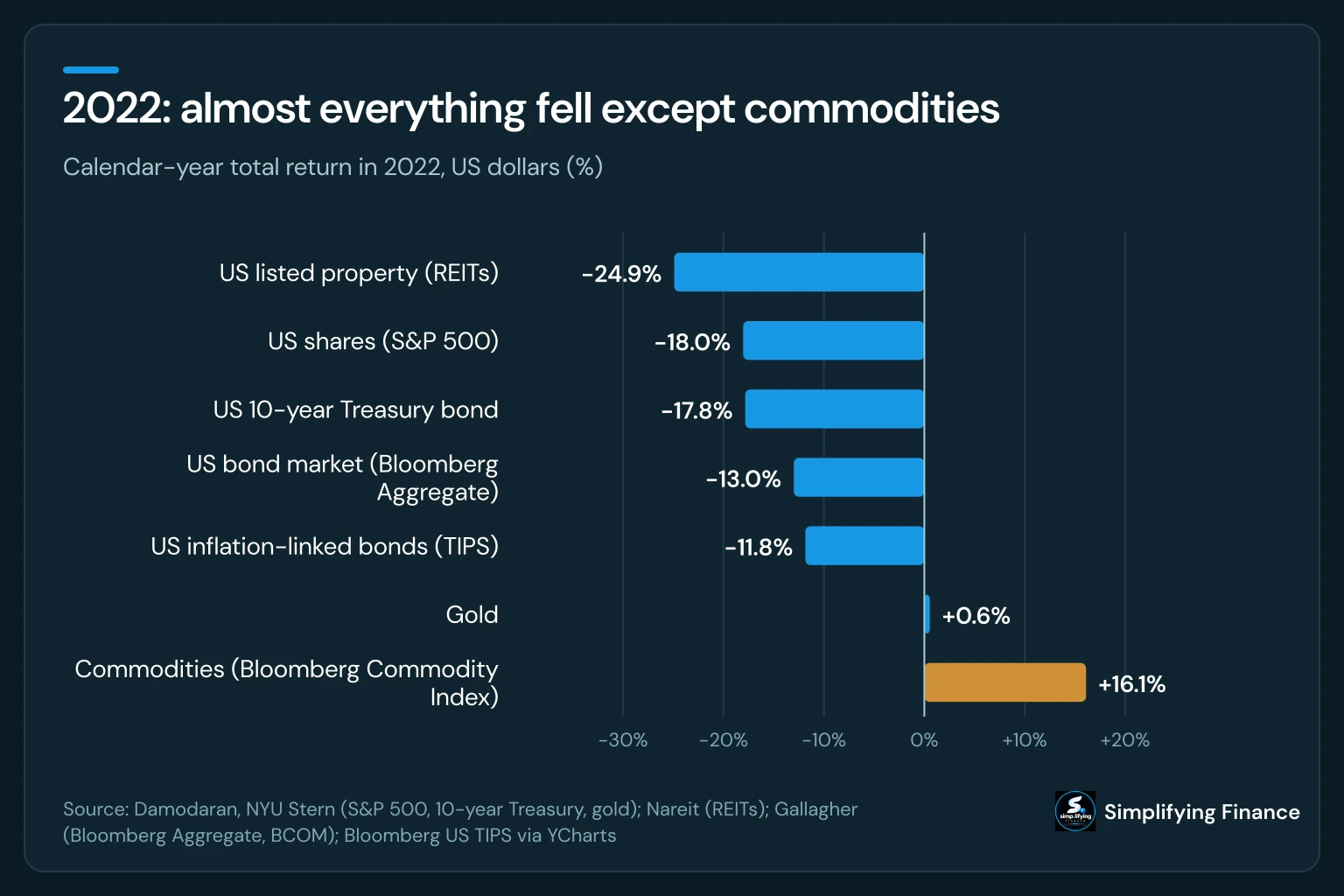
For decades, many investors relied on government bonds to rise when shares fell, as they did in 2008. In 2022 that relationship broke. Damodaran's data show the S&P 500 lost about 18.0% and the US 10-year Treasury bond about 17.8%. Gallagher reports that the broad Bloomberg US Aggregate bond index fell 13%, its steepest annual drop since 1976.
A typical 60/40 portfolio of US shares and Treasuries therefore lost about 18% that year, almost as much as shares alone.
For many savers, it was the first time they had seen both parts of a balanced portfolio fall in the same year.
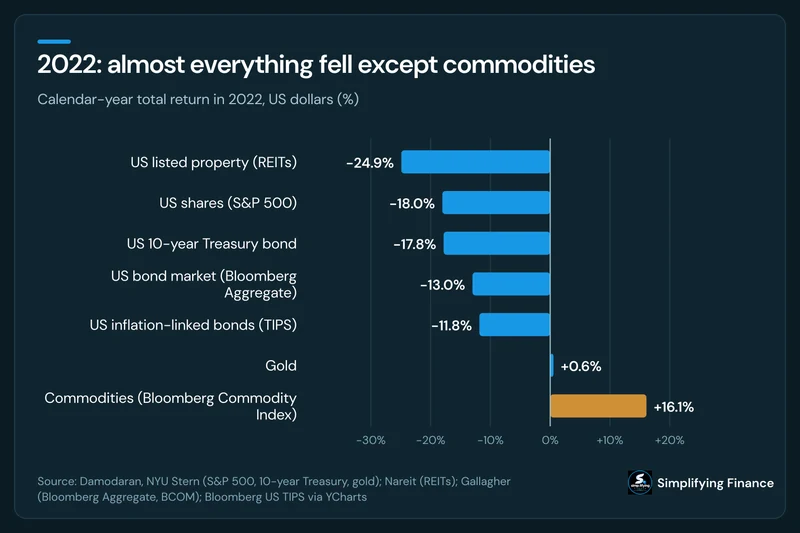
See the numbers behind the chart
| Asset | 2022 return |
|---|---|
| US listed property (REITs) | -24.9% |
| US shares (S&P 500) | -18.0% |
| US 10-year Treasury bond | -17.8% |
| US bond market (Bloomberg Aggregate) | -13.0% |
| US inflation-linked bonds (TIPS) | -11.8% |
| Gold | +0.6% |
| Commodities (Bloomberg Commodity Index) | +16.1% |
Why it happened
The cause was inflation. Prices rose quickly in 2021 and 2022, and central banks raised interest rates sharply to bring inflation down. Rising rates lower the value of existing bonds, as the library lesson on bonds and interest rates explains. They also make future company profits worth less today, which hurts shares, especially growth shares.
In other words, the same force hit both assets at once. That is very different from a growth scare like 2008, when falling rates helped bonds while shares fell.
Inflation was the common enemy of both.
Not just a US story
Bond markets around the world fell in 2022 as central banks in many countries raised rates. The earlier page on currency risk showed that a US-dollar investor in shares outside the US lost about 16% that year in dollar terms, as the strong dollar added to local losses. For investors in other currencies, the experience varied, but very few traditional portfolios escaped without a loss.
Even inflation protection fell
US inflation-linked bonds, which are designed to protect against inflation, also lost about 11.9% in 2022, according to Bloomberg index data via YCharts. As the earlier page on inflation-linked bonds explained, their prices fall when real interest rates jump, even though their payments rise with inflation over time.
US listed property fell too: Nareit reports the FTSE Nareit All Equity REITs index lost 24.9% in 2022.
What held up
Commodities were the main exception. Gallagher reports that the Bloomberg Commodity Index returned about 16.1% in 2022, led by energy. Gold was roughly flat, up about 0.6% in Damodaran's data. Short-term cash also held its value while its yield rose through the year.
Some investment styles also did better than others, as the earlier page on styles and factors showed: value shares fell far less than growth shares in 2022.
A reminder about duration
The size of bond losses in 2022 depended heavily on their length. Short-term bonds and Treasury bills lost little or even gained as their yields rose, while long-term bonds fell much further than the 10-year bond. The earlier page on inflation-linked bonds showed the same pattern among TIPS, where long-dated bonds fell far more than short ones.
Investors who held shorter bonds, or a mix of maturities, had a gentler experience than those concentrated in long bonds.
What it means for building a portfolio
2022 showed that a portfolio built only for one kind of crisis can be caught out by another. Government bonds protect well against deflationary shocks and recessions. They protect poorly against inflation shocks. Commodities, inflation-linked bonds held to maturity, short-term cash and some real assets can help when inflation is the problem, though each has its own drawbacks.
The stagflation lesson in the library looks at the rare combination of high inflation and weak growth, which tends to be hardest for traditional portfolios.
Keeping perspective
Years like 2022 are rare. Damodaran's data show that 2022 was one of very few years since 1928 in which both US shares and 10-year Treasuries lost money. Bonds also became more attractive afterwards, because higher yields mean higher future income. The 10-year Treasury returned about 3.9% in 2023 and 7.8% in 2025, according to Damodaran.
Diversification still helped
It is tempting to conclude that diversification failed in 2022. A fairer reading is that one particular kind of diversification, US shares plus long US government bonds, failed in that particular kind of year. Portfolios that also held commodities, short-term cash, value shares or other currencies did better. The lesson is to diversify across sources of risk, not only across the two most familiar asset classes.
Two mixes in 2022
Take a saver in Canada with C$ 100,000. Use Damodaran's 2022 returns for US shares and 10-year Treasuries and Gallagher's figure for commodities, as an illustration and ignoring currency.
| 60% shares, 40% Treasuries | about -C$ 17,960 |
| 55% shares at -18.04% | about -C$ 9,920 |
| 35% Treasuries at -17.83% | about -C$ 6,240 |
| 10% commodities at +16.1% | about +C$ 1,610 |
A 60/40 mix of shares and Treasuries would have lost about C$ 17,960. A mix of 55% shares, 35% Treasuries and 10% commodities would have lost about C$ 14,550: about C$ 9,920 on shares and C$ 6,240 on bonds, offset by about C$ 1,610 gained on commodities. The small commodity slice reduced the loss by about C$ 3,400.
Where people go wrong
- Assuming bonds always rise when shares fall. In inflation shocks they can fall together.
- Relying on one defensive asset. Different crises need different defences.
- Abandoning bonds after one bad year. Higher yields after 2022 meant higher future bond income.
- Chasing commodities after a strong year. They fell about 7.9% in 2023 after 2022's gains.
- Holding only long bonds as a defence. Long bonds fell the most when rates rose.
Put it to work
- Name your defences. List which assets you rely on in a recession and which in an inflation shock.
- Check bond duration. Longer bonds fall more when rates rise; know what you hold.
- Consider a mix of defences. Think about cash, inflation-linked bonds or real assets alongside government bonds.
- Mix bond lengths. Consider holding bonds of different maturities rather than only long ones.
- Read on. The next page looks at the opposite problem: over-diversification.
When the shock is inflation and rising rates, bonds can fall with shares. A portfolio needs defences for more than one kind of storm.
Facts checked against the sources above on 27 November 2026. Figures are as of the dates stated and will change. Worked examples use round illustrative numbers to show the arithmetic, not forecasts. Educational content only, not personal investment advice.