Diminishing returns
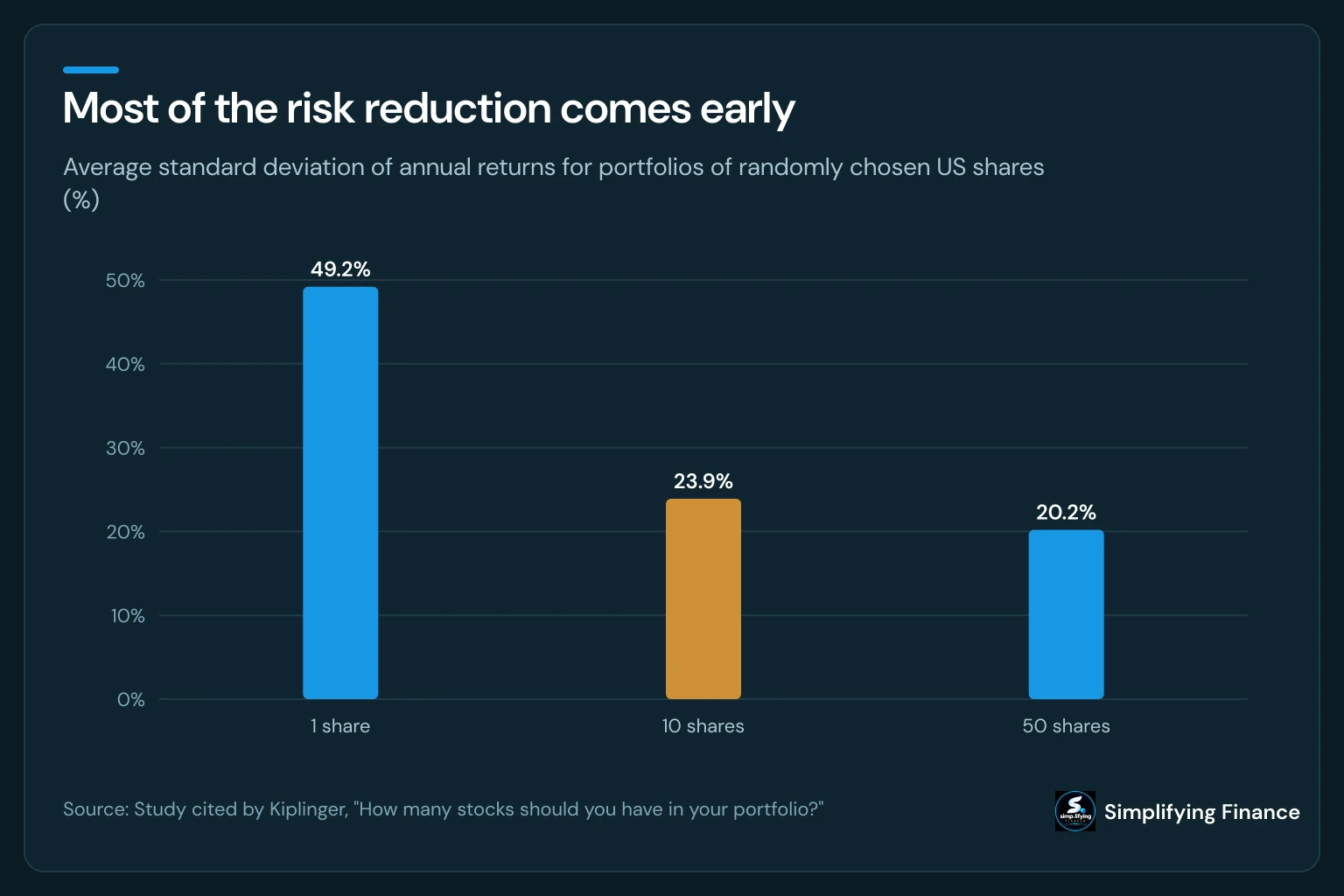
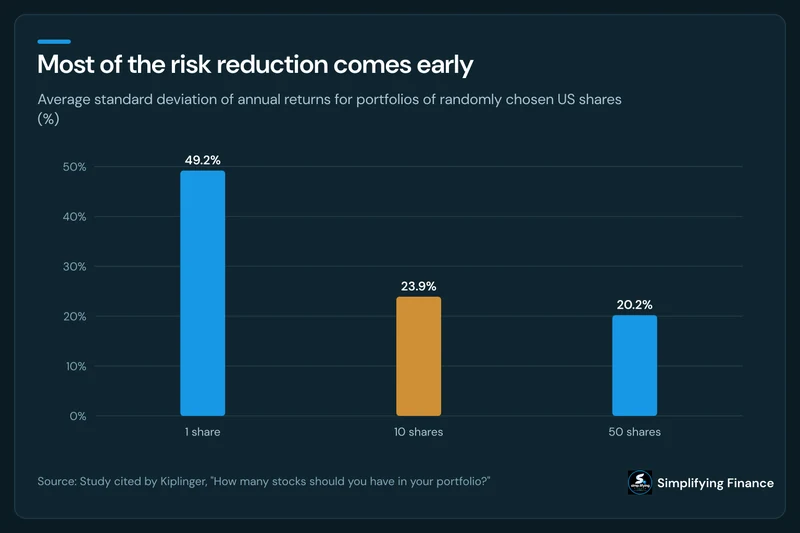
The earlier page on how many holdings are enough showed that spreading money across more shares reduces company-specific risk. But the benefit shrinks quickly. Kiplinger, citing an academic study, reports that the standard deviation of a one-share portfolio was about 49.2%, falling to about 23.9% with 10 shares, but only to about 20.2% with 50.
Meir Statman's 1987 study in the Journal of Financial and Quantitative Analysis argued that at least 30 shares are needed for a well-diversified portfolio, and 40 for some investors, more than the ten often quoted before. Either way, the gain from adding shares beyond a few dozen is small, and the remaining risk is market risk, which no amount of share-picking removes.
See the numbers behind the chart
| Portfolio size | Volatility |
|---|---|
| 1 share | 49.2% |
| 10 shares | 23.9% |
| 50 shares | 20.2% |
What "diworsification" means
The term was popularised by the fund manager Peter Lynch to describe companies that expand into unrelated businesses and become worse at all of them. Investors now use it for portfolios that hold so many funds, shares or strategies that the extra holdings add cost and confusion without reducing risk.
How it happens
It usually happens gradually. An investor adds a fund recommended by a friend, another after reading a news story, a third because it did well last year. Each seems reasonable on its own. After a few years the portfolio holds ten or fifteen funds, many of which own the same large companies, as the earlier pages on overlap and the top 10 showed.
The case of overlapping managers
Some investors try to diversify by holding several actively managed funds with different managers. But if each manager holds 50 to 100 shares from the same broad market, the combined portfolio often ends up looking like the index, while still paying active fees on every fund. The library lesson on index funds versus active funds explains why that combination is usually expensive for what it delivers.
The costs of too much
Over-diversification has several costs. Each fund charges its own fee, and specialist funds usually charge more than broad ones. More holdings mean more transactions, more paperwork and, in some countries, more complicated tax. And a portfolio of many overlapping funds often behaves like a single broad index fund, only at a higher cost.
There is also a behavioural cost. A portfolio too complicated to understand is hard to rebalance and easy to tinker with.
Diversification versus dilution
There is a useful distinction between diversification and dilution. Diversification adds holdings that behave differently and reduce risk. Dilution adds holdings that behave much the same and simply spread the same exposure more thinly, often at extra cost. The first improves a portfolio; the second only makes it more complicated.
When more holdings do help
More holdings are genuinely useful when they add something new: a market you do not yet own, a different asset class, or a way of reducing reliance on a few large companies. The aim is not to have as few holdings as possible, but to make sure every holding earns its place. A portfolio of three funds that each do a distinct job is usually better diversified, and cheaper, than one of twelve that mostly repeat each other.
Too few versus too many
This is not an argument for concentration. The pages on famous concentration losses and on betting twice on your employer show how much damage too little diversification can do. The goal is enough diversification, achieved simply: a small number of broad funds that each do a distinct job.
A simpler alternative
For many investors, two to five broad funds can provide wide diversification: for example, a global share fund, a bond fund in their own currency and perhaps a cash or inflation-linked holding. A single broad global fund already holds thousands of companies across dozens of countries. The library lessons on naive diversification and index funds versus active funds explore how to keep a portfolio both broad and simple.
How many funds is enough?
There is no magic number, but a useful test is whether you can explain in one sentence what each fund does that the others do not. A global share fund, a home-currency bond fund and a cash or inflation-linked holding each pass that test. A fifth large-company growth fund on top of three others probably does not.
Simplicity also makes the rest of this guide easier to apply: rebalancing, checking overlap and avoiding drift all become quicker with fewer moving parts.
Twelve funds or three?
Take a saver in Nigeria with ₦10,000,000 spread across twelve share funds with an average yearly fee of 1.2%. Most hold the same large global companies. These are illustrative numbers.
| Portfolio | ₦10,000,000 |
| Twelve funds at 1.2% a year | about ₦120,000 in fees |
| Three broad funds at 0.3% a year | about ₦30,000 in fees |
| Yearly saving | about ₦90,000 |
Replacing them with three broad funds charging an average of 0.3% would cut yearly fees from about ₦120,000 to about ₦30,000, a saving of about ₦90,000 a year, while keeping similar diversification. Over twenty years, at the same returns, that saving compounds into a meaningful difference.
Where people go wrong
- Counting funds instead of exposures. Many funds can hold the same companies.
- Adding a fund for every new idea. Each addition should do a job the others do not.
- Ignoring the fee total. Small fees across many funds add up.
- Swinging to too few holdings. Concentration has its own, larger dangers.
- Holding many active funds in one market. Together they may cost more and look like the index.
Put it to work
- List every holding. Write down each fund and what job it does.
- Look for duplicates. Use fact sheets to spot funds that hold the same top companies.
- Simplify deliberately. Consider combining overlapping funds, minding any tax on sales.
- Apply the one-sentence test. For each fund, write one sentence on what it adds that the others do not.
- Read on. The next page looks at false diversification: many funds, one bet.
The first few holdings remove most of the risk diversification can remove. After that, more names often means more cost, not more safety.
Facts checked against the sources above on 27 November 2026. Figures are as of the dates stated and will change. Worked examples use round illustrative numbers to show the arithmetic, not forecasts. Educational content only, not personal investment advice.