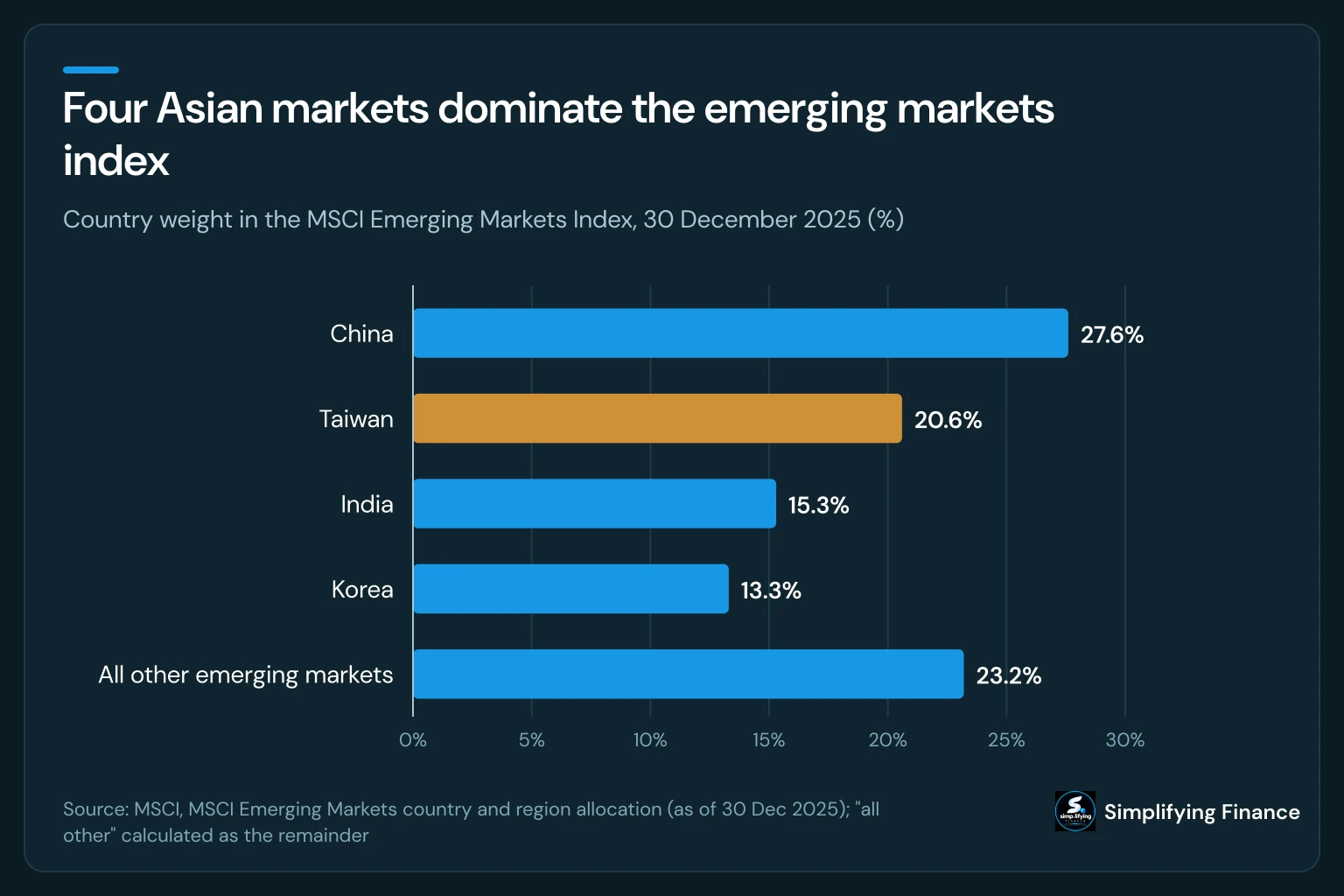
Four markets, most of the index
According to MSCI, at the end of 2025 China made up about 27.6% of the MSCI Emerging Markets Index, Taiwan 20.6%, India 15.3% and Korea 13.3%. Together these four markets were about three-quarters of the index, and Asia-Pacific as a whole about 80.6%.
That means an "emerging markets" fund is, in practice, largely an Asian fund, with smaller holdings in Latin America, Europe, the Middle East and Africa.
The name can mislead.
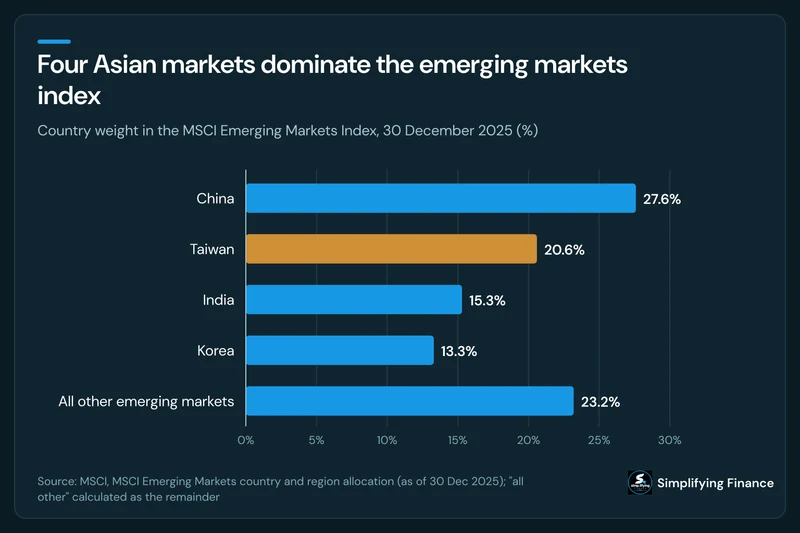
See the numbers behind the chart
| Market | Weight |
|---|---|
| China | 27.6% |
| Taiwan | 20.6% |
| India | 15.3% |
| Korea | 13.3% |
| All other emerging markets | 23.2% |
Weights shift quickly
The mix changes fast. MSCI reported that by April 2026 Taiwan had become the largest country in the index. Focus Taiwan reports that MSCI raised Taiwan's weight to 26.85% in its August 2026 review, and that TSMC alone was the largest stock in the index at 15.46%. The Taipei Times reported in May 2026 that India's weight had fallen to about 12% from 19% the previous year.
These moves reflect share prices, index rule changes and the inclusion or exclusion of particular shares. They can change a fund's country mix substantially within a year or two.
A fund bought for one reason can drift into something rather different.
Concentration inside the markets
Several of these markets are themselves concentrated. The earlier page on one-giant markets showed that TSMC makes up more than 40% of Taiwan's main index. Tom's Hardware reports that Samsung and SK hynix account for nearly half of the weighting of Korea's KOSPI. Both markets are therefore heavily tied to the global chip cycle.
China and India are broader, with large weights in financials, consumer and internet companies, but each comes with its own policy, currency and market-access considerations.
That is worth knowing.
Access and rules
Each of these markets has its own rules for foreign investors. Some shares are available to foreigners only through particular share classes, listings abroad or special access programmes, and index providers adjust weights to reflect what foreign investors can actually buy. These rules change from time to time, which is one more reason country weights can move.
For individual investors, the practical point is that a fund handles this access, but the rules still affect what the fund can hold and how its weights are set.
Their economic ties to each other, through supply chains and trade, also mean that a shock in one can spill into the others.
A changing story over decades
The make-up of the emerging markets index has changed repeatedly. MSCI's historical charts show that China, Taiwan, India, Korea and Brazil have each risen and fallen in weight over the past fifteen years. Any fund tracking the index will keep shifting with them, so its future mix may look quite different from today's.
Four different stories
Although they are grouped together, these four markets are very different. They have different currencies, interest rates, sector mixes, regulations and links to the global economy. In some years they move together; in others they diverge sharply. Holding all four spreads risk, but not as much as their number might suggest when two of them depend heavily on the same industry.
Beyond the big four
The remaining quarter of the index spreads across many countries, including Brazil, Saudi Arabia, South Africa, Mexico, Indonesia, Malaysia, Thailand and others. Each is small on its own, but together they add exposure to commodities, banking and consumer markets in different regions. Investors who want more of them usually need a fund that caps the largest countries or a separate regional fund.
Options for investors
Investors who want broader exposure sometimes combine a standard emerging markets fund with funds that cap country or company weights, or hold individual regional funds in chosen proportions. Others accept the market weights. As elsewhere in this guide, the key is to look at what the fund actually holds and decide whether that matches your intentions.
Investors who live in one of these countries should also count their home exposure, as the page on home bias explained.
Putting it together
An emerging markets fund can be a useful part of a diversified portfolio, but its contents are more concentrated than its name suggests. Knowing that four Asian markets dominate it, and that a few chip makers are a large slice, helps you decide how much to hold and whether to add anything alongside it.
What a small emerging slice really holds
Take a saver in Egypt with E£ 500,000 in shares, of which E£ 50,000 is in an emerging markets fund. Use the MSCI weights from the end of 2025.
| China at 27.6% | about E£ 13,800 |
| Taiwan at 20.6% | about E£ 10,300 |
| India at 15.3% | about E£ 7,650 |
| Korea at 13.3% | about E£ 6,650 |
| All other emerging markets | about E£ 11,600 |
Of the E£ 50,000, about E£ 13,800 is in China, E£ 10,300 in Taiwan, E£ 7,650 in India and E£ 6,650 in Korea, leaving about E£ 11,600 for every other emerging market combined, including Egypt itself. Knowing this helps the saver judge whether the fund adds the spread they expected.
Where people go wrong
- Assuming "emerging markets" means evenly spread. Four Asian markets make up about three-quarters of the main index.
- Ignoring single-company weights. One chip maker was over 15% of the index in 2026.
- Treating Asia as one market. China, India, Korea and Taiwan differ in currency, sectors and rules.
- Forgetting that weights change. Country weights can shift several percentage points within a year.
- Overlooking access rules. What foreign investors can buy shapes the index weights.
Put it to work
- Open the fact sheet. Check the country and top-holding weights of any emerging markets fund you hold.
- Look at sector overlap. Note how much of the fund is in technology and chips.
- Recheck yearly. Country weights change; review them at least once a year.
- Note the top five holdings. Check how much of the fund sits in its five largest companies.
- Read on. The next page looks at frontier and smaller growing markets.
An emerging markets fund is now mostly four Asian markets, and increasingly a few large chip makers. Look inside before treating it as broad diversification.
Facts checked against the sources above on 27 November 2026. Figures are as of the dates stated and will change. Worked examples use round illustrative numbers to show the arithmetic, not forecasts. Educational content only, not personal investment advice.