What frontier markets are
Index providers use the label "frontier" for stock markets that are smaller, less liquid or less accessible than emerging markets. MSCI's Frontier Markets Index covers 28 countries, including Vietnam, Romania, Morocco, Kazakhstan, Kenya, Nigeria, Bangladesh, Sri Lanka and several Baltic and West African markets. The library lesson on emerging markets explains how countries are grouped.
The label describes the stage of a stock market, not the quality of a country's economy or the ambition of its companies.
See the numbers behind the chart
| Country | Weight |
|---|---|
| Vietnam | 31.2% |
| Romania | 13.7% |
| Morocco | 9.1% |
| Slovenia | 6.4% |
| Kazakhstan | 6.3% |
| All other frontier markets | 33.3% |
Tiny in global terms
Frontier markets are very small compared with the rest of the world. MSCI's May 2026 factsheet put the total market value of its Frontier Markets Index at about US$211 billion, spread across 247 companies. By comparison, MSCI's all-country index including frontier markets was worth more than US$115 trillion in mid-2026. In a global portfolio held at market weights, frontier markets would be a fraction of one percent.
Many different economies
The countries in the frontier group differ enormously. Some are in Eastern Europe and closely linked to the European Union; others are in Africa, the Middle East or Asia, with their own currencies and economic cycles. Vietnam's market, the largest in the index, is driven by manufacturing exports and domestic growth, while Romania's is heavily weighted towards banks and energy. That variety is part of the appeal, but it also means a frontier fund is several very different stories bundled together.
Concentrated, despite many countries
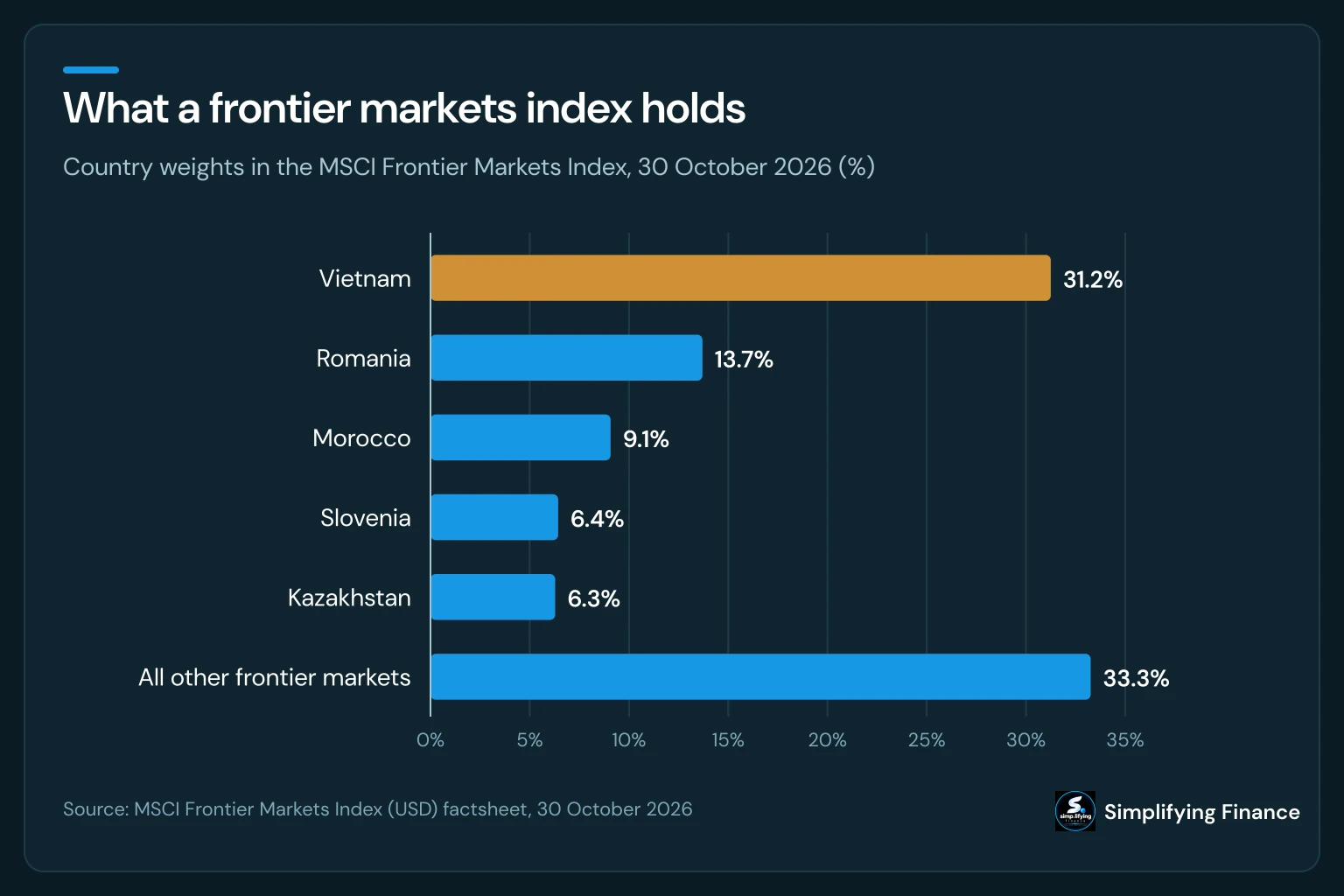
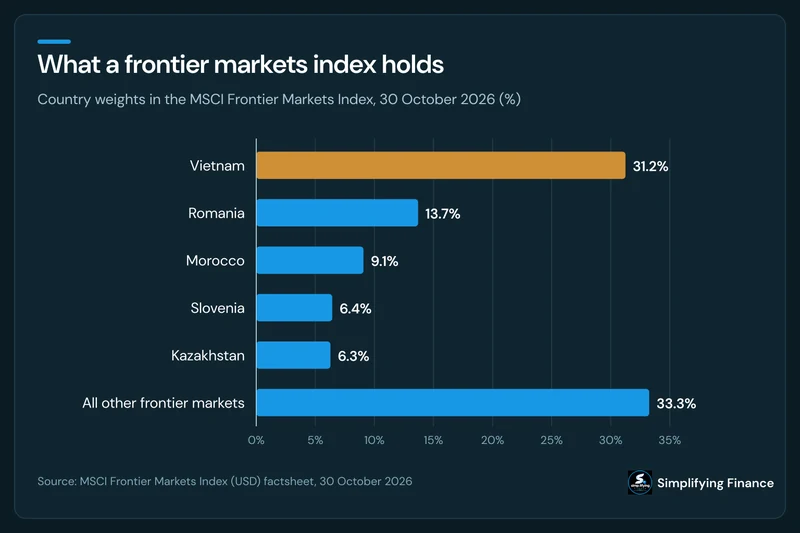
Although the index covers 28 countries, it is dominated by a few. At the end of October 2026, Vietnam made up about 31% of it, Romania about 14% and Morocco about 9%, with Slovenia and Kazakhstan around 6% each. Financials are also heavily represented: about 36% of the index in October 2026, with real estate another 15%.
So a frontier fund is not an even spread across many small economies. It is a significant bet on a handful of markets and on their banks.
Why some investors hold them
Frontier markets are often driven by local factors: domestic demand, local banking systems, commodity exports and national reforms. Their returns have tended to move less closely with large developed markets than emerging markets do. For an investor who already holds broad global shares, a small frontier slice can add exposure that is genuinely different.
Markets move between groups
The frontier list changes over time. MSCI publishes regular reviews that add and remove companies, and countries are reclassified as their markets develop or as access for foreign investors changes. In recent years, several markets have moved between the frontier, emerging and standalone categories. When that happens, index funds must buy or sell, which can cause sharp price moves around the change.
This is one reason frontier weights shift more than developed-market weights, and why a frontier fund's country mix can look different from one year to the next.
The risks
The trade-offs are real. Frontier markets can be hard to trade, with wide price gaps between buying and selling and, at times, limits on taking money out of the country. Currencies can be volatile or managed. Company information may be less detailed, and some markets have only a few large listed companies. Countries also move in and out of the frontier group as they are upgraded, downgraded or lose access.
Fees for frontier funds are usually higher than for broad index funds, reflecting the cost of trading in these markets.
If you live in one
For savers who live in a frontier economy, the picture is reversed. Their job, home and local savings are already tied to that market. For them, the diversification question is usually how to add exposure outside it, within local rules, rather than how to add more of it.
Where frontier fits in a plan
For most investors, the order of priorities matters. A broad global share fund, a bond holding in your own currency and an emergency fund come first. Only after those foundations are in place does a small frontier slice make sense, and even then many diversified investors choose to leave it out. Holding nothing in frontier markets is a perfectly reasonable choice; holding a large amount is rarely one.
A frontier slice in context
Take a saver in Pakistan with PKR 5,000,000 in shares, of which PKR 4,500,000 is in a global fund and PKR 500,000 (10%) in a frontier fund. Use the October 2026 MSCI weights.
| Frontier fund | PKR 500,000 |
| Vietnam at 31.25% | about PKR 156,000 |
| Romania at 13.7% | about PKR 69,000 |
| Morocco at 9.07% | about PKR 45,000 |
Of the frontier slice, about PKR 156,000 would be in Vietnam, PKR 69,000 in Romania and PKR 45,000 in Morocco. If the saver also holds Pakistani shares directly, they would be adding frontier exposure on top of a home market that is already part of the frontier group.
Where people go wrong
- Treating "28 countries" as even diversification. The five largest make up about two-thirds of the index.
- Ignoring liquidity. Frontier shares can be hard to sell quickly or at a fair price.
- Overweighting a tiny market. At market weights frontier markets are a fraction of one percent of world shares.
- Adding more of your own market. If you live in a frontier economy, you may already have plenty of exposure.
- Expecting smooth returns. Frontier markets can swing sharply on local politics, currencies or commodity prices.
Put it to work
- Decide if you need it. Ask what a frontier slice would add that your current funds lack.
- Keep it small. If you add one, size it so a large fall would not derail your plan.
- Check costs and access. Compare fees and read how the fund handles hard-to-trade markets.
- Build the core first. Make sure broad shares, bonds and cash are in place before adding a frontier slice.
- Read on. Part 7 begins: 2008, when correlations jumped.
Frontier markets add genuinely different exposure, but they are small, less liquid and concentrated. For most investors they are an optional extra, not a core holding.
Facts checked against the sources above on 27 November 2026. Figures are as of the dates stated and will change. Worked examples use round illustrative numbers to show the arithmetic, not forecasts. Educational content only, not personal investment advice.