What false diversification looks like
False diversification is owning several investments that look different but move together because they hold the same things or depend on the same drivers. A portfolio of a US large-company fund, a US technology fund and a US growth fund can feel spread out, yet much of the money may sit in the same handful of companies.
The comfort comes from the number of funds; the risk comes from what they share.
See the numbers behind the chart
| Measure | Share |
|---|---|
| Nasdaq-100 fund holdings also in the S&P 500 fund, by weight | about 95% |
| Overlap between the two funds, by weight | about 52% |
| S&P 500 fund holdings not in the Nasdaq-100 fund | about 67% |
An example from two popular indices
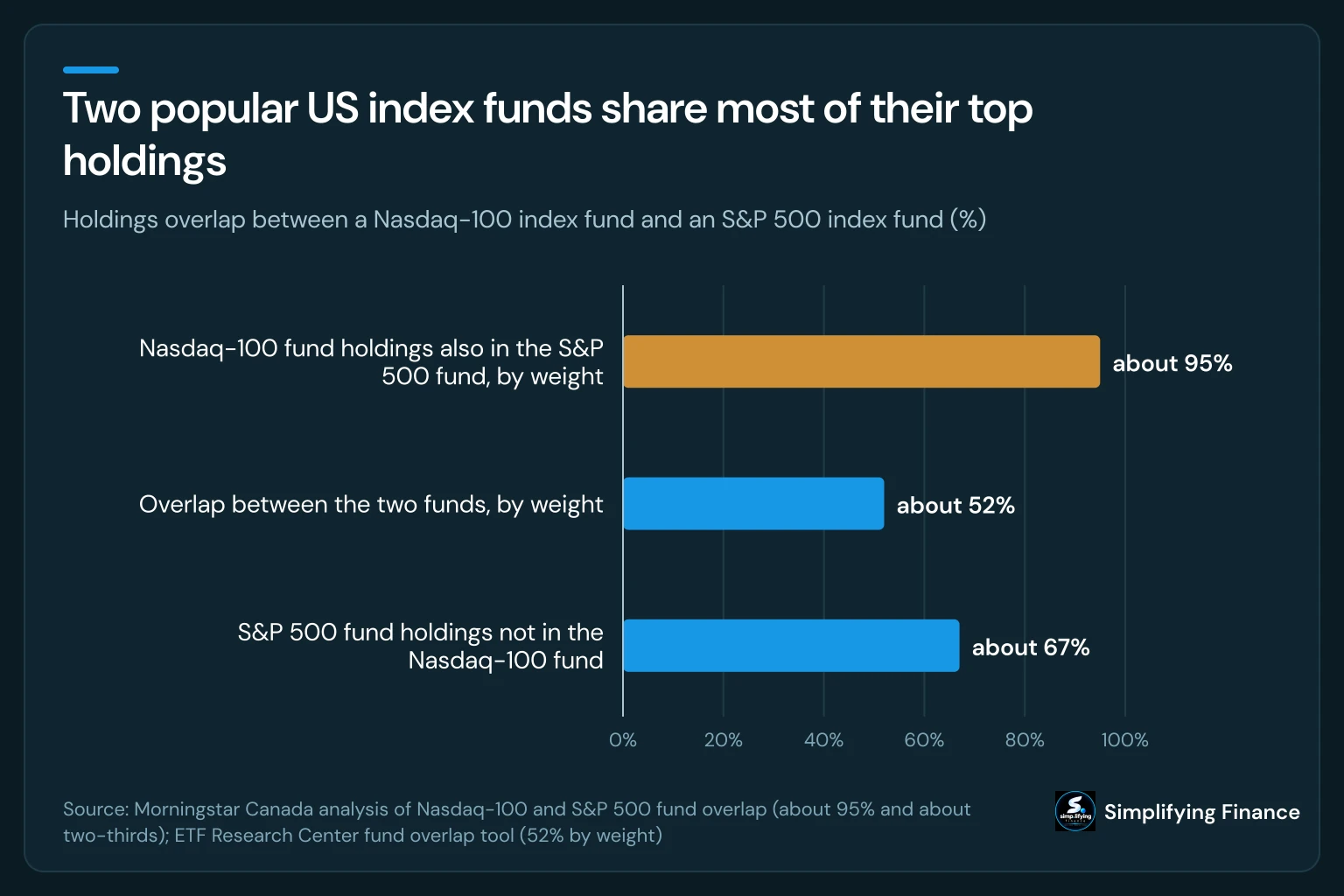
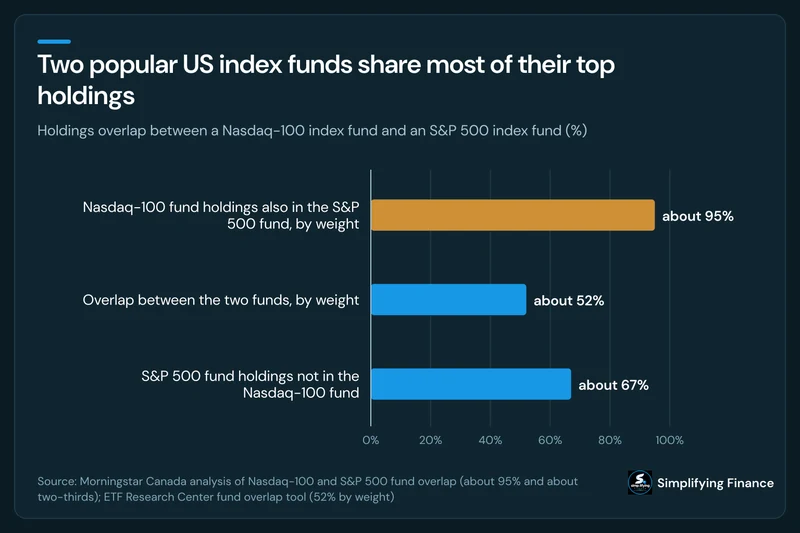
Many investors combine a fund tracking the S&P 500 with one tracking the Nasdaq-100. Morningstar found that only about 5% of a Nasdaq-100 fund's holdings, by weight, were not also held by an S&P 500 fund, while about two-thirds of the S&P 500 fund did not appear in the Nasdaq-100 fund. The ETF Research Center's overlap tool puts the overlap between two such funds at about 52% by weight, with 83 companies in common.
In other words, adding a Nasdaq-100 fund to an S&P 500 fund mostly increases the weight of companies you already own, especially the largest technology firms.
Other hidden overlaps
Overlap is not only about fund holdings. Different assets can share the same driver. A technology fund, shares in your technology employer and a growth-style fund all depend on the same part of the economy. A property fund, a home and a bank fund in the same country may all depend on local interest rates. The earlier pages on human capital and your home covered these.
Countries can overlap too
False diversification also appears across countries. A "world" fund, a "developed markets" fund and a US fund may all be dominated by the same US companies, as the pages on world index overlap and the size of the US showed. Adding a second global fund from a different provider usually adds almost nothing, because both track similar indices.
Style and factor overlap
Funds with different names can also share the same style. A "quality" fund and a "growth" fund may both lean towards large, highly valued companies. Two "income" funds may both lean towards banks and utilities. The page on styles and factors showed how leadership between styles changes, so holding several funds with one style concentrates that risk.
A quick look-through
A "look-through" means treating all your funds as one combined portfolio and asking what it holds in total. Many fund platforms and free tools now offer this. Even without a tool, adding up the top holdings and country weights from each fact sheet gives a good approximation. The answer is often surprising, and it is the most reliable way to see whether you are diversified or just own several labels.
A test for any new fund
Before adding any fund, ask three questions. What will it own that I do not already own? How did it behave in the last major fall compared with what I already hold? And what will it cost each year? If the answers are "not much", "about the same" and "more", the fund is likely to add false diversification rather than real.
How to check
Three checks catch most false diversification. First, look at the top 10 holdings of each fund and note repeats. Second, compare the country and sector breakdowns on each fact sheet. Third, add up your combined exposure to the largest companies and sectors across all funds. Free online overlap tools can help, and the library lessons on fund overlap and fund fact sheets explain the steps.
What real diversification adds
Funds that add genuine diversification usually hold something different: other countries, smaller companies, a different style, bonds, cash or real assets. The question to ask of any new holding is simple: what will this own that I do not already own, and will it behave differently when my main holdings fall?
Real diversification can feel uncomfortable
Genuinely different holdings will sometimes lag badly while your main holdings do well. That is exactly what makes them useful: they behave differently. Investors often drop them after a few years of underperformance and replace them with something that looks more like their best performer, which quietly turns a diversified portfolio back into a concentrated one.
Accepting that some part of a diversified portfolio will always be disappointing is part of the price of diversification.
Three funds, one theme
Take a saver in Kenya with KSh 3,000,000 split equally across an S&P 500 fund, a Nasdaq-100 fund and a global technology fund. Assume, for illustration, that the same five large technology companies make up 25%, 40% and 45% of the three funds.
| S&P 500 fund KSh 1,000,000 at 25% | KSh 250,000 |
| Nasdaq-100 fund KSh 1,000,000 at 40% | KSh 400,000 |
| Tech fund KSh 1,000,000 at 45% | KSh 450,000 |
| Total in five companies | KSh 1,100,000 (37%) |
Those five companies would account for about KSh 1,100,000, or about 37% of the whole portfolio. The saver owns three funds, but more than a third of the money depends on five businesses in one industry and one country.
Where people go wrong
- Judging diversity by fund names. Different names can hold the same companies.
- Adding a "different" fund that tracks a subset. A narrower index inside a broad one adds overlap, not spread.
- Ignoring shared drivers. Assets in one industry or country can fall together.
- Never checking again. Overlap changes as markets move and index members change.
- Dropping the laggard that diversifies you. Holdings that behave differently will sometimes lag; that is their job.
Put it to work
- Compare top 10 lists. Note companies that appear in more than one of your funds.
- Add up your largest exposures. Work out your total weight in the biggest companies and sectors.
- Ask what each fund adds. Keep only funds that hold something genuinely different.
- Expect one part to lag. Accept that a diversified portfolio always has a disappointing part.
- Read on. The next page looks at famous concentration losses.
Diversification is about owning different things, not different fund names. Check what is inside before assuming you are spread out.
Facts checked against the sources above on 27 November 2026. Figures are as of the dates stated and will change. Worked examples use round illustrative numbers to show the arithmetic, not forecasts. Educational content only, not personal investment advice.