What a government bond is
A government bond is a loan to a national government. The government pays interest and returns the money on a set date. Bonds issued by governments with strong finances, in their own currency, are treated as among the safest assets available, because the issuer can almost always pay.
Not every government bond is low-risk. Bonds from governments with weaker finances, or bonds in a currency you do not spend, carry extra risks. This page is about high-quality government bonds in the investor's own currency.
Bond prices and yields move in opposite directions. If you buy a bond paying 4% and new bonds start paying 5%, your bond is worth less to anyone who might buy it from you, so its price falls until its effective yield matches the market.
See the numbers behind the chart
| Year | S&P 500 | 10-year Treasury |
|---|---|---|
| 1931 | -44% | -3% |
| 1937 | -35% | +1% |
| 1974 | -26% | +2% |
| 2001 | -12% | +6% |
| 2002 | -22% | +15% |
| 2008 | -37% | +20% |
| 2022 | -18% | -18% |
Why they often rise when shares fall
In a recession or financial panic, investors rush to safety and central banks usually cut interest rates. Bond prices move in the opposite direction to interest rates, so existing bonds paying higher rates become more valuable. That is why high-quality government bonds have often gained just when shares fell.
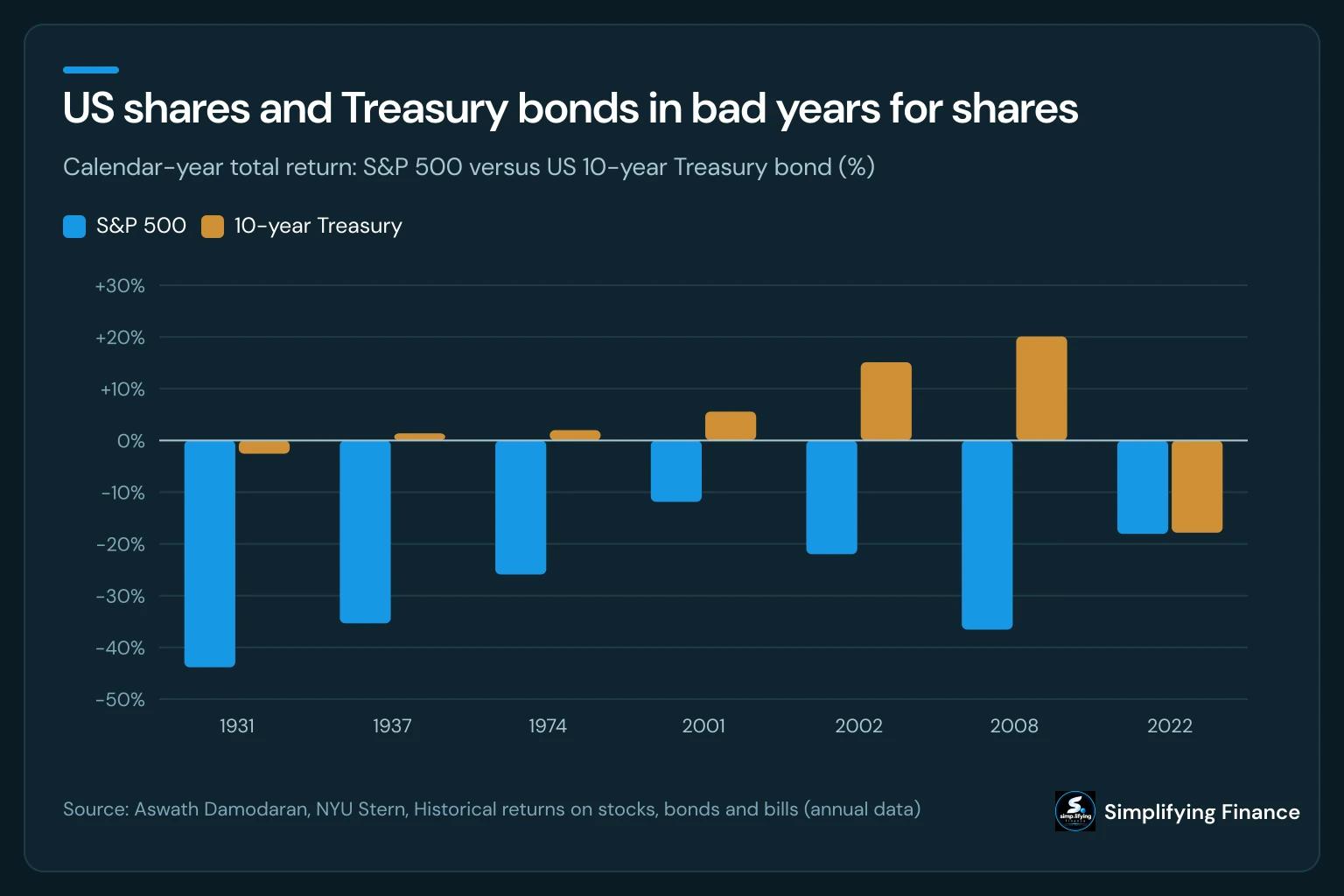
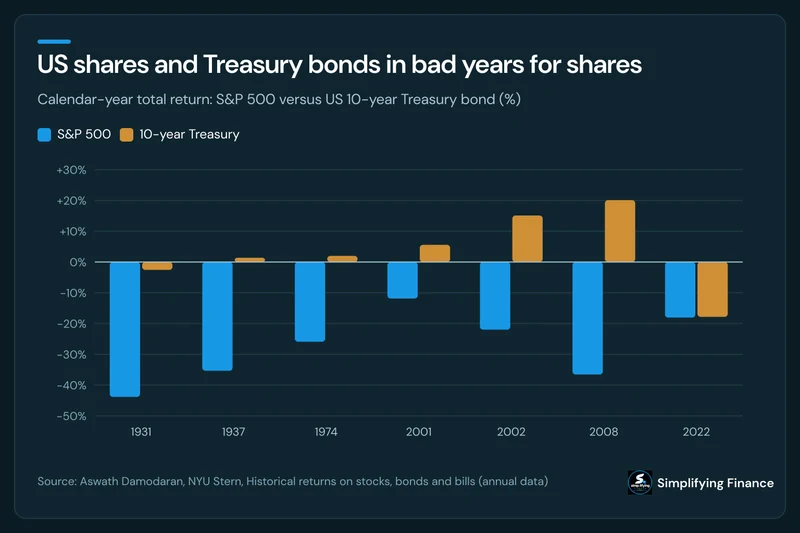
The chart shows US examples from Damodaran's data. In 2002, when the S&P 500 lost about 22%, the 10-year Treasury gained about 15%. In 2008, shares lost about 36.6% and the Treasury gained about 20.1%.
When the cushion fails
The same chart shows the exceptions. In 1931 both fell, although bonds fell far less. In 2022 the Treasury lost about 17.8%, almost as much as shares. The reason was inflation: when prices rise quickly and central banks raise rates sharply, bond prices fall at the same time as shares.
This matches the earlier page on changing correlations. Government bonds are a strong defence against growth shocks and a weak one against inflation shocks.
Income as well as insurance
Government bonds are not only crash insurance. They also pay a steady stream of interest. When yields are high, as they were in many countries after 2022, that income can make up a meaningful part of a balanced portfolio's return. When yields are very low, the income is small and the main reason to hold bonds is their behaviour in a crisis.
Over the very long run their return has been modest. The UBS Yearbook's 2025 edition put world government bonds at about 1.7% a year after inflation from 1900 to 2024, far below shares but above cash.
Duration: how sensitive a bond is
A bond's sensitivity to interest-rate changes is measured by its duration. Long-dated bonds swing more when rates move: they gain more when rates fall and lose more when rates rise. Short-dated bonds move less in both directions.
For a shock absorber, longer bonds give more cushion in a growth scare and more pain in an inflation scare. Many investors hold a spread of maturities, sometimes called a ladder, so they are not betting everything on one direction for interest rates.
Thinking globally
For a saver in India, Brazil or Indonesia, the "safe" bond is usually the government bond of their own country, in their own currency, because that matches the currency they spend. Buying a foreign government bond adds currency risk, which can swamp the cushion in a bad year unless it is hedged.
In euro countries the picture is mixed, because national government bonds share one currency but not one level of credit quality. The page on currency risk returns to these choices.
How much to hold
There is no single right amount. A common starting point in many countries is to hold more bonds as the date you need the money draws closer, so that a share crash late in the plan cannot do too much damage. Someone decades from needing their savings may hold few bonds; someone about to retire may hold many. The page on diversification at every life stage, in Part 8, returns to this.
Whatever the amount, the bond part works best when its job is clear: to provide stability and money that can be used, or rebalanced into shares, when shares are down.
A 70/30 portfolio in 2002
Use Damodaran's 2002 US figures on a portfolio of $50,000, with 70% in the S&P 500 and 30% in 10-year Treasury bonds at the start of the year.
| Shares $35,000 at -21.97% | about -$7,690 |
| Bonds $15,000 at +15.12% | about +$2,270 |
| Portfolio, 2002 | about -$5,420 (-10.8%) |
| Same mix, 2022 | about -18.0% |
The share part, $35,000, lost 21.97%: about $7,690. The bond part, $15,000, gained 15.12%: about $2,270. The portfolio lost about $5,420, or 10.8%, half the loss of an all-share portfolio. In 2022 the same mix would have lost about 18.0%, because bonds fell too.
Where people go wrong
- Assuming all government bonds are safe. Safety depends on the issuer's finances and on the currency. High-quality, own-currency bonds are the shock absorbers.
- Buying only very long bonds. Long bonds give the biggest cushion in a crash and the biggest losses when rates jump.
- Treating 2022 as proof bonds are broken. It shows they do not protect against inflation shocks. They still protected in most growth scares.
- Ignoring currency. Unhedged foreign bonds can move with exchange rates far more than with interest rates.
- Chasing yield abroad. A higher-yielding foreign government bond is a different asset once currency moves are included.
Put it to work
- Check what your bonds are. Note the issuer, currency and typical maturity of any bond fund you own.
- Decide what they protect against. If your main worry is inflation, consider inflation-linked bonds, covered later in Part 2.
- Mix maturities. A spread of short and longer bonds reduces your bet on one direction for interest rates.
- Read on. The next page looks at corporate and high-yield bonds and how they behave in a crisis.
- Plan for rebalancing. Decide in advance that after a large share fall you will use bonds to top shares back up to your target.
Government bonds cushion growth scares well. They cushion inflation scares poorly. Know which you are buying protection against.
Facts checked against the sources above on 27 November 2026. Figures are as of the dates stated and will change. Worked examples use round illustrative numbers to show the arithmetic, not forecasts. Educational content only, not personal investment advice.