Lending to companies
A corporate bond is a loan to a company. Because a company can go bust, investors demand a higher interest rate than on a high-quality government bond. The gap between the two yields is called the credit spread. It is the reward for taking default risk.
Rating agencies grade bonds by their judged chance of default. Bonds rated BBB- (or Baa3) and above are called investment grade. Bonds rated BB+ (or Ba1) and below are called high-yield, or sometimes "junk". Bloomberg, for example, classes a bond as high-yield if its middle rating from Moody's, Fitch and S&P is Ba1/BB+/BB+ or below.
In good times spreads tend to be narrow, because investors feel confident. In bad times they widen sharply, and the prices of existing corporate bonds fall to match.
See the numbers behind the chart
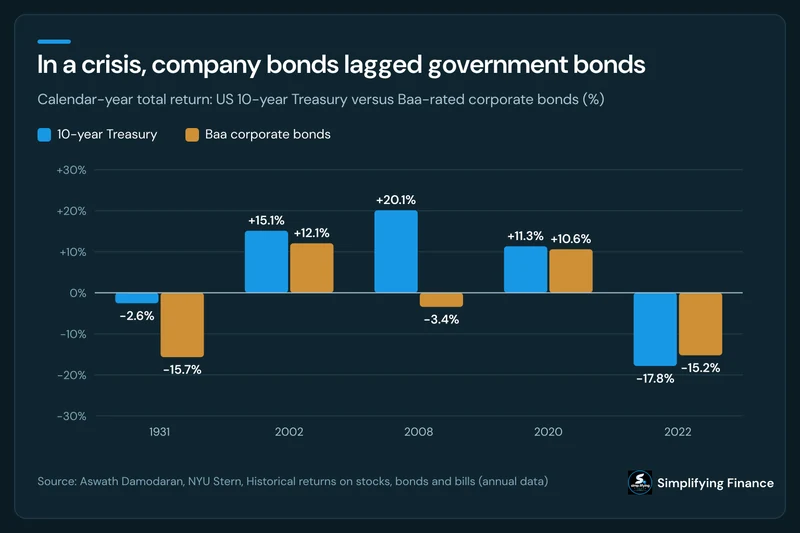
| Year | 10-year Treasury | Baa corporate bonds |
|---|---|---|
| 1931 | -2.6% | -15.7% |
| 2002 | +15.1% | +12.1% |
| 2008 | +20.1% | -3.4% |
| 2020 | +11.3% | +10.6% |
| 2022 | -17.8% | -15.2% |
Why they act partly like shares
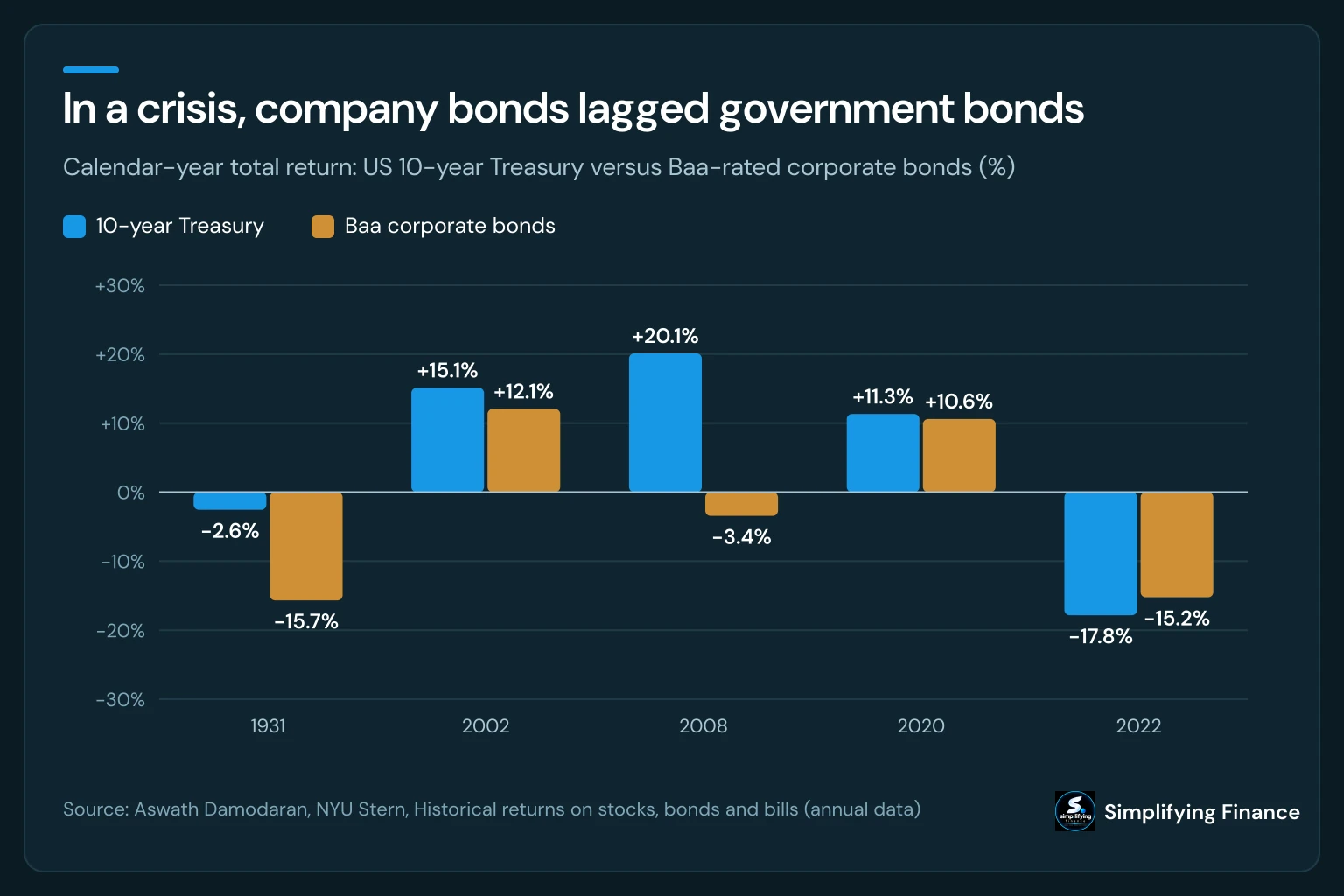
A company's ability to repay its bonds depends on the same things that drive its share price: profits, cash flow and the economy. In a recession, defaults become more likely and credit spreads widen, so corporate bond prices fall even as government bonds rise.
Damodaran's data shows this clearly. In 2008, US 10-year Treasuries gained about 20.1%, while Baa-rated corporate bonds lost about 3.4%: a gap of more than 23 percentage points. In 1931, Treasuries lost about 2.6% while Baa bonds lost about 15.7%.
That gap is the clearest sign of the difference between the two kinds of bond.
High-yield bonds go further
The lower the rating, the stronger the link to shares. High-yield bonds pay the most income and suffer the most in a downturn. In the UK, for example, Morningstar reported that the Merrill Lynch sterling high-yield index fell about 23% in 2008, with the average fund in the sector losing about 24%.
In good years, the extra income and narrowing spreads can make high-yield bonds look attractive. The risk is that much of that extra return can be given back in a single bad year, exactly when a portfolio most needs a cushion.
Treat that income as payment for real risk.
Defaults and recovery
When a company defaults, bond holders usually do not lose everything. They often recover part of their money through a restructuring or the sale of assets, because lenders rank ahead of shareholders. That is one reason corporate bonds tend to fall less than shares in a crisis.
But recoveries vary widely and can take years. In a small portfolio of individual bonds, one default can wipe out several years of extra income. That is why most ordinary investors who want corporate bonds hold them through broad funds that own hundreds of issuers.
When they help
Corporate bonds still play a useful role. Investment-grade corporate bonds add income above government bonds and have often held up reasonably in milder slowdowns. In 2002 and 2020, Baa bonds gained more than 10% in years when US shares struggled or swung wildly.
They also add a different source of return: lending rather than owning. In a long-term portfolio, a mix of government and investment-grade corporate bonds is common.
Where they fit in a diversified portfolio
A useful rule is to think about each bond holding by the job it does. High-quality government bonds are the shock absorber. Investment-grade corporates are income with some shock absorption. High-yield bonds are closer to a share-like income asset and should be counted partly as equity risk when you add up how much risk you carry.
In 2022, as the chart shows, both Treasuries and Baa bonds fell by more than 15%. When inflation is the shock, no kind of fixed-rate bond is a reliable shelter.
Questions to ask before buying
Before adding corporate or high-yield bonds, it helps to ask three questions. What is the average credit rating? How long is the average maturity? And how did this kind of bond behave in 2008 and 2022? If the answers point to something that behaves much like shares, it may be better to count it as part of your share allocation rather than your safe allocation.
This simple step stops a common mistake: believing a portfolio is cautious because it holds a lot of bonds, when many of those bonds would fall alongside shares in a crisis.
Extra income versus crisis risk
Take $10,000 in bonds. Use round illustrative yields: a government bond yielding 4% and a corporate bond yielding 6%. The corporate bond pays an extra $200 a year.
| Extra yearly income from corporate bond | $200 |
| 2008: Treasuries on $10,000 | about +$2,010 |
| 2008: Baa bonds on $10,000 | about -$344 |
| Gap in one year | about $2,354 |
Now apply the actual 2008 returns from Damodaran's data. $10,000 in 10-year Treasuries would have gained about $2,010. $10,000 in Baa corporate bonds would have lost about $344. One bad year cost about $2,354 relative to Treasuries, roughly twelve years of the extra $200 of income.
Where people go wrong
- Counting all bonds as safe. Lower-rated bonds can fall sharply in the same crisis that hits shares.
- Chasing the highest yield. A high yield is a price for risk, not a free gift.
- Forgetting the rating can change. Companies can be downgraded, and bond prices usually fall when that happens.
- Holding few issuers. One company default in a small bond portfolio can wipe out years of extra income. Spread across many issuers.
- Ignoring the economy. Corporate bonds are tied to company health. In a recession, the extra income can be outweighed by price falls.
Put it to work
- Sort your bonds by job. Label each bond holding as shock absorber, income, or share-like income.
- Check credit quality. Look up the average rating of any bond fund you own.
- Count high-yield as partly equity. When you add up your risk, treat high-yield bonds as closer to shares.
- Read on. The next page looks at cash and money-market funds, the simplest asset of all.
- Spread across issuers. If you hold corporate bonds, prefer broad funds over a handful of individual bonds.
Corporate bonds sit between government bonds and shares. The lower the credit rating, the closer they move to shares.
Facts checked against the sources above on 27 November 2026. Figures are as of the dates stated and will change. Worked examples use round illustrative numbers to show the arithmetic, not forecasts. Educational content only, not personal investment advice.