What they are
An inflation-linked bond is a government bond whose principal, and therefore its interest payments, rises with a measure of consumer prices. In the United States they are called Treasury Inflation-Protected Securities (TIPS); the Bloomberg TIPS index starts in 1997. Several other governments issue similar bonds in their own currencies.
If you buy one and hold it to maturity, you know your real return in advance: the yield above inflation that was set when you bought. That is a promise no ordinary bond or share can make.
The catch is that the guaranteed real return only applies if you hold until maturity. Along the way, the market price can rise and fall like any bond, which is the theme of the next section.
See the numbers behind the chart
| Year | Return |
|---|---|
| 2018 | -1.3% |
| 2019 | +8.4% |
| 2020 | +11.0% |
| 2021 | +6.0% |
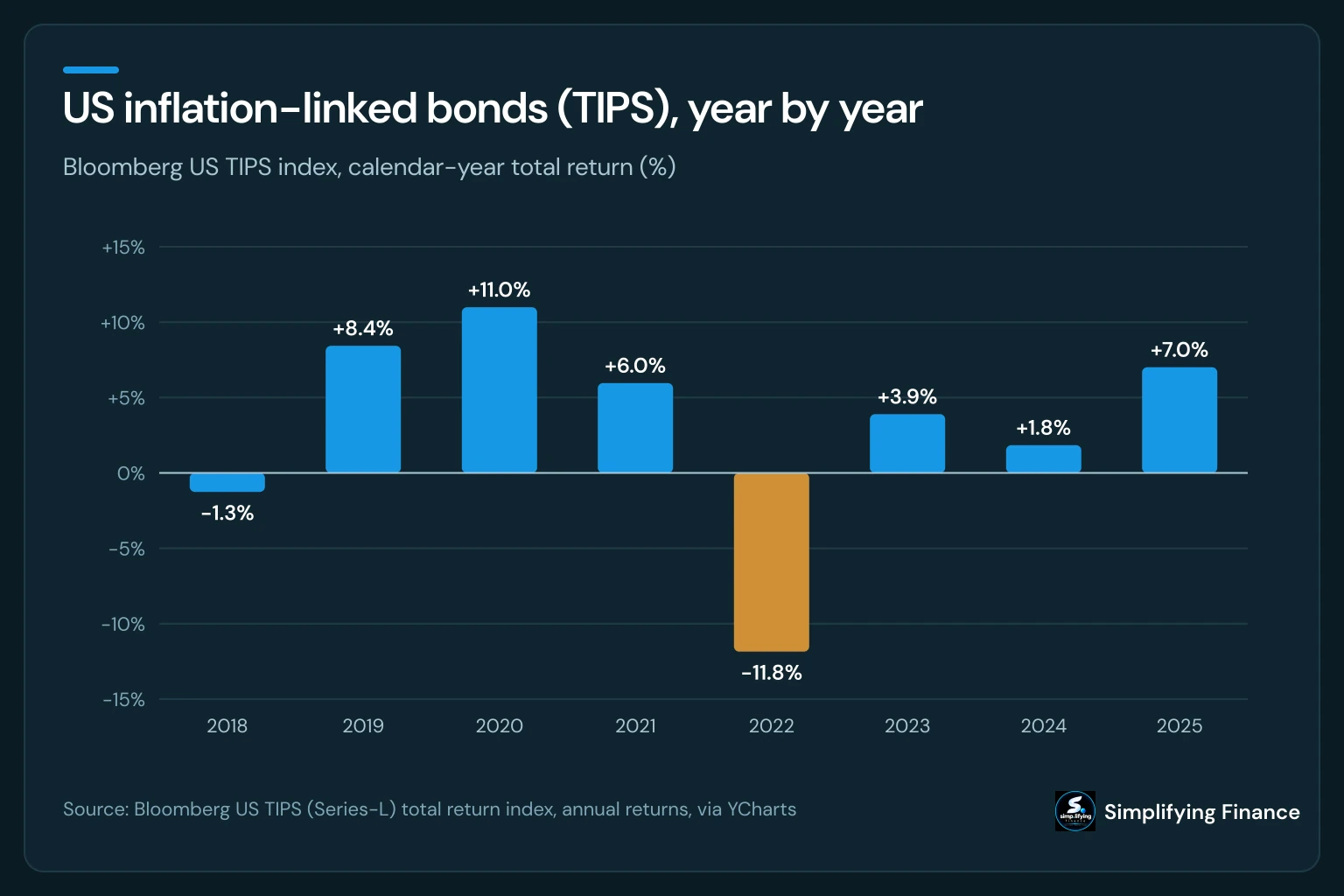
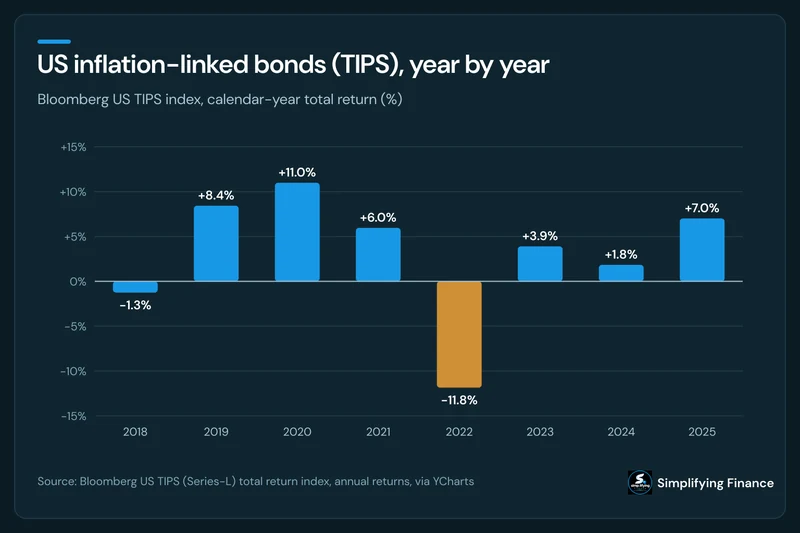
| 2022 | -11.8% |
| 2023 | +3.9% |
| 2024 | +1.8% |
| 2025 | +7.0% |
Why they still fell in 2022
Before maturity, an inflation-linked bond's price moves with real interest rates. When real yields jump, prices fall, just as with ordinary bonds. In 2022 central banks raised rates quickly, and that price effect overwhelmed the extra inflation payments.
Bloomberg notes that its TIPS index fell about 11.8% in 2022, similar to the 12.5% fall in its US Treasury index, even though US consumer prices rose 6.5% over the year. The duration of the bonds, their sensitivity to rates, did the damage.
Short versus long
The length of the bond matters a great deal. Bloomberg reports that short-dated TIPS outperformed their ordinary Treasury counterparts significantly during the post-pandemic inflation shock, because shorter bonds are less sensitive to rate changes. Longer-dated TIPS fell much further: Morningstar reported that its 10-plus-year TIPS index had lost nearly 22% by late July 2022.
For a saver worried about inflation over the next few years, shorter inflation-linked bonds usually match the job better than long ones.
Real yield: the number to watch
The key figure for an inflation-linked bond is its real yield, the return above inflation that you lock in if you hold to maturity. When real yields are close to zero or negative, as they were in many countries before 2022, buyers are paying a lot for protection. When real yields are higher, protection costs less and the bonds offer a positive real return on top.
Comparing the yield on an ordinary government bond with the real yield on an inflation-linked bond of the same length gives the "break-even" inflation rate. If inflation turns out higher than that rate, the inflation-linked bond does better; if lower, the ordinary bond wins.
Where they fit
Earlier pages showed that ordinary government bonds cushion growth scares well and inflation scares poorly. Inflation-linked bonds fill part of that gap. Over the full life of the bond, rising prices raise your payments; in a sudden rate spike, their price can still fall.
They also suit people with spending that rises with prices, such as retirees. Many pension schemes use them to match future payments for that reason.
Check your currency
An inflation-linked bond protects against inflation in the currency it is issued in, measured by that country's price index. A US index tracks US prices; it does not protect a saver in Egypt or Pakistan from inflation at home, and currency moves add another layer of risk. Where your own government issues them, those are usually the closest match.
Using them alongside other bonds
Many diversified portfolios hold both kinds of government bond. Ordinary bonds tend to help most in growth scares and recessions, while inflation-linked bonds help most when inflation surprises upwards. Holding some of each spreads the bet on which kind of shock comes next.
Neither kind replaces shares as a growth engine. Their role is to make the rest of the portfolio easier to hold through difficult years, which is the theme running through this whole part of the guide.
For anyone spending in a currency without its own inflation-linked bonds, a mix of short-term cash and real assets such as shares often does the job instead.
Holding to maturity versus selling early
Take a UK saver with £10,000 in a five-year inflation-linked government bond with a real yield of 1% a year. Assume, for illustration, that prices rise 4% a year for five years.
| Starting amount | £10,000 |
| Principal after 5 years at 4% inflation | about £12,170 |
| Real return if held to maturity | about 1% a year |
| If sold early after a rate jump | can be a loss |
Held to maturity, the principal rises with prices to about £12,170 and the saver also collects interest of roughly 1% a year on that rising amount: a real gain of about 1% a year whatever inflation does. But if real yields jump in year one and the saver sells, the price could be well below what they paid, as 2022 showed.
Where people go wrong
- Expecting them to rise whenever inflation rises. Before maturity, real interest rates drive the price, and they can dominate.
- Buying very long bonds for near-term needs. Long inflation-linked bonds can fall sharply when rates jump.
- Using another country's inflation bond. It protects against that country's inflation, not yours, and adds currency risk.
- Forgetting tax. In some countries the inflation uplift is taxed each year, even though you only receive it at maturity.
- Ignoring the real yield. Buying when real yields are very low or negative locks in a poor real return, even with full inflation protection.
Put it to work
- Find out what your government issues. Check whether inflation-linked bonds exist in your currency and how ordinary savers can buy them.
- Match the term. Line up the bond's maturity with when you expect to need the money.
- Look at fund duration. If you use a fund, check its average maturity and how it fared in 2022.
- Read on. The next page looks at private markets and alternatives, and what ordinary investors should know.
- Note the break-even rate. Compare ordinary and inflation-linked yields of the same length to see what inflation the market expects.
Inflation-linked bonds protect against inflation over their life, not against rising interest rates along the way.
Facts checked against the sources above on 27 November 2026. Figures are as of the dates stated and will change. Worked examples use round illustrative numbers to show the arithmetic, not forecasts. Educational content only, not personal investment advice.