What "private markets" means
Private markets are investments that are not traded on a public exchange. The main types are private equity (buying whole companies or stakes in them), venture capital (young companies), private credit (loans made directly by funds rather than banks), private real estate and infrastructure such as toll roads, ports and power networks.
They are usually reached through funds that lock up investors' money for years. The library lessons on venture capital stages and leveraged buyouts cover how two of these strategies work.
Unlike shares, there is no screen showing a live price. Values come from appraisals, recent deals or models, which is the root of several trade-offs described below.
See the numbers behind the chart
| Year | All private markets | Private credit |
|---|---|---|
| 2020 | $10.0tn | $1.0tn |
| 2024 | $15.1tn | $1.7tn |
How big they have become
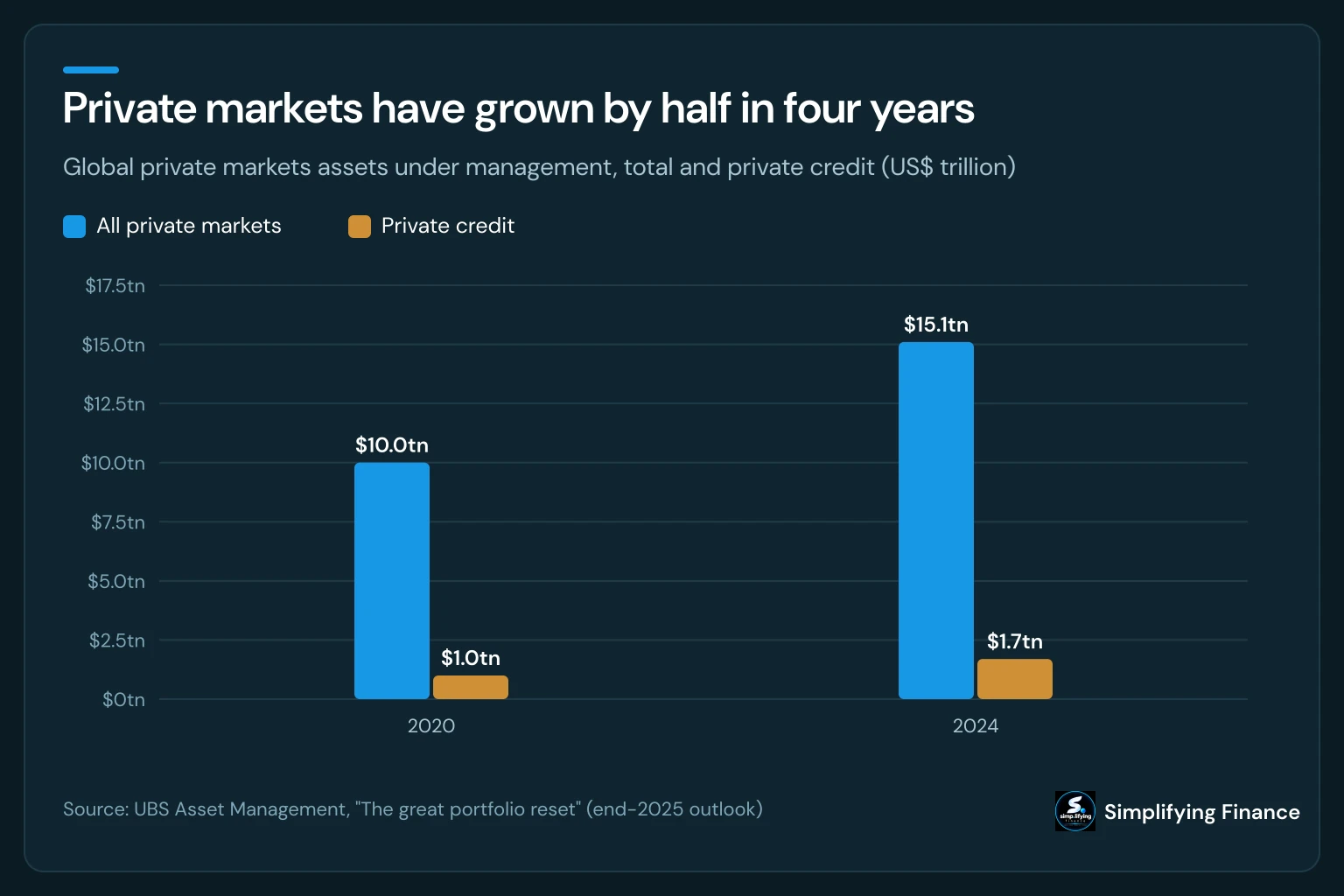
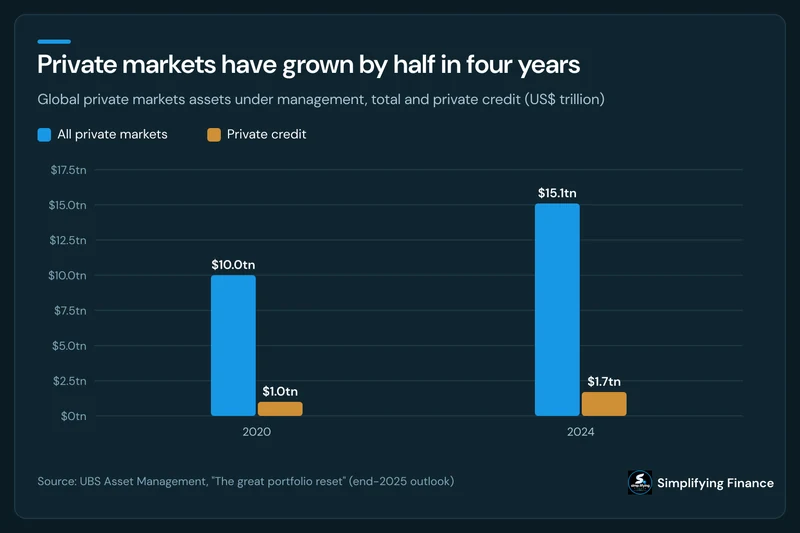
UBS Asset Management estimates that global private markets assets under management grew from about $10 trillion in 2020 to about $15.1 trillion at the end of 2024, and private credit alone from about $1 trillion to about $1.7 trillion. A CFA Institute research paper, citing Preqin, puts the figure above $18 trillion by September 2025. Estimates differ because these assets are hard to measure.
Large pension funds, university endowments and sovereign wealth funds are among the biggest investors, which is why later sections of this guide return to private markets.
What they can add
Private markets give access to businesses and projects that are not on any stock exchange, and some strategies, such as infrastructure, have long-term contracted cash flows. For very long-term investors who can wait years for their money, that can widen the menu of returns.
Some investors also value the discipline that lock-ups impose: money that cannot be sold in a panic cannot be sold at the bottom.
Hedge funds and other "alternatives"
The word "alternatives" is also used for hedge funds, commodities and other strategies outside ordinary shares and bonds. They vary enormously. Some aim to profit whether markets rise or fall; others are simply concentrated bets with higher fees. Section 5 of this hub looks at ten large hedge funds using only their public filings.
A useful rule is to judge each alternative by what it actually holds and how it behaved in past crises, not by its label.
Taken together, these trade-offs mean the headline return on a private fund can tell only part of the story. Liquidity, valuation and cost all need to be weighed before deciding whether the extra variety is worth the price.
The hidden trade-offs
The first trade-off is liquidity. Money is often locked up for many years, and getting out early can mean selling at a discount. The second is valuation. Private assets are valued by estimates, often quarterly, so their prices look smoother than they really are. A calm-looking line on a chart does not mean the underlying risk is low.
The third is cost. Fees are usually much higher than for index funds, often including a share of profits. And prices paid can be high: McKinsey reports that the median private equity purchase multiple rose from 11.3 times EBITDA in 2024 to 11.8 times in 2025.
For ordinary investors
Newer "evergreen" and semi-liquid funds have opened private markets to individuals in several countries. They can be useful, but they often allow withdrawals only within limits, which can be paused when many investors want out at once. Before buying, it is worth asking how you would get your money back in a bad year, and what you are paying for the privilege.
For most people, a portfolio of public shares and bonds already provides broad diversification. Private markets are an optional extra, not a requirement.
Questions to ask first
Before adding any private or alternative investment, it helps to ask four plain questions. What exactly does it own? How is its value measured, and how often? How and when can I get my money back? And what will I pay in total each year, including any share of profits?
If any answer is unclear, that is information in itself. Large institutions have teams to answer these questions; individual investors usually do not, which is one reason many keep private markets small or leave them out entirely.
Smooth prices, real risk
Imagine two funds holding similar companies, one listed and one private, each worth €10,000 at the start of a bad year. Use round illustrative numbers.
| Listed fund, worst point | €7,500 (-25%) |
| Private fund, reported low | €9,200 (-8%) |
| Can you sell the listed fund? | yes, daily |
| Can you sell the private fund? | often not until lock-up ends |
The listed fund's price falls 25% to €7,500 in a few weeks and recovers by year-end. The private fund reports values once a quarter and shows a gentle dip to €9,200. Its owner feels calmer, but cannot sell before the lock-up ends, and the true value of its companies may have fallen just as far. The smooth line hides risk rather than removing it.
Where people go wrong
- Mistaking smooth reported values for low risk. Infrequent valuations make private assets look calmer than they are.
- Locking up money you may need. Withdrawals can be limited or paused exactly when markets are stressed.
- Ignoring fees. Management fees plus a share of profits can take a large slice of the return.
- Assuming access means advantage. The best private funds are hard to get into, and average results vary widely.
- Comparing reported returns with share indices directly. Private fund returns are calculated differently and smoothed by infrequent valuations, so like-for-like comparisons are hard.
Put it to work
- Ask the exit question. Before investing, find out exactly how and when you could withdraw.
- Add up all fees. Include management fees, performance fees and fund expenses.
- Keep it optional. Make sure your core plan works without private markets.
- Read on. Part 3 begins: how to spread risk within shares, starting with sectors.
- Read the later sections. The endowment and sovereign fund pages show how very large investors use private markets, and why their situation differs from yours.
Private markets trade daily price swings for locked-up money, higher fees and less transparency. Know that trade before you buy it.
Facts checked against the sources above on 27 November 2026. Figures are as of the dates stated and will change. Worked examples use round illustrative numbers to show the arithmetic, not forecasts. Educational content only, not personal investment advice.