Insurance is pooling
Insurance works on the same principle as diversification. Many people each pay a small, predictable premium into a pool. The few who suffer a large loss, such as a house fire, a serious illness or the death of a breadwinner, are paid from the pool. No single household has to carry the full cost of a rare disaster.
Diversification spreads investment risk across many assets. Insurance spreads personal risk across many people. Each covers a gap the other cannot.
See the numbers behind the chart
| Risk | Protection gap |
|---|---|
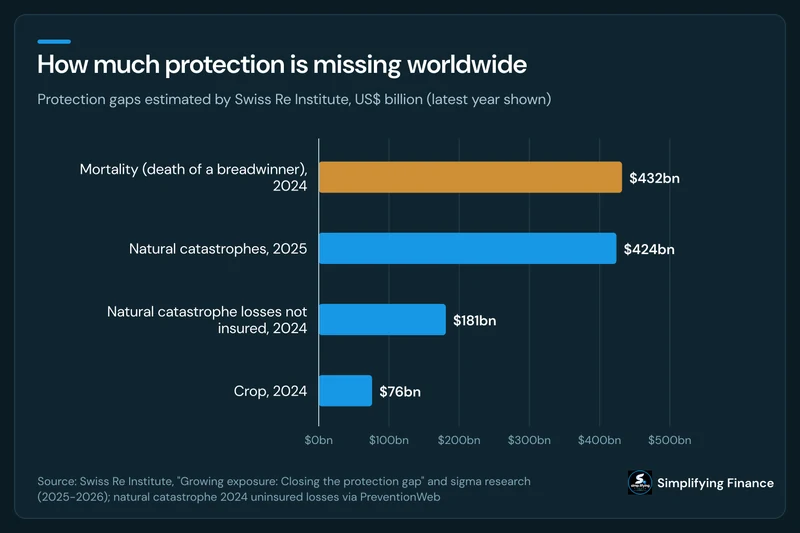
| Mortality (death of a breadwinner), 2024 | $432bn |
| Natural catastrophes, 2025 | $424bn |
| Natural catastrophe losses not insured, 2024 | $181bn |
| Crop, 2024 | $76bn |
The protection gap
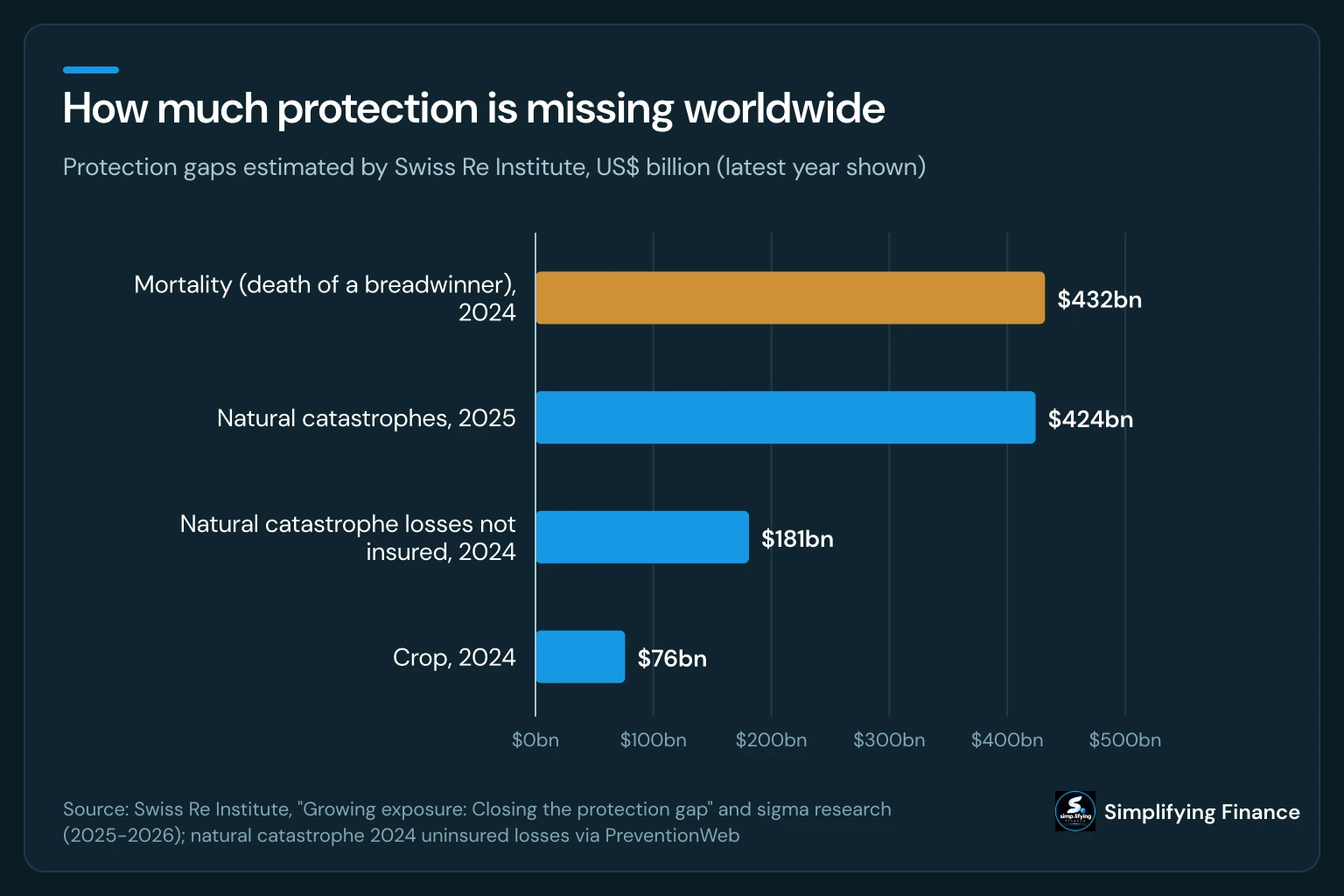
Swiss Re Institute measures how much financial protection households and economies have compared with what they need. Its mortality resilience index, which looks at how well households would cope financially with the death of a breadwinner, was 44.4% in 2024. That means households had less than half of the cover needed, and the global mortality protection gap reached a record of about US$432 billion in premium-equivalent terms.
According to Insurance Business, emerging markets accounted for about US$271 billion of that gap, 63% of the total. For natural catastrophes, Swiss Re estimates the protection gap at about US$424 billion in 2025. PreventionWeb, citing Swiss Re, reports that of US$318 billion of economic losses from disasters in 2024, 57% were insured, leaving US$181 billion uninsured.
Resilience is improving, slowly
There is some good news. Swiss Re Institute reports that its mortality resilience index improved in 2024, and that in emerging markets mortality resilience has improved gradually, though from a much lower base. Insurance Business notes that resilience in emerging markets rose from 29.2% in 2014 to 32.6%. Rising incomes and wider access to insurance are slowly narrowing the gap in many countries, even as protection needs rise.
For individual households, though, the averages matter less than their own cover. A family can be well protected in a country with a large gap, or under-protected in a country with a small one.
Why it matters for investors
A family without enough insurance may be forced to sell investments at the worst moment to pay for an emergency. A diversified portfolio cannot protect against a serious illness, a disability or a house fire on its own. Insurance does the job that investments are poorly suited for: covering large, sudden, rare losses.
A simple test is to ask whether a loss would force you to sell investments, take on expensive debt or change your life plans. If the answer is yes, the risk is usually worth insuring. If you could absorb it from savings without real hardship, insurance may cost more than it is worth.
Insurance does not replace saving
Insurance and investing serve different purposes. Some policies combine life cover with savings, but these are often more expensive and less flexible than buying simple cover and investing separately. Understanding what each part of a combined product costs, and what it would pay out, helps avoid paying for features you do not need.
Which risks to insure
Insurance works best for risks that are rare but would be financially devastating: the death or disability of the main earner, serious illness, major damage to the home, and liability claims. Small, frequent costs are usually cheaper to pay from savings. The library lessons on insurance basics and insurance deductibles explain how to choose cover and excesses.
Insurance and your emergency fund
An emergency fund and insurance work together. The fund covers the small and medium shocks and the excess on insurance claims. Insurance covers the large ones. A higher excess usually lowers the premium, which makes sense only if the emergency fund can cover it.
Check before you buy
Insurance policies differ widely in what they cover, how claims are handled and how financially strong the insurer is. Reading the exclusions, understanding the waiting periods and using regulated insurers are as important as the price. This guide does not recommend any product; the aim is to understand insurance as part of a diversified financial plan.
Insurance through work and the state
Many people already have some protection without realising it: life or health cover through an employer, state health systems, or social insurance that pays benefits on disability or death. Before buying more, it helps to list what you already have and where the gaps are. Cover linked to a job may end if the job ends, which is another reason to think of your employment and your protection together.
Insurance versus selling investments
Take a family in Indonesia with Rp 200 million in investments who face an unexpected Rp 80 million medical bill. These are illustrative figures.
| Investments | Rp 200 million |
| Medical bill | Rp 80 million |
| Without insurance | sell about 40% of investments |
| With insurance | pay Rp 5 million excess |
Without health insurance, they would need to sell about 40% of their investments, possibly after a market fall. With a policy costing Rp 4 million a year and an excess of Rp 5 million, they would pay the excess from their emergency fund and keep the investments intact.
Where people go wrong
- Relying on investments to cover disasters. A large shock can force sales at the worst time.
- Insuring small risks and ignoring large ones. Insurance gives the most value for rare, severe losses.
- Not reading the exclusions. What a policy does not cover matters as much as what it does.
- Choosing a high excess without savings to pay it. A high excess only works if your emergency fund can cover it.
- Forgetting cover linked to your job. Workplace cover may stop when the job ends.
Put it to work
- List the big risks. Note what would happen financially if the main earner died, fell ill or became disabled.
- Check current cover. Review existing policies, including any provided through work.
- Match excess to savings. Set excesses at levels your emergency fund can pay.
- List existing cover. Include workplace, state and private policies before buying more.
- Read on. The next page looks at pensions as a bond-like asset.
Diversification spreads market risk. Insurance spreads life's big shocks. A sound plan needs both.
Facts checked against the sources above on 27 November 2026. Figures are as of the dates stated and will change. Worked examples use round illustrative numbers to show the arithmetic, not forecasts. Educational content only, not personal investment advice.