One income, one risk
For most households, a single salary pays most of the bills. That makes the job, and the employer behind it, a concentrated source of risk, as the earlier pages on human capital explained. A second income stream, even a small one, can reduce how much depends on one organisation.
Even an income worth a tenth of the main salary can make a difference in a difficult month.
See the numbers behind the chart
| Year | All workers | Men | Women |
|---|---|---|---|
| 2024 | 5.2% | 4.7% | 5.8% |
| 2025 | 5.4% | 4.9% | 5.9% |
How common it is
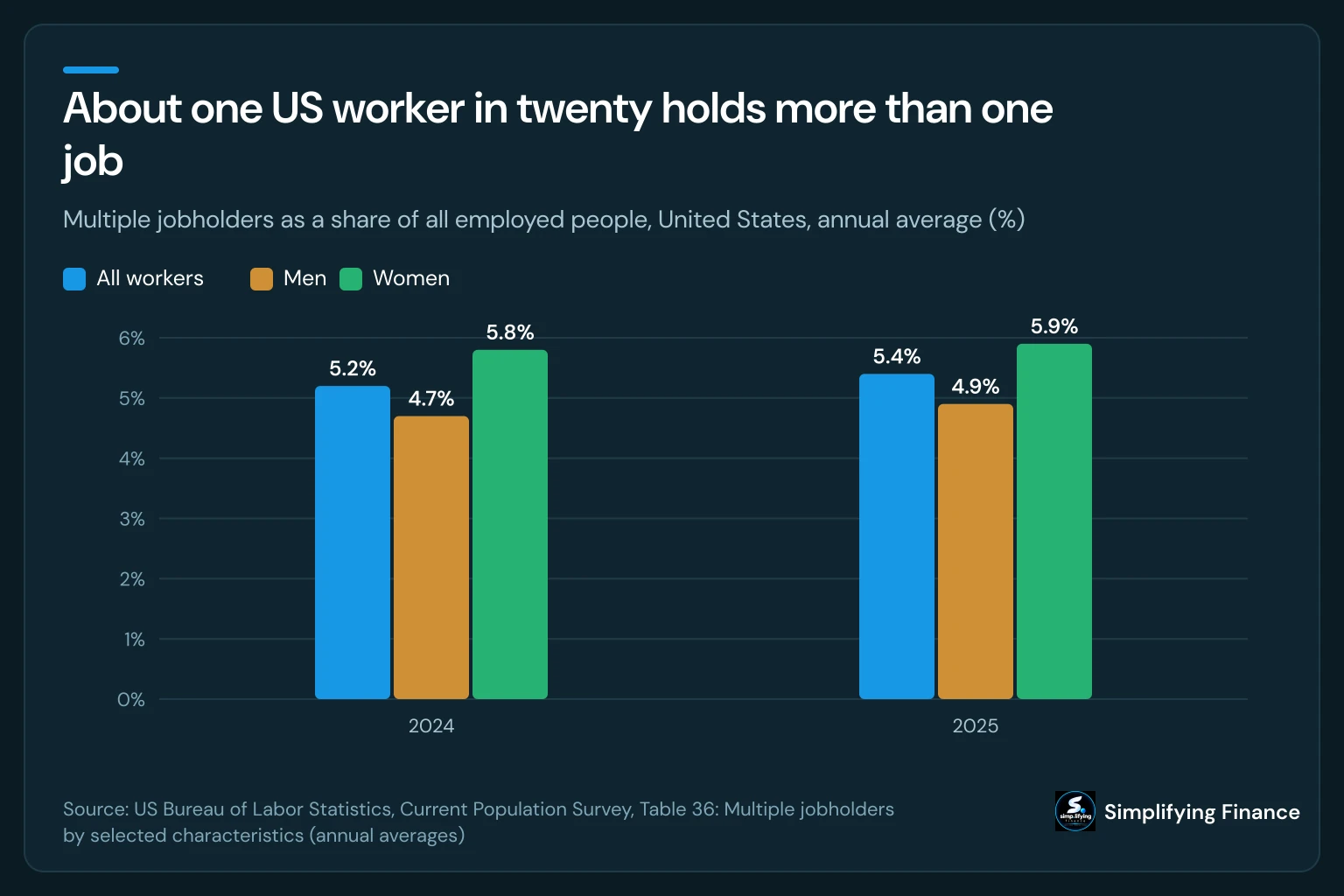
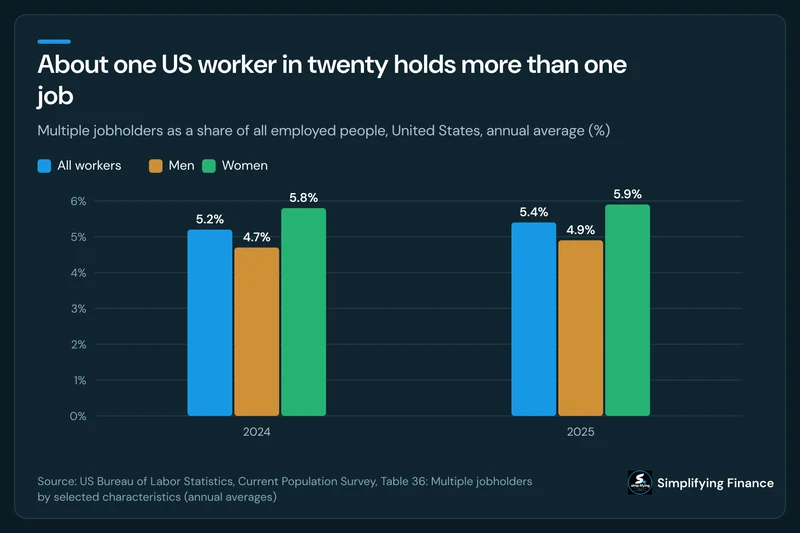
According to the US Bureau of Labor Statistics, about 8.8 million people, or 5.4% of employed Americans, held more than one job on average in 2025, up from 5.2% in 2024. The rate was 5.9% for women and 4.9% for men. Statista reports that in November 2025 the number of multiple jobholders reached about 9.3 million, the highest since records began in 1994.
In many countries, especially where informal work is common, the share of people with more than one source of income is much higher. Second incomes from trading, farming, tutoring or rental income are a normal part of household finances in large parts of the world.
Kinds of second income
Second incomes come in many forms. Some are earned: a part-time job, freelance work, consulting, teaching or a small business. Others come from assets: interest, dividends, rent or royalties. The library lesson on side income looks at practical options and their pros and cons.
From a diversification point of view, the most useful second incomes are those that do not depend on the same industry or employer as the main job. A bank employee who freelances for other banks adds less diversification than one who teaches or runs an unrelated small business.
Income from investments
Over time, savings themselves can become an income stream. A diversified portfolio that pays dividends and interest provides income that does not depend on any employer. For retirees, this becomes the main income. For working people, it is a gradual cushion that grows with their savings.
Who holds more than one job
The BLS data show that multiple job holding is spread across age groups. In 2025 the rate was about 5.7% for workers aged 25 to 54, compared with 4.0% for those aged 16 to 19. The Missouri Economy Indicators report, using Census Bureau estimates, notes that adults aged 25 to 54 saw the largest increase in multiple job holding of any age group between 2015 and 2025, nearly one percentage point.
Statista adds that about half of today's multiple jobholders hold a college degree, compared with about one third in 1996.
The costs and limits
A second income is not free. It takes time and energy, can affect health and family life, and may be restricted by an employment contract. Tax rules also differ for second incomes. Statista notes that many multiple jobholders work extra jobs to make ends meet, which is a reminder that a second job can be a necessity rather than a choice.
The aim is not to work more for its own sake, but to reduce the risk of depending on a single source of income when that is practical and sustainable.
Income from savings grows slowly but steadily
Investment income tends to start small. A saver with modest savings may earn only a little in interest and dividends each year. But as savings grow and income is reinvested, that stream can become a meaningful second income over a working life, one that needs no extra hours of work. The library lessons on compound growth and reinvesting dividends show how this builds up.
Skills as diversification
Even without a second job, broad skills act as a form of income diversification. A person who could find work in several industries is less exposed to the fortunes of any one. Training, qualifications and professional networks all increase the number of places your earning power can go if your current job ends.
Building income diversification over time
Income diversification is rarely built all at once. Many people start with a small side activity, steady savings that generate interest, or new skills learned alongside their main job. Over years, these can grow into meaningful income that does not depend on one employer. Like investment diversification, the benefit comes from consistency and from choosing sources that behave differently from each other.
A small second income
Take a nurse in Kenya earning KSh 90,000 a month from a hospital job, who adds KSh 15,000 a month from weekend tutoring for nursing students. These are illustrative figures.
| Main job | KSh 90,000 a month |
| Second income | KSh 15,000 a month |
| If main job hours fall by a third | KSh 60,000 + KSh 15,000 |
| Income after the cut | KSh 75,000 instead of KSh 60,000 |
The second income is about 14% of the household's earnings. If hours at the hospital were cut by a third, monthly income would fall from KSh 105,000 to KSh 75,000 instead of to KSh 60,000. The tutoring income is small, but it softens the blow and depends on different demand.
Where people go wrong
- Choosing a second income in the same industry. It may fall at the same time as your main income.
- Ignoring contracts and tax. Check employment terms and tax rules before taking on extra work.
- Burning out. A second income that damages health or the main job can reduce total income.
- Overlooking investment income. Savings that pay dividends and interest are also a second income stream.
- Expecting quick results. Second incomes and investment income usually take years to build.
Put it to work
- List your income sources. Note where each comes from and what industry it depends on.
- Look for unrelated options. Consider skills or assets that could earn income outside your main field.
- Check the rules. Review your contract and local tax rules before starting.
- Start small. Pick one small, sustainable addition rather than a large new commitment.
- Read on. The next page looks at insurance as a way of spreading risk.
Diversifying income can matter as much as diversifying investments, especially when one job pays all the bills.
Facts checked against the sources above on 27 November 2026. Figures are as of the dates stated and will change. Worked examples use round illustrative numbers to show the arithmetic, not forecasts. Educational content only, not personal investment advice.