Two ways to own property
Most families meet property as a home, and some as a landlord. Investors can also own it through listed companies, most often Real Estate Investment Trusts (REITs), which own offices, warehouses, shops, flats, data centres and more, and must pay out most of their rental profits as dividends in many countries.
The library lesson on REITs explains how they work. This page asks a narrower question: what does property do for a diversified portfolio?
Property can also be owned through unlisted funds, which are valued less often and can be hard to exit, and through property company shares that are not REITs. Each route changes how the investment behaves, so it helps to know which one you hold.
See the numbers behind the chart
| Index | 2022 return |
|---|---|
| Developed Europe REITs | -40.4% |
| North America REITs | -24.8% |
| Emerging market real estate | -12.4% |
| Developed Asia REITs | -11.0% |
| S&P 500 (US shares) | -18.1% |
What property brings
Property earns rent, and rents in many markets tend to rise with prices over long periods. That gives it a reputation as a partial inflation hedge, covered in the lesson on property as an inflation hedge. Listed property also lets a small saver spread money across hundreds of buildings and many cities for the price of one fund unit.
It also brings a different set of drivers from most shares: occupancy, lease lengths, building values and borrowing costs. In some years that difference helps a portfolio.
When property behaves like shares
Listed property trades on the stock market every day, so in a panic it is sold along with everything else. And because property companies borrow heavily, rising interest rates hit them twice: through higher borrowing costs and lower valuations.
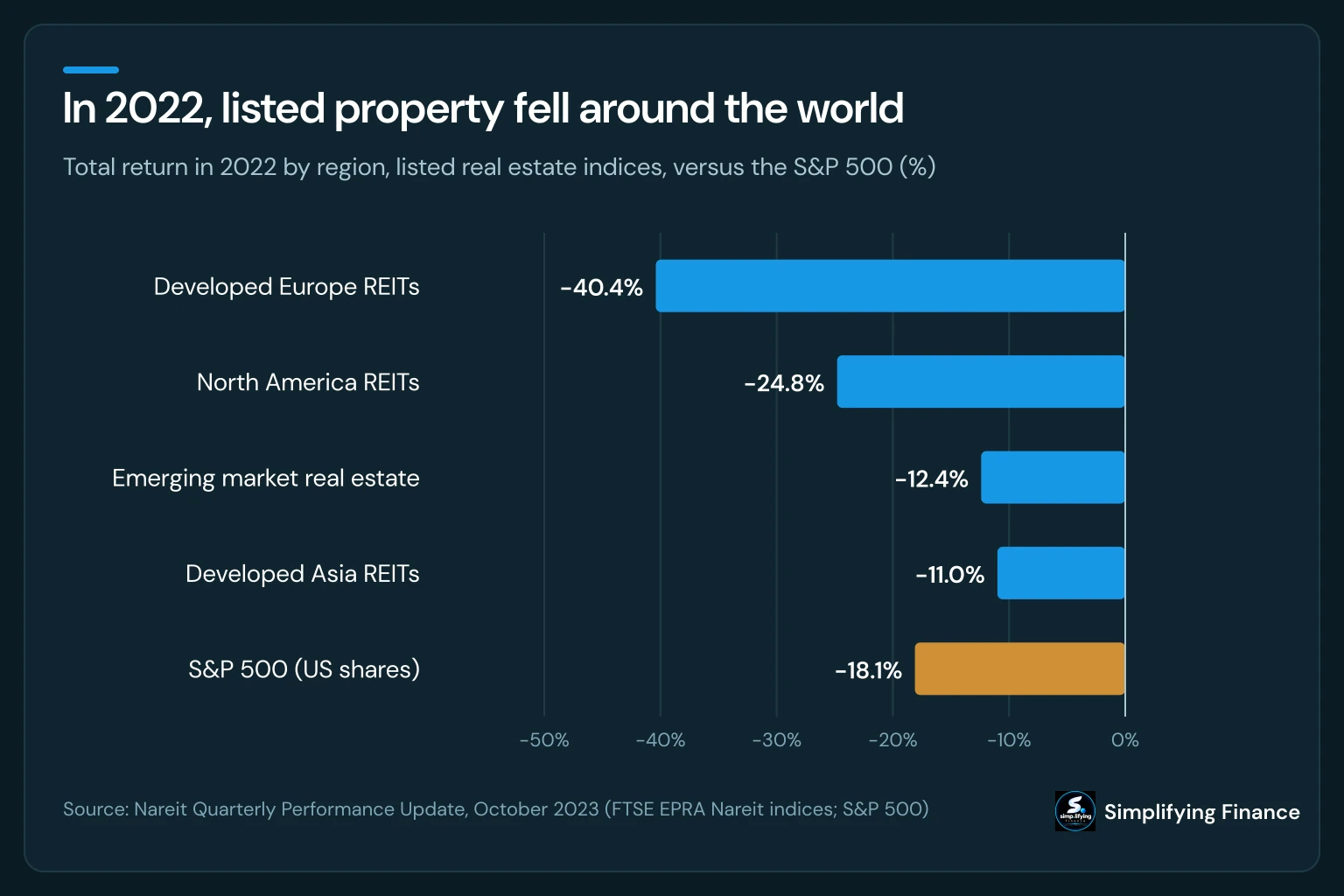
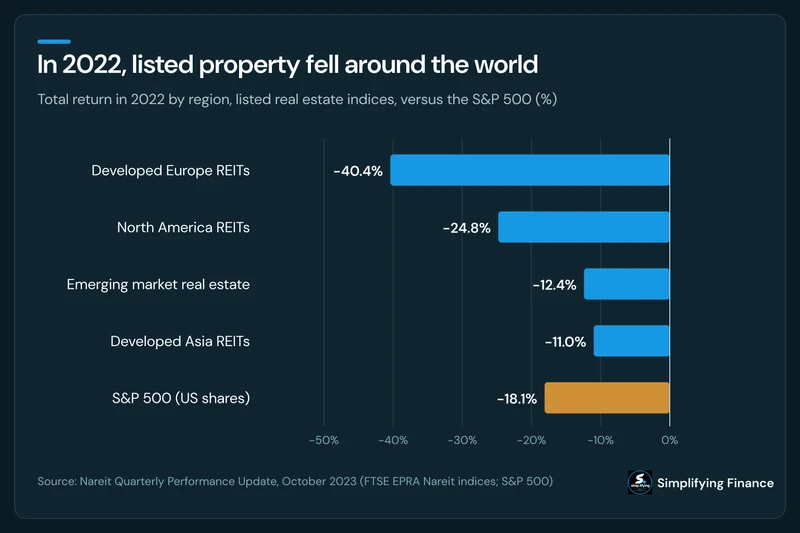
The chart shows 2022. According to Nareit, the FTSE Nareit All Equity REITs index in the United States lost 24.9% that year, after a gain of 41.3% in 2021, while the S&P 500 lost 18.1%. Developed European listed property fell 40.4%, North America 24.8%, emerging markets 12.4% and developed Asia 11.0%.
Rates are the big driver
Property values depend heavily on interest rates. When rates fall, borrowing is cheaper and the rent from a building is worth more compared with what bonds pay, so values tend to rise. When rates climb quickly, the reverse happens. That is why 2021 and 2022 looked so different for REITs, even though the buildings themselves barely changed.
This link means listed property often moves with long-term bonds as well as with shares. In a year when both shares and bonds fall because of rising rates, property can fall too, which limits how much it diversifies a typical mix of shares and bonds.
Not all property is the same
The 2022 fall was uneven. Nareit reported that office REITs lost 37.6% and residential REITs 31.3%, while specialty REITs lost just 0.8%. Changes in how people work, shop and store data can help one kind of property and hurt another for years.
So "owning property" can mean very different things. A portfolio with one office building, or one city's flats, is concentrated in the same way as one share.
Your home is already a big property bet
For many families, the home is by far their largest asset. Adding listed property on top can double up on one asset class, especially if the listed holdings are in the same country. Part 5 of this guide covers your home as part of your portfolio in detail.
Where property fits
A modest slice of global listed property can add rental income and a different set of businesses to a share portfolio. Most broad world share indices already include property companies, so many investors own some without a separate fund. Checking how much you already hold through your share funds avoids buying the same exposure twice.
For people who own their home, the biggest property decision is usually already made. The question then becomes whether more property, through funds or rental flats, adds variety or simply adds weight to one asset class you already hold in large size.
Either way, the aim is the same as elsewhere in this guide: know what you own and why.
One flat or a slice of many buildings
Imagine a saver in Brazil with R$ 400,000 who is choosing between a deposit on one rental flat and a broad listed property fund. These are round illustrative numbers, not a recommendation.
| Money available | R$ 400,000 |
| One flat: rent R$ 1,800 a month | 5.4% gross a year |
| One flat: tenants and buildings | one of each |
| Listed fund: buildings | hundreds, traded daily |
The flat might yield rent of R$ 1,800 a month, a gross 5.4% a year, but it depends on one tenant, one building and one city. It may also take months to sell. The fund spreads the same money across hundreds of properties and can be sold in days, but its price swings with the stock market, as 2022 showed.
Where people go wrong
- Counting REITs as a safe asset. Listed property can fall as much as shares, or more, especially when rates rise.
- Ignoring borrowing. Property companies and landlords often use debt, which magnifies both gains and losses.
- Doubling up on your own city. If your home, job and property fund all depend on one local economy, you hold one bet three times.
- Treating all property as one thing. Offices, warehouses, homes and data centres can move in very different directions.
- Judging by one great year. REITs gained about 41% in 2021 and lost about 25% the next year. Single years say little.
Put it to work
- Add up your property exposure. Include your home, any rental property and listed property funds.
- Check the spread. Note how many countries and property types your listed holdings cover.
- Look at borrowing. Check the debt level of any property fund or company you own.
- Read on. The next page looks at gold and commodities, two assets that behave differently again.
- Check your share funds. Look up how much property your broad share funds already hold, so you do not buy it twice.
Listed property is a share-like way to own buildings. It adds income and variety, but it does not reliably cushion a crash.
Facts checked against the sources above on 27 November 2026. Figures are as of the dates stated and will change. Worked examples use round illustrative numbers to show the arithmetic, not forecasts. Educational content only, not personal investment advice.