What counts as cash
In investing, "cash" means more than notes in a wallet. It includes bank deposits, savings accounts, short-term government bills and money-market funds, which pool savers' money and lend it for very short periods to governments, banks and large companies. What these have in common is a stable value and quick access.
Cash is the only asset whose value in your own currency barely moves from day to day. That is exactly why it matters in a diversified portfolio, even though its long-run return is the lowest of the main asset classes.
See the numbers behind the chart
| Year | T-bill return |
|---|---|
| 2000 | 6.00% |
| 2008 | 1.40% |
| 2020 | 0.36% |
| 2022 | 2.09% |
| 2023 | 5.28% |
| 2024 | 5.18% |
The long-run return is small
The UBS Global Investment Returns Yearbook 2025 puts the world return on Treasury bills, the classic measure of cash, at about 0.5% a year after inflation from 1900 to 2024. Shares returned about 5.2% and bonds about 1.7% over the same period.
In other words, over the very long run cash has roughly kept pace with prices and little more. Anyone who holds most of their long-term savings in cash is choosing safety from swings at the price of very slow growth.
The short-run return moves a lot
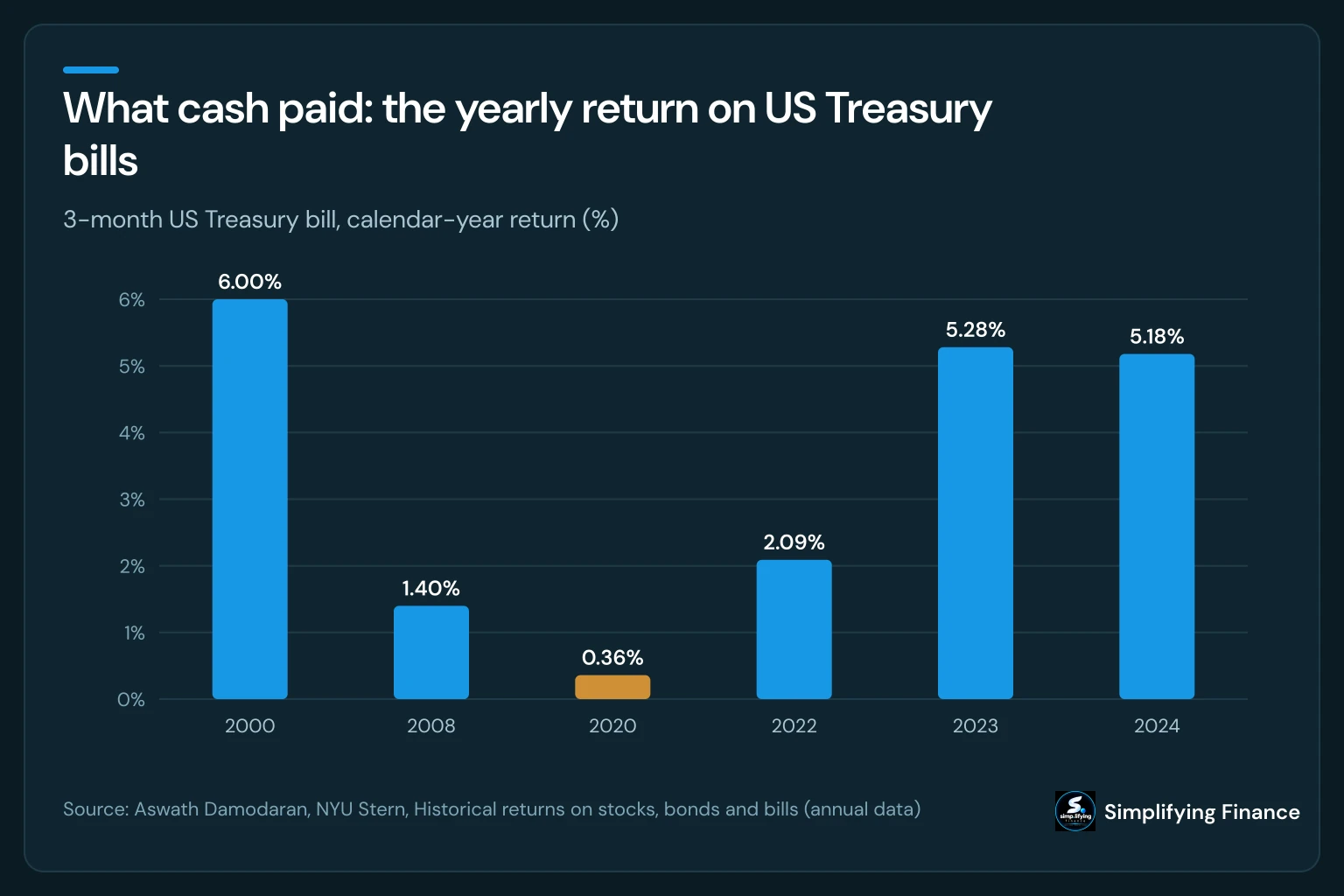
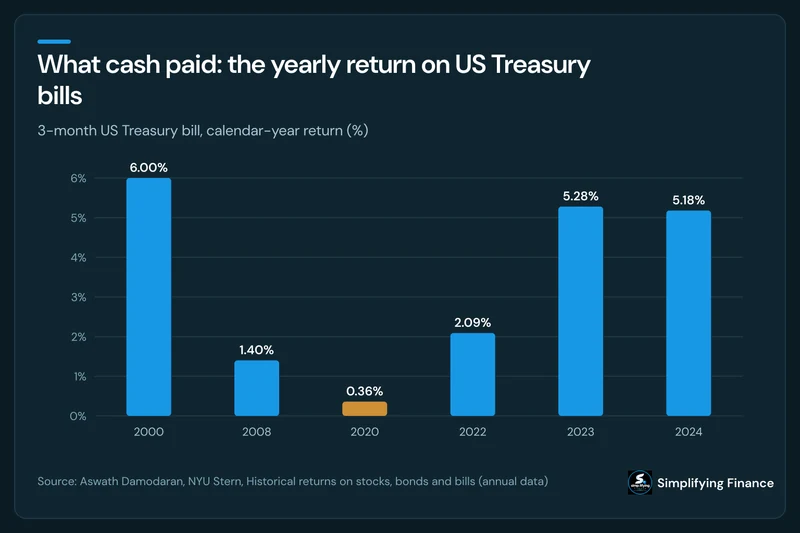
The chart shows how much the yield on cash can change. US three-month Treasury bills returned about 6.0% in 2000, about 1.4% in 2008, just 0.36% in 2020, then about 5.3% in 2023 and 5.2% in 2024, according to Damodaran's data.
The same pattern appears in other currencies as central banks raise or cut rates. That matters for savers who live on interest: when rates fall, income from cash can shrink quickly, even though the amount saved does not.
Even "safe" cash has risks
Money-market funds are designed to be very stable, but they are not bank deposits. On 16 September 2008, the day after Lehman Brothers went bankrupt, the Reserve Primary Fund, the original US money-market fund, announced that its shares were worth 97 cents instead of one dollar. It had held $785 million of Lehman debt, about 1.2% of its $62.6 billion of assets.
Researchers at the Federal Reserve Bank of New York later found that at least 29 money-market funds suffered losses large enough to "break the buck" in September and October 2008, which would have broken the buck without support from their sponsors, even with significant government support for the sector. Regulators have since tightened the rules, but the lesson stands: check what a cash fund holds, and know whether your deposit is covered by a deposit-insurance scheme.
Cash in different countries
The right home for cash depends on where you live. In some countries, savers can buy short-term government bills directly; in others, bank deposits and money-market funds are the main options. Deposit-insurance limits, account fees and tax rules also differ widely, so the same idea, safe and quick-to-reach money, can look different in Lagos, Lima or London.
What matters is the job, not the label: the money must keep its value in the currency you spend, and you must be able to reach it within days without a loss.
Cash in a diversified portfolio
Cash earns its place in three ways. It pays for emergencies, so you never have to sell shares in a crash to cover a bill. It funds near-term goals, such as a deposit or school fees due within a year or two. And it gives you options: money ready to invest, or to rebalance into other assets when they are cheap.
The main risk of cash is not a crash but a slow loss of purchasing power. In a year when prices rise 6% and cash pays 2%, the saver is 4% poorer in real terms, even though the balance went up.
Getting the balance right
Too little cash leaves a household one emergency away from selling investments at a bad moment. Too much cash leaves long-term money growing slowly, sometimes for decades. A simple way to steer between the two is to give every unit of cash a named job: emergency fund, known bills within a year, and money waiting to be invested on a set date.
Anything without a job is a candidate for a longer-term home. Reviewing this once a year, or whenever income or family circumstances change, keeps the cash slice from quietly growing or shrinking without a reason.
How much is "enough" cash?
Take a household in Kenya spending KSh 100,000 a month. A common rule of thumb, discussed in the library lesson on emergency funds, is to hold three to six months of essential spending in cash.
| Monthly spending | KSh 100,000 |
| Emergency fund, 3-6 months | KSh 300,000-600,000 |
| Known bill within 12 months | KSh 200,000 |
| Cash target | KSh 500,000-800,000 |
That means KSh 300,000 to KSh 600,000 kept in savings or a money-market fund. If the household also plans a KSh 200,000 school payment next year, that amount belongs in cash too. Everything beyond those two needs is long-term money that can be spread across growth assets.
Where people go wrong
- Keeping long-term money in cash for decades. Over a century, cash has barely beaten inflation. Money you will not need for many years usually needs a growth engine.
- Having no cash at all. Without a buffer, a job loss or repair bill can force you to sell investments after a fall.
- Assuming every cash fund is risk-free. Money-market funds and bank deposits are different products with different protections. Check which you own.
- Forgetting inflation. Compare the interest rate with inflation in your own country, not just with zero.
- Chasing the highest rate blindly. A slightly higher rate is rarely worth giving up protection or quick access.
Put it to work
- Work out your emergency number. Multiply your essential monthly spending by three to six.
- List bills due within a year. Add them to the cash you should keep aside.
- Check your protection. Find out whether your deposits are covered by a national deposit-insurance scheme and up to what limit.
- Read on. The next page looks at property and REITs as part of a portfolio.
Cash is not there to grow your money. It is there so you never have to sell something else at the worst moment.
Facts checked against the sources above on 27 November 2026. Figures are as of the dates stated and will change. Worked examples use round illustrative numbers to show the arithmetic, not forecasts. Educational content only, not personal investment advice.