A small university with a very large endowment
Princeton's endowment is managed by the Princeton University Investment Company (Princo), a university office established in 1987, when the endowment was worth US$2.2 billion. Princo says Princeton's endowment ranks among the five largest university endowments in the United States and, measured per student, is the largest.
The endowment is central to Princeton's finances. The university reports that endowment earnings provide about two-thirds of its net annual operating revenues, helping to fund its financial aid, teaching and research.
See the numbers behind the chart
| Asset class | Target weight |
|---|---|
| Private equity | 30% |
| Independent return (hedge funds) | 24% |
| Real assets | 18% |
| Developed market equities | 12% |
| Emerging market equities | 8% |
| Fixed income and cash | 8% |
The latest results
Princeton's endowment returned 23.7% in fiscal 2026, the year to 30 June 2026, and reached a record US$42.3 billion, up from US$36.4 billion a year earlier, according to the Princeton Alumni Weekly. That passed the previous peak of US$37.7 billion reached in 2021. Over five, ten and twenty years, the endowment's average annual returns were 6.7%, 11.3% and 9.7% respectively.
Princeton's fiscal 2026 gain of about US$5.9 billion, or 16.2%, in the endowment's value was smaller than its 23.7% investment return, because the university also spent from the endowment during the year. The difference between return and growth in value is the money that went to work for students and research.
How Princo invests
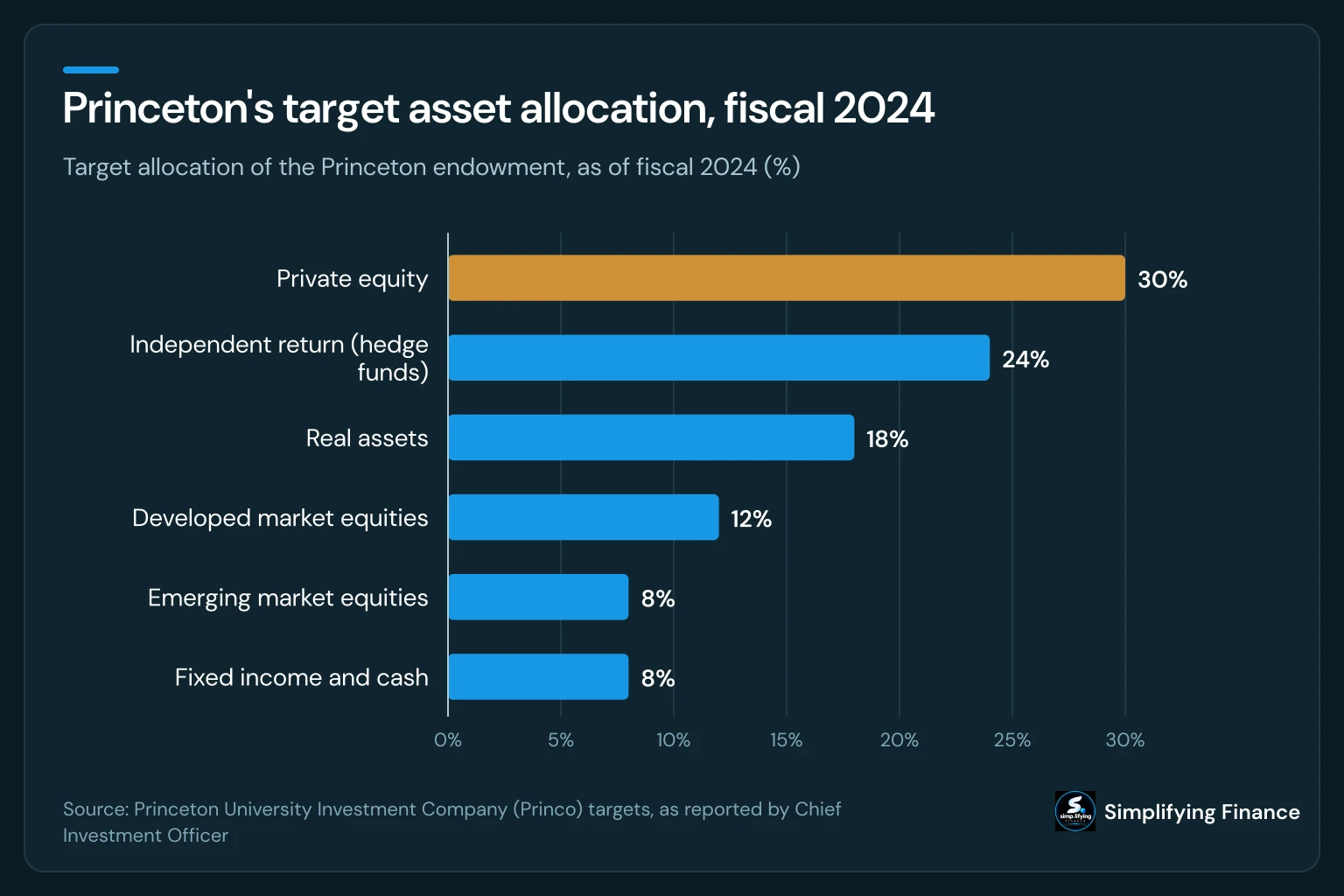
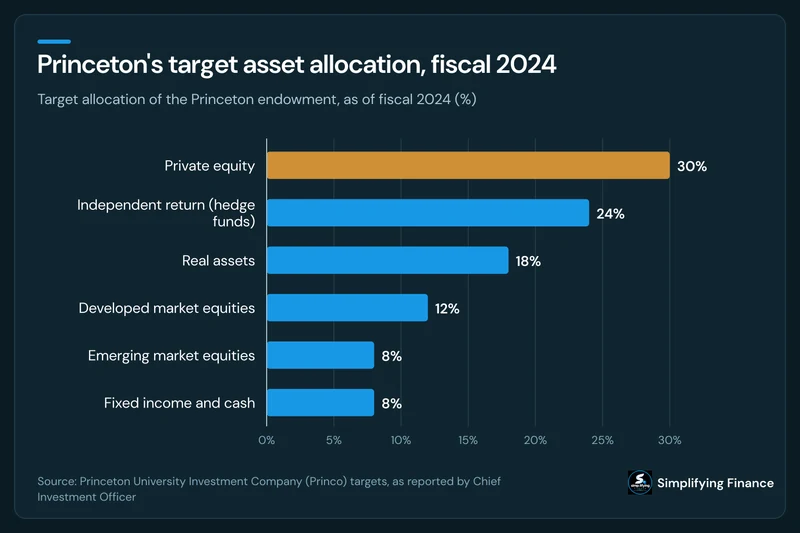
Princo invests almost entirely through outside investment managers, choosing specialist firms across asset classes and building long relationships with them. As of fiscal 2024, its target allocation was 30% private equity, 24% independent return assets (hedge-fund-style strategies), 18% real assets, 12% developed market equities, 8% emerging market equities and 8% fixed income and cash.
That mix is heavily weighted to equity and equity-like assets. Coverage of Princo's fiscal 2025 disclosures put equities and equity-like assets at about 94% of the portfolio. This is a portfolio built for long-run growth, not for stability in any single year.
Why outside managers
Princo describes itself as a team that selects and partners with external investment managers rather than picking investments directly. Its role is to decide how much to allocate to each kind of asset, find managers with an edge in their field, and stay with them through good and bad periods. Princo staff are university employees, and its president reports both to the university president and to the chair of the Princo board.
This structure concentrates Princeton's own effort on the decisions that matter most for a long-term investor: the overall mix of assets, the choice of managers and the discipline to stick with both. For a household, the equivalent decisions are the overall mix of shares, bonds and cash, and the choice of a few low-cost funds.
A bumpy path
Princeton's recent history shows what that means in practice. Princo reported a 46.9% return in fiscal 2021, followed by losses of 1.5% in 2022 and 1.7% in 2023, a gain of 3.9% in 2024, 11% in 2025 and 23.7% in 2026. In fiscal 2023 and 2024 Princeton's returns were the lowest among its Ivy League peers, according to Chief Investment Officer; by 2026 they were ahead of many of them.
An investor who judged Princo on 2022 or 2023 alone would have drawn the wrong conclusion. The long-run record is what matters for an endowment designed to last indefinitely.
Planning on a lower assumption
Despite strong recent returns, Princeton has reduced the long-term return it assumes for planning purposes to 8%, according to coverage of the university's decisions. Using a cautious assumption helps protect spending plans from disappointment if future returns are lower than in the past, a sensible approach for any long-term plan.
Spending for current and future students
Princeton reported that over the 20 years to June 2024, the endowment contributed US$19.8 billion towards the university's operations, almost double the endowment's value at the start of that period, while still growing. That is the core achievement of a well-run endowment: paying out a large amount over time while preserving, and increasing, its real value for future generations.
What it means for students
Princeton links its endowment directly to affordability. Strong long-run returns have allowed it to expand financial aid, so that most families below certain income levels pay nothing towards tuition. This is the ultimate test of any endowment's investment approach: whether it can keep funding its purpose, generation after generation, through good markets and bad.
How the swings added up
Follow US$100 through Princeton's reported returns from fiscal 2021 to 2026: +46.9%, -1.5%, -1.7%, +3.9%, +11% and +23.7%. It would grow to about US$146.90, slip to about US$142.20 over the next two years, then rise to about US$202.90 by June 2026, roughly doubling in six years before spending.
| US$100 after fiscal 2021 (+46.9%) | about US$146.90 |
| After fiscal 2023 | about US$142.20 |
| After fiscal 2026 | about US$202.90 |
| US$100,000 at 9.7% for 20 years | about US$637,000 |
Over 20 years at Princeton's reported 9.7% average, US$100,000 would grow to about US$637,000 before spending. The path included painful years, but the destination was strong.
Where people go wrong
- Judging a growth portfolio on a bad year. Princeton lagged its Ivy peers in 2023-24 and was ahead of many in 2026.
- Using a rosy return assumption. Princeton plans on 8%, below its long-run record.
- Copying a 94% equity-like mix without the horizon. Such a mix suits money that never needs to be withdrawn quickly.
- Ignoring what the money pays for. Endowment income funds two-thirds of Princeton's operating revenue.
- Forgetting governance. Princo reports to both the university and its own board, which keeps decisions accountable.
Put it to work
- Choose a cautious planning return. Plan with a return below your portfolio's best historical figure.
- Match growth to horizon. Hold a high growth share only for money you will not need for many years.
- Track cumulative results. Look at how your savings have grown over five and ten years.
- Write down who decides. In a family, agree who makes investment decisions and how they are reviewed.
- Read on. Next: Oxford and Cambridge.
Princeton's endowment is almost entirely invested in growth assets, mostly through outside managers. Its history shows how big swings, from +46.9% to losses, still add up to strong long-run returns for a patient investor.
Facts checked against the sources above on 27 November 2026. Figures are as of the dates stated and will change. Worked examples use round illustrative numbers to show the arithmetic, not forecasts. Educational content only, not personal investment advice.