Two universities, many endowments
Oxford and Cambridge are made up of a central university and many independent colleges, each with its own endowment and investment policy. Both universities have created their own investment managers to run pooled funds that the university, and many colleges and related charities, can invest in.
At Oxford, Oxford University Endowment Management (OUem), a commercial operating subsidiary of the university, is the discretionary investment manager of the Oxford Endowment Fund. At Cambridge, University of Cambridge Investment Management manages the Cambridge University Endowment Fund (CUEF).
See the numbers behind the chart
| Period | Return |
|---|---|
| FY2024 | 9.1% |
| FY2025 | 5.6% |
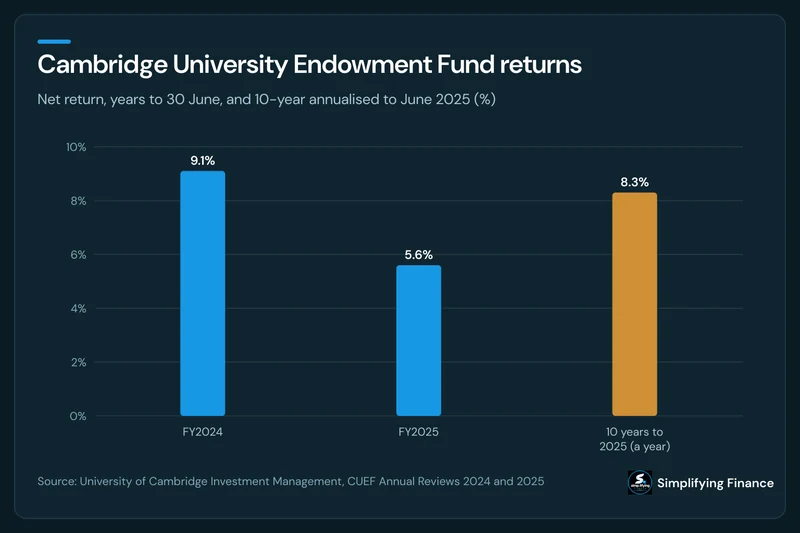
| 10 years to 2025 (a year) | 8.3% |
Cambridge: targets and results
The CUEF's long-term objective is to achieve returns of 5% above inflation, measured by the UK Consumer Price Index, net of fees, and to fund distributions to investors of about 4% of the fund's net asset value each year. The fund is diversified across five broad asset classes: public equity, private equity, absolute return and credit, real assets, and cash and fixed income.
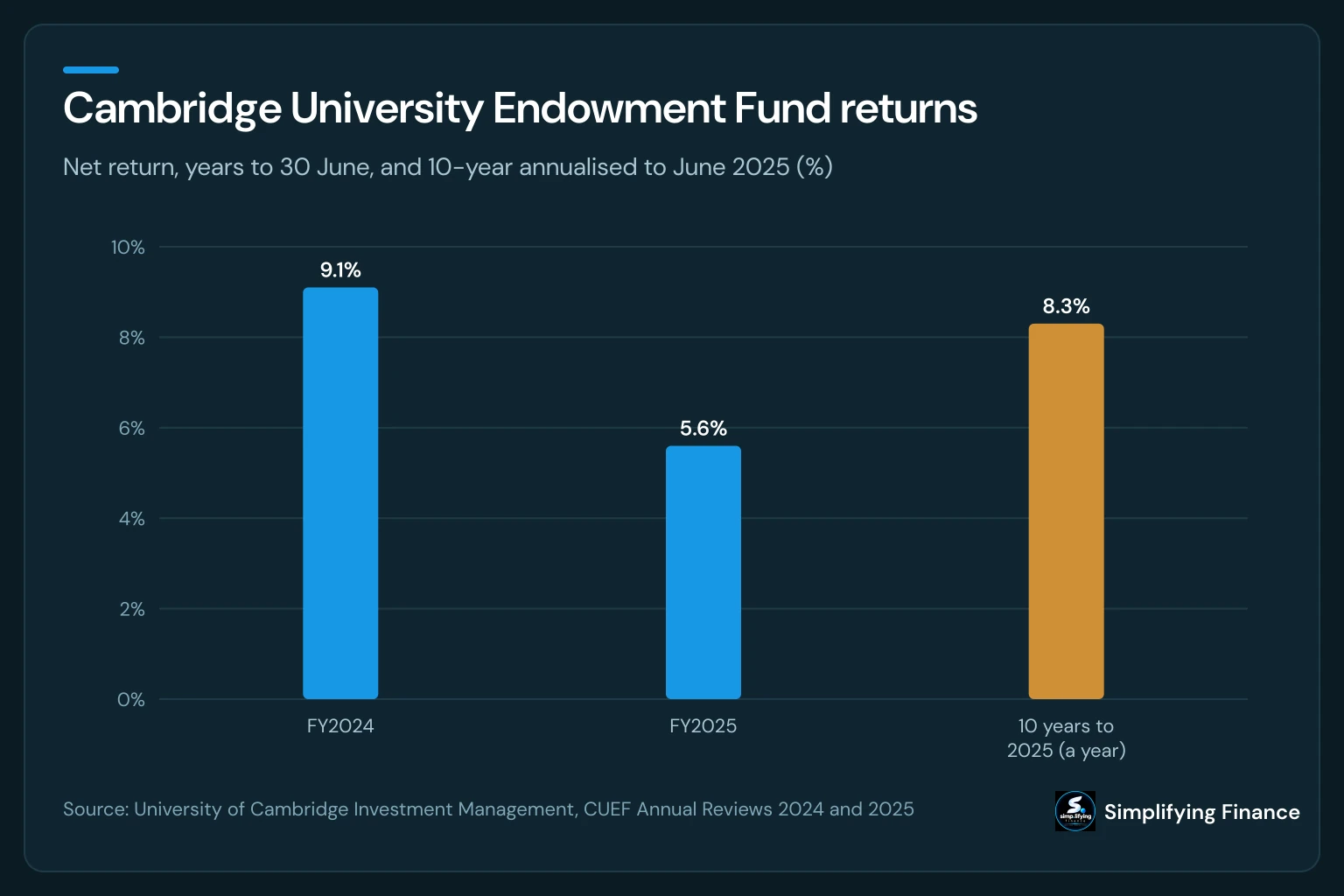
For the year to 30 June 2025, the CUEF reported a net return of 5.6% and an annualised net return of 8.3% over ten years, which it described as in line with its target of inflation plus 5%. Its net asset value was £4.4 billion at 30 June 2025, up from £4.2 billion a year earlier. It distributed £172.7 million during the year and more than £1.25 billion over the past ten years. In the previous year, to June 2024, it returned 9.1%.
Oxford: separating long-term and spendable money
Oxford University separates its long-term capital, invested in the Oxford Endowment Fund, from expendable capital held in a separate Capital Account. The Oxford Endowment Fund's stated objective is to grow by an average of 5% a year in real terms, and to achieve this with lower volatility than investing solely in public equity markets. The Capital Account, which holds money the university expects to draw on more regularly, has a different objective: 4.5% a year in nominal terms, with annual volatility kept between 3% and 5%.
This two-account structure is a simple but powerful idea. Money that will be spent soon is invested cautiously; money meant to last for generations is invested for growth.
The colleges
Each Oxford and Cambridge college is a separate legal entity with its own endowment and investment policy. Some invest with the central university fund, some use other managers, and some combine both. Several colleges' annual reports list Oxford University Endowment Management alongside other investment managers, for example. The wealthiest colleges have large endowments of their own, built up over centuries from gifts and property.
For readers, this shows another form of diversification: spreading money across more than one manager or approach, so that results do not depend on a single team.
Currency and benchmarks
UK endowments invest globally but measure results in pounds, so currency moves can help or hurt. The Rhodes Trust, which invests most of its scholarship endowment with OUem, reported that OUem's return for the year to 30 June 2025 was 3.6%, modest relative to its goals and affected by currency headwinds.
Cambridge also compares its results with an illustrative passive portfolio of 65% equities and 35% bonds and property, made up of global equity and bond indexes, UK index-linked gilts and UK property. Comparing an actively managed endowment with a simple passive mix is good practice, and one that individuals can follow.
How they compare with US endowments
The largest US endowments are much bigger than Oxford's and Cambridge's central funds, and many invest more heavily in private equity and venture capital. Both British funds use diversified portfolios with private assets, but they place particular emphasis on a clear real-return target and a steady distribution rate, the two numbers that matter most for an institution that must spend every year.
Long histories, long horizons
Cambridge's endowment fund publishes a record of its unit value and distributions going back to the late 1950s, one of the longest continuous records of any university fund. Records like this show the effect of compounding over many decades, through high inflation in the 1970s, financial crises and recoveries. They also show how a steady distribution, paid every year, has supported teaching and research throughout.
A long record is the best evidence that a spending rule and investment policy work together. For a household, keeping a simple record of your savings, contributions and withdrawals over many years does the same job: it shows whether your plan is on track.
A two-account plan in pounds
Suppose a UK saver has £100,000. Following Oxford's structure, they keep £20,000 they expect to spend within a few years in a cautious account, and invest £80,000 for the long term, aiming for inflation plus a few percent.
| Total savings | £100,000 |
| Cautious account (spend soon) | £20,000 |
| Long-term account | £80,000 |
| 4% distribution in year one | about £3,200 |
If the long-term account earned Cambridge's ten-year rate of 8.3% a year, £80,000 would grow to about £177,000 over ten years before any withdrawals. Taking 4% a year, as the CUEF aims to, would mean about £3,200 in the first year.
Where people go wrong
- Mixing spending money with long-term capital. Oxford keeps them in separate accounts with different goals.
- Ignoring currency. Global investments measured in pounds can be hit by exchange rates.
- Having no real-return target. Both funds aim for inflation plus about 5%.
- Never comparing with a passive mix. Cambridge benchmarks itself against a simple 65/35 portfolio.
- Relying on a single manager. Many colleges spread their money across more than one approach.
Put it to work
- Split your savings by time horizon. Separate money you will spend soon from money for the long term.
- Set an inflation-plus target. Decide what return above inflation your long-term money needs.
- Benchmark against a passive mix. Compare your results with a simple index portfolio.
- Keep a long record. Track your savings, contributions and withdrawals each year.
- Read on. Next: Texas and Notre Dame.
Oxford and Cambridge set clear real-return targets, around inflation plus 5%, and pay out about 4% a year. Their structure, separating long-term capital from money that will be spent soon, is a model any saver can copy.
Facts checked against the sources above on 27 November 2026. Figures are as of the dates stated and will change. Worked examples use round illustrative numbers to show the arithmetic, not forecasts. Educational content only, not personal investment advice.