Texas: a fund built from land
The Permanent University Fund (PUF) is a constitutional fund and public endowment that supports the University of Texas System and the Texas A&M University System. Its money comes from oil and gas royalties, mineral lease rentals, bonuses and other income from state land set aside for the universities. The UT System reports that the PUF's total net asset value was US$45.0 billion at 31 August 2026.
The PUF's investments are managed by the University of Texas/Texas A&M Investment Management Company (UTIMCO), which manages the PUF and the UT System's General Endowment Fund in a similar way. The land itself, managed separately by the University Lands office, was valued at about US$11.1 billion at 31 August 2026 and is not included in the investment figures.
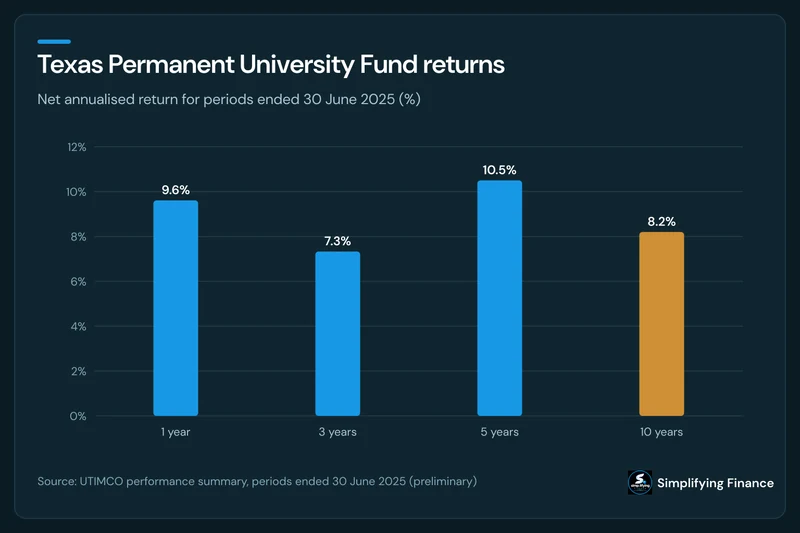
See the numbers behind the chart
| Period | Annualised return |
|---|---|
| 1 year | 9.6% |
| 3 years | 7.3% |
| 5 years | 10.5% |
| 10 years | 8.2% |
A strict rule on payouts
Texas's constitution limits what the PUF can pay out. Distributions go to a separate fund, the Available University Fund, and are drawn from the PUF's total return. In general, the annual distribution cannot exceed 7% of the average net fair market value of PUF investments, except as needed to pay debt service on PUF bonds, and the fund must preserve its purchasing power over rolling ten-year periods. For the fiscal year ending 31 August 2026, the UT Board of Regents approved a distribution of about US$2.23 billion.
This is a classic resource-fund design, similar to Alaska's Permanent Fund described in the sovereign wealth funds section: a finite resource is turned into a permanent, diversified portfolio, and a rule limits how much can be spent.
Two universities share one fund
The PUF supports two university systems. Distributions to the Available University Fund are shared between the University of Texas System and the Texas A&M University System, with Texas A&M receiving one-third of the income from investments as determined under the state's rules. The money helps fund excellence programmes at UT Austin, Texas A&M and Prairie View A&M, and the administration of the university systems.
The PUF can also support borrowing. Its constitution allows PUF bonds to be issued for capital projects, within limits set as a share of the fund's value, and debt service on those bonds is one of the uses of the distribution.
Texas: results
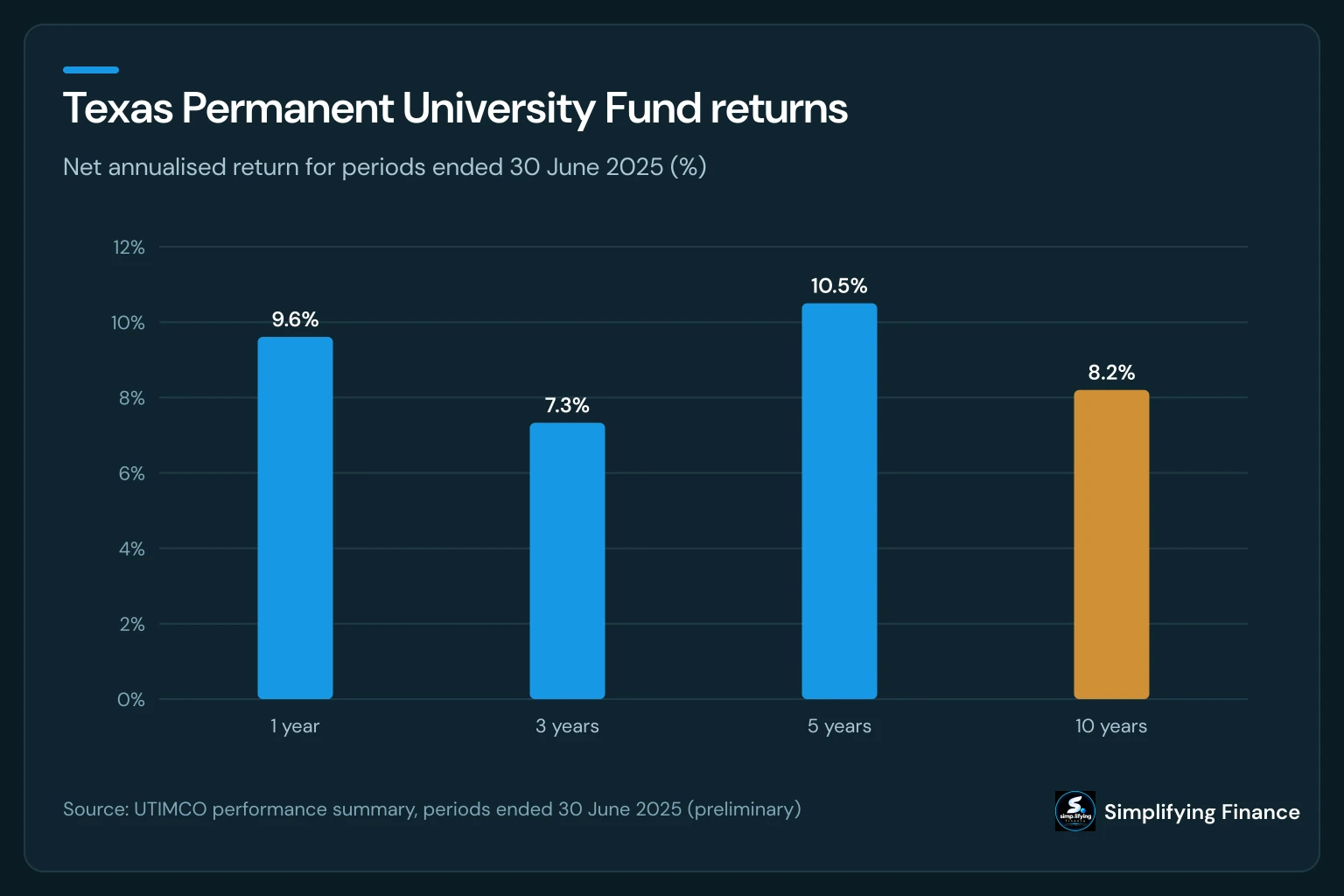
UTIMCO reported that, for periods ended 30 June 2025, the PUF returned 9.61% over one year and 8.20% a year over ten years, with a value of about US$39.5 billion at that date. For the fiscal year to 31 August 2024, UTIMCO reported that the endowments returned 10.5%.
Notre Dame: an intergenerational horizon
The University of Notre Dame's endowment is a collection of about 8,000 individual funds, invested together in a highly diversified portfolio. In its 2024 annual report, Notre Dame reported a 10% return for the year to 30 June 2024, matching its average annual return over the past two decades and bringing the endowment's value to US$17.9 billion. Including working capital and other assets, its total investment portfolio was US$20.4 billion.
Notre Dame says that one of the endowment's guiding principles is its intergenerational time horizon. In fiscal 2024, it spent US$607 million from the endowment, providing 43% of the university's annual operating revenues, its largest single source of revenue. Notre Dame's president has written that the endowment has averaged a 10% return a year over the last 20 years.
Different inflows, same discipline
The two funds differ in where their money comes from. Texas's grows from resource income on state land; Notre Dame's grows mainly from gifts. But both apply the same discipline: invest for the long term in a diversified portfolio, and spend according to a rule designed to preserve the fund's real value for future students.
A resource fund that keeps growing
Because royalties from oil and gas on PUF lands continue to flow in, the PUF receives new money each year in addition to its investment returns. UT System reports show PUF land receipts of about US$1.3 billion to US$1.9 billion a year in recent fiscal years. This steady inflow, combined with a payout cap, lets the fund grow over time, much as Norway's and Alaska's funds have grown from resource income.
For an individual, the closest parallel is a steady stream of savings from income. Regular contributions, invested and left to compound, build wealth in the same way that royalties build the PUF.
A payout cap in practice
Suppose a fund worth US$10 million on average has a rule that it may pay out no more than 7% of its average value. The maximum payout is US$700,000 a year. If the fund actually pays 4.5%, it distributes US$450,000 and reinvests the rest of its return.
| Fund value (example) | US$10 million |
| Maximum payout at 7% | US$700,000 |
| Payout at 4.5% | US$450,000 |
| PUF approved distribution, FY2026 | about US$2.23 billion |
At the PUF's scale, 7% of US$45 billion would be about US$3.15 billion, while the approved distribution for fiscal 2026 was about US$2.23 billion, well below the cap. A cap protects the fund in good years from being spent too freely.
Where people go wrong
- Spending a resource windfall as income. Texas turns land income into a permanent fund.
- Treating the payout cap as a target. The PUF's actual distribution was well below its 7% limit.
- Mixing land value with investments. Texas reports its land separately from the invested fund.
- Assuming gifts are the only source. Some of the largest endowments are built from resource income.
- Ignoring the power of steady inflows. Regular new money, invested consistently, drives long-term growth.
Put it to work
- Write a payout cap. Decide the most you will ever draw from long-term savings in a year.
- Treat windfalls as capital. Invest one-off income rather than spending it.
- Keep a long horizon. Plan for the next generation, not just the next year.
- Automate contributions. Set up a regular monthly transfer into your long-term savings.
- Read on. Next: endowments versus a simple 60/40 portfolio.
The Texas fund turns natural-resource income into a permanent fund with a strict payout limit; Notre Dame's grows from donations with an intergenerational horizon. Both show how clear rules about money coming in and going out protect long-term wealth.
Facts checked against the sources above on 27 November 2026. Figures are as of the dates stated and will change. Worked examples use round illustrative numbers to show the arithmetic, not forecasts. Educational content only, not personal investment advice.