An endowment that changed investing
Under David Swensen, who led Yale's investment office from 1985 until his death in 2021, Yale moved away from a traditional mix of US shares and bonds towards a portfolio spread across many asset classes, including hedge funds, venture capital, leveraged buyouts, real estate and natural resources. Yale's own reports describe it as pioneering diversification into these alternative asset classes. The approach became known as the Yale model and was widely copied by other endowments and foundations.
See the numbers behind the chart
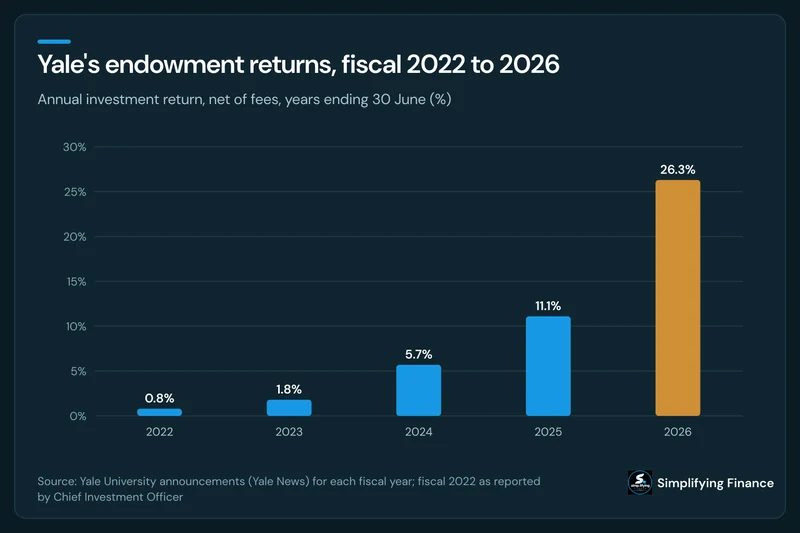
| Fiscal year | Return |
|---|---|
| 2022 | 0.8% |
| 2023 | 1.8% |
| 2024 | 5.7% |
| 2025 | 11.1% |
| 2026 | 26.3% |
The size and the latest results
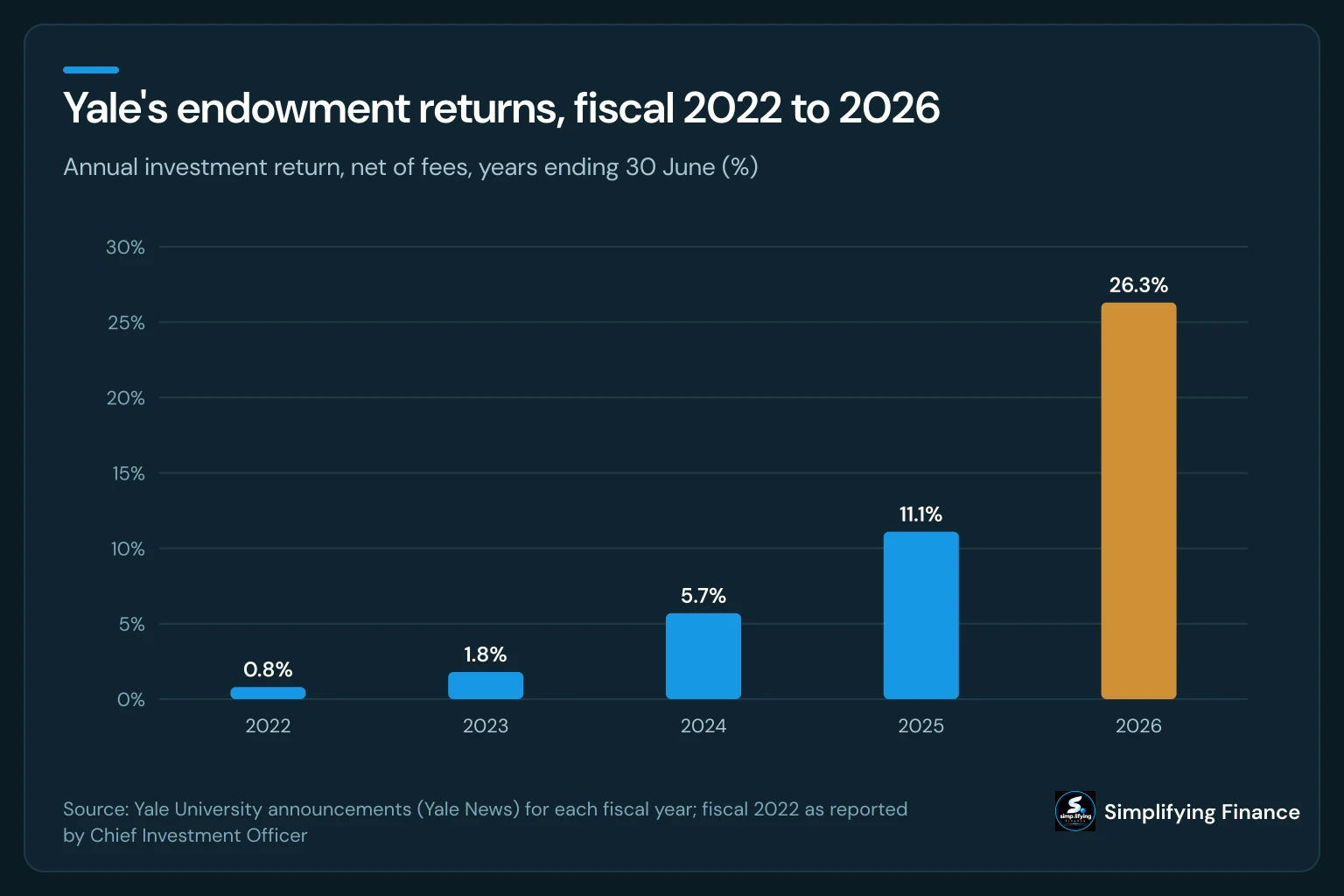
Yale reported that its endowment earned 26.3%, net of fees, in fiscal 2026, an investment gain of US$11.3 billion. After distributing US$2.2 billion to the university's operating budget, the endowment was worth US$54.5 billion at 30 June 2026, up from US$44.1 billion a year earlier.
Over the decade to June 2026, Yale reported an annualised return of 11.7%, exceeding the estimated median college and university endowment return by 1.6 percentage points a year, and a portfolio of 70% stocks and 30% bonds by 2.7 percentage points a year. Over that decade Yale spent US$16.3 billion from the endowment, equivalent to 64% of its value at the start.
Yale reports that it needs to meet a target return in order to support its budget, and that fiscal 2026 comfortably exceeded it.
How the model is built
Yale has published its target allocations in past years. For fiscal 2019, for example, Yale's targets were 26% absolute return (hedge-fund-style strategies), 18% venture capital, 15.5% foreign equity, 15% leveraged buyouts, 9.5% real estate, 6.5% bonds and cash, 6.5% natural resources and only 3% domestic equity.
At that time Yale targeted a minimum of 30% in what it called market-insensitive assets, such as cash, bonds and absolute return, and sought to limit illiquid assets such as venture capital, buyouts, real estate and natural resources to 50% of the portfolio. Those two guardrails, one for stability and one for liquidity, are central to the model.
Why it can work
The idea behind the Yale model is that a long-term investor can earn extra returns in markets that are less efficient and harder to access, such as private companies and specialised funds, where skilled managers can make a big difference. Yale accepts that these assets cannot be sold quickly, because it does not need to sell them. It also relies heavily on choosing outside managers carefully and staying with the best for many years.
Investing through outside managers
Yale invests mainly through outside investment firms, each a specialist in its own area, rather than picking individual shares or companies itself. The investment office's job is to decide the mix across asset classes, find and back the best managers, and stay with them for many years. Its reports describe close, long-term relationships with those managers as a source of strength.
For individuals, choosing an active fund manager is far harder, because the best managers are often closed to new money or available only to large institutions. That is one reason low-cost index funds remain the default recommendation for most people.
Why it can lag
The model does not win every year. Yale returned 0.8% in fiscal 2022, 1.8% in 2023 and 5.7% in 2024. In fiscal 2025 Yale's chief investment officer, Matt Mendelsohn, noted that the endowment trailed public indexes during a strong period for markets, with outperformance in several asset classes tempered by underperformance in leveraged buyouts and, more meaningfully, real estate.
Periods like this are part of the design. A portfolio that holds few listed shares will often lag when share prices rise quickly, and may hold up better when they fall.
What it needs
Swensen himself argued that most individual investors should not try to copy the Yale model, and should instead use low-cost index funds across a few asset classes. The model depends on access to top managers, a skilled staff, a horizon measured in decades and the ability to tie up money for years. Those conditions are rare outside large institutions. The library lesson on index funds versus active funds explains the alternative most households can use.
Many endowments that adopted the model without Yale's resources found it hard to match its results. Copying the asset mix is easy; copying the manager access, staff and patience behind it is not.
Yale's decade versus a 70/30 portfolio
Take US$100,000 invested for ten years. At Yale's reported 11.7% a year, it would grow to about US$302,000. At 2.7 percentage points less a year, about 9.0%, roughly what Yale reports for a 70% stock and 30% bond portfolio over the same decade, it would grow to about US$237,000.
| Starting amount | US$100,000 |
| 10 years at 11.7% | about US$302,000 |
| 10 years at about 9.0% | about US$237,000 |
| Difference | about US$65,000 |
The gap, about US$65,000, shows the value Yale added. But that result depended on Yale's managers, access and patience; for most investors, a 70/30 index portfolio is the realistic benchmark, and a strong one.
Where people go wrong
- Copying the Yale model without Yale's access. Its results rely on top managers that most investors cannot reach.
- Abandoning a plan after a slow year. Yale had three modest years before two strong ones.
- Forgetting the guardrails. Yale set limits on illiquid assets and kept a stable core.
- Treating "alternative" as automatically better. Alternatives add value only with skill and patience.
- Expecting to pick the next star manager. Even large institutions spend years researching and monitoring managers.
Put it to work
- Set two guardrails. Decide a minimum for stable assets and a maximum for hard-to-sell ones.
- Benchmark against a simple mix. Compare your results with a low-cost 70/30 or 60/40 index portfolio.
- Prefer low-cost index funds. Follow Swensen's own advice for individual investors.
- Keep it simple. A few broad index funds can capture most of the benefit of diversification.
- Read on. Next: Stanford.
The Yale model diversifies into many less-efficient, often illiquid markets and relies on skilled managers. It has worked well for Yale over decades, but it needs a very long horizon, deep expertise and tolerance for years when it lags simple portfolios.
Facts checked against the sources above on 27 November 2026. Figures are as of the dates stated and will change. Worked examples use round illustrative numbers to show the arithmetic, not forecasts. Educational content only, not personal investment advice.