The largest university endowment
Harvard's endowment is managed by Harvard Management Company (HMC), a wholly owned subsidiary of the university. According to Harvard's financial report for fiscal 2026, the endowment was worth about US$68 billion on 30 June 2026, up US$11.1 billion from US$56.9 billion a year earlier, after HMC earned a 27.1% return. That was the second-highest return of the past decade, after 33.6% in fiscal 2021.
During fiscal 2026 the endowment distributed about US$2.6 billion to the university. Harvard reports that endowment distributions provided about 39% of its revenue for the year.
The endowment is made up of thousands of individual funds, many restricted by donors to particular purposes such as financial aid or specific professorships, so not every dollar can be spent freely.
See the numbers behind the chart
| Asset class | Share of endowment |
|---|---|
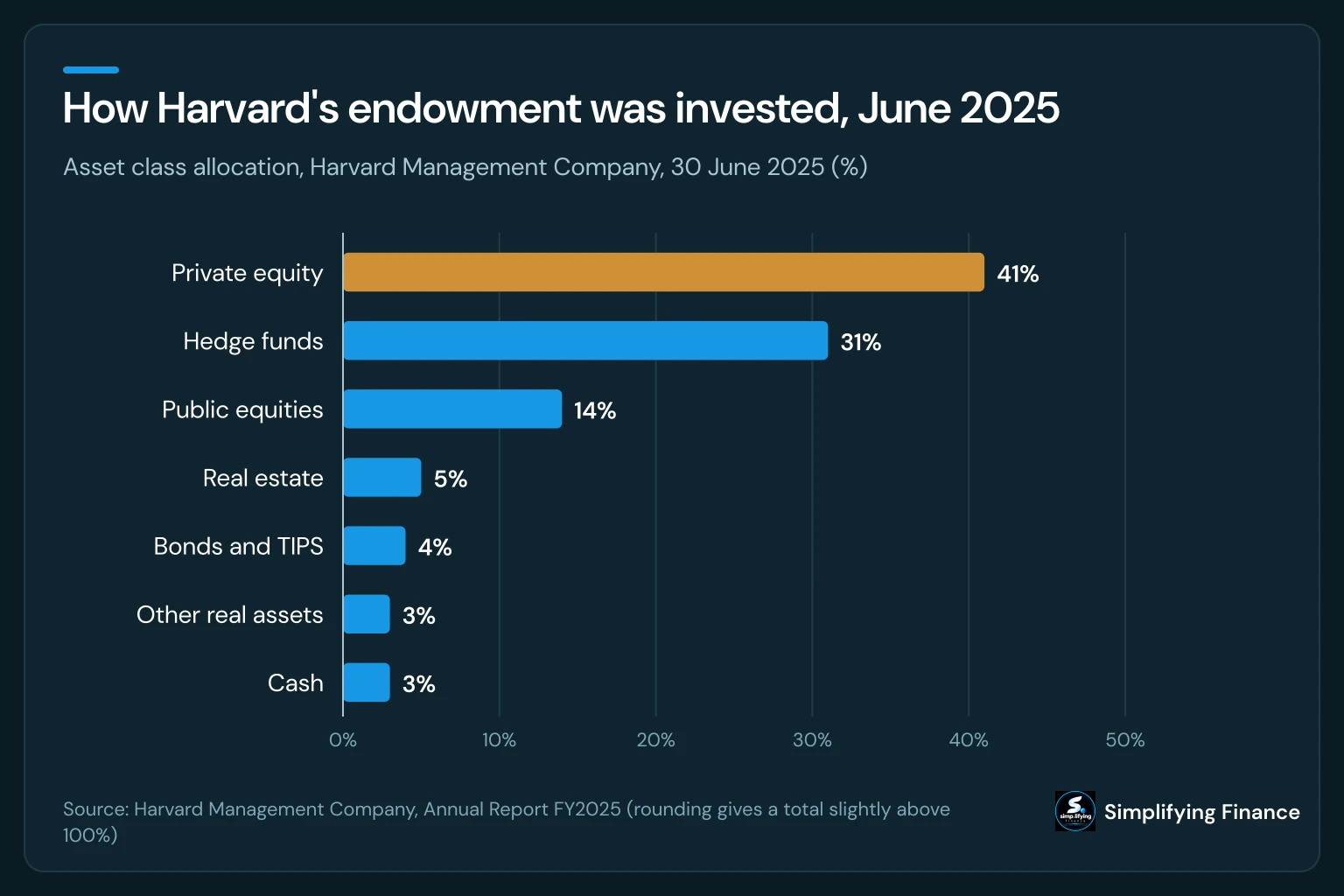
| Private equity | 41% |
| Hedge funds | 31% |
| Public equities | 14% |
| Real estate | 5% |
| Bonds and TIPS | 4% |
| Other real assets | 3% |
| Cash | 3% |
A portfolio built around private markets
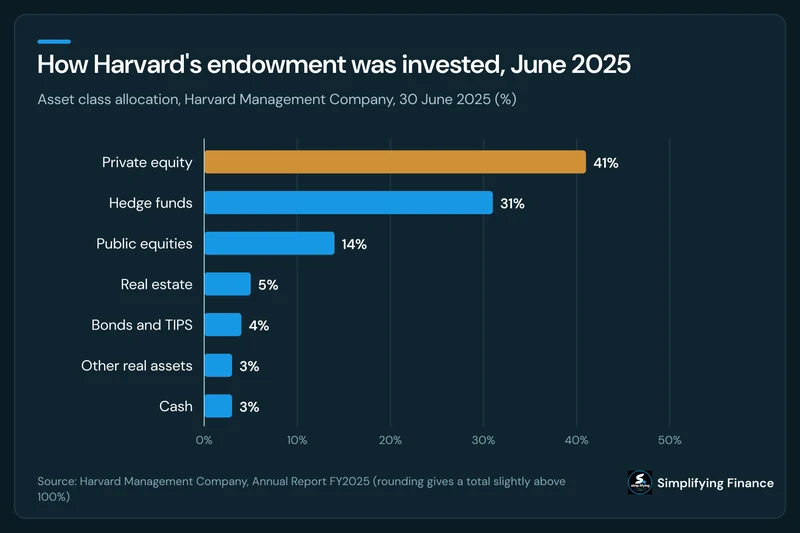
HMC's fiscal 2025 annual report showed private equity at 41% of the endowment, hedge funds at 31% and public equities at only 14%, with the rest in real estate, bonds and inflation-protected securities, other real assets and cash. Within private equity, venture capital was 14%, buyouts 13%, growth venture 10% and growth buyouts 4%.
By the end of fiscal 2026, according to coverage of Harvard's report, private equity had risen to about 46% of the portfolio, including about 31% in venture and growth investments, with hedge funds at about 29% and public equities still at about 14%.
How the mix changed
The shift has been deliberate. When HMC's current chief executive, N.P. Narvekar, took over in late 2016, private equity made up a much smaller share of the portfolio and public equities a much larger one, according to HMC's reports and coverage of them. HMC has described moving away from a narrow focus on individual asset-class benchmarks towards managing the portfolio as a whole, with a focus on long-term risk-adjusted returns.
Narvekar has written that over his nine-year tenure the endowment has earned an annualised return of about 11.4%.
A larger allocation to private markets also means more commitments to fund over time, which the investment office must plan for alongside the university's spending needs.
Hedge funds as diversifiers
About half of Harvard's hedge fund allocation in fiscal 2025, 16% of the endowment, was in what HMC calls uncorrelated strategies: funds designed to make money independently of the direction of stock markets. HMC has said this allocation helps moderate risk and provides access to liquidity across market cycles. That matters for an institution that relies on the endowment for a large share of its budget.
How much of the budget depends on it
For Harvard, the endowment is not a reserve to be admired but a working part of the budget. Harvard Magazine reports that, including endowment distributions, philanthropy provided about 48% of Harvard's revenue in fiscal 2026: 39% from the endowment distribution and about 10% from gifts for current use. That dependence is why Harvard cares as much about the stability of the payout as about the size of the return in any year.
Why one year can look very different
Because Harvard holds relatively little in listed shares, its results do not track the stock market closely. In fiscal 2023, HMC noted that its limited public equity exposure meant the strong rally in listed shares had little impact on its return. In fiscal 2026 the reverse was true: venture capital, public equities and hedge funds all contributed strongly, according to HMC.
Private investments are also valued less often than listed shares, so their reported values can lag market moves in both directions, a point HMC has discussed in its annual letters.
New pressures on spending
Harvard's finances face a new federal tax on the investment income of the wealthiest university endowments. Harvard Magazine reports that the university kept its endowment distribution for fiscal 2027 flat, with no increase, partly to pay an estimated US$300 million in tax. It is a reminder that any long-term investor's spending plan must account for taxes as well as returns.
For readers, the broader lesson is that taxes, fees and spending all reduce what a portfolio can deliver, and that a long-term plan should be built on returns after all of them, not on headline gains.
Harvard's mix, scaled to US$100,000
Using HMC's June 2025 allocation, a US$100,000 portfolio built like Harvard's would hold about US$41,000 in private equity, US$31,000 in hedge funds and US$14,000 in listed shares, with the remaining US$14,000 split across real estate, bonds, other real assets and cash.
| Private equity (41%) | US$41,000 |
| Hedge funds (31%) | US$31,000 |
| Public equities (14%) | US$14,000 |
| Easy to sell quickly (shares, bonds, cash) | about US$21,000 |
Only about US$21,000 of that portfolio, the listed shares, bonds and cash, could be sold quickly at a known price. The rest would be tied up in funds that are hard or slow to exit. That is fine for a university with a perpetual horizon, but it would be a serious problem for a household that might need its money in an emergency.
Where people go wrong
- Assuming Harvard's mix suits everyone. Its scale, staff and endless horizon make illiquid assets workable.
- Comparing it with the stock market each year. With only 14% in listed shares, it is not designed to track the market.
- Ignoring liquidity. Most of the portfolio cannot be sold quickly.
- Forgetting taxes. A new tax on endowment income is changing spending plans.
- Reading a big return as free money. Much of the endowment is restricted by donors to specific purposes.
Put it to work
- Check how much you could sell quickly. Work out what share of your savings you could access within a week.
- Use uncorrelated assets sparingly. If you add diversifiers, understand what they do in a falling market.
- Plan for tax. Include taxes on investment gains in your long-term spending plan.
- Separate restricted and flexible money. Know which of your savings are earmarked and which you can use freely.
- Read on. Next: Yale and the Yale model.
Harvard's portfolio is dominated by private equity and hedge funds, with only about 14% in listed shares. It shows how a very large, patient investor builds diversification, and why its results can differ sharply from the stock market in any one year.
Facts checked against the sources above on 27 November 2026. Figures are as of the dates stated and will change. Worked examples use round illustrative numbers to show the arithmetic, not forecasts. Educational content only, not personal investment advice.