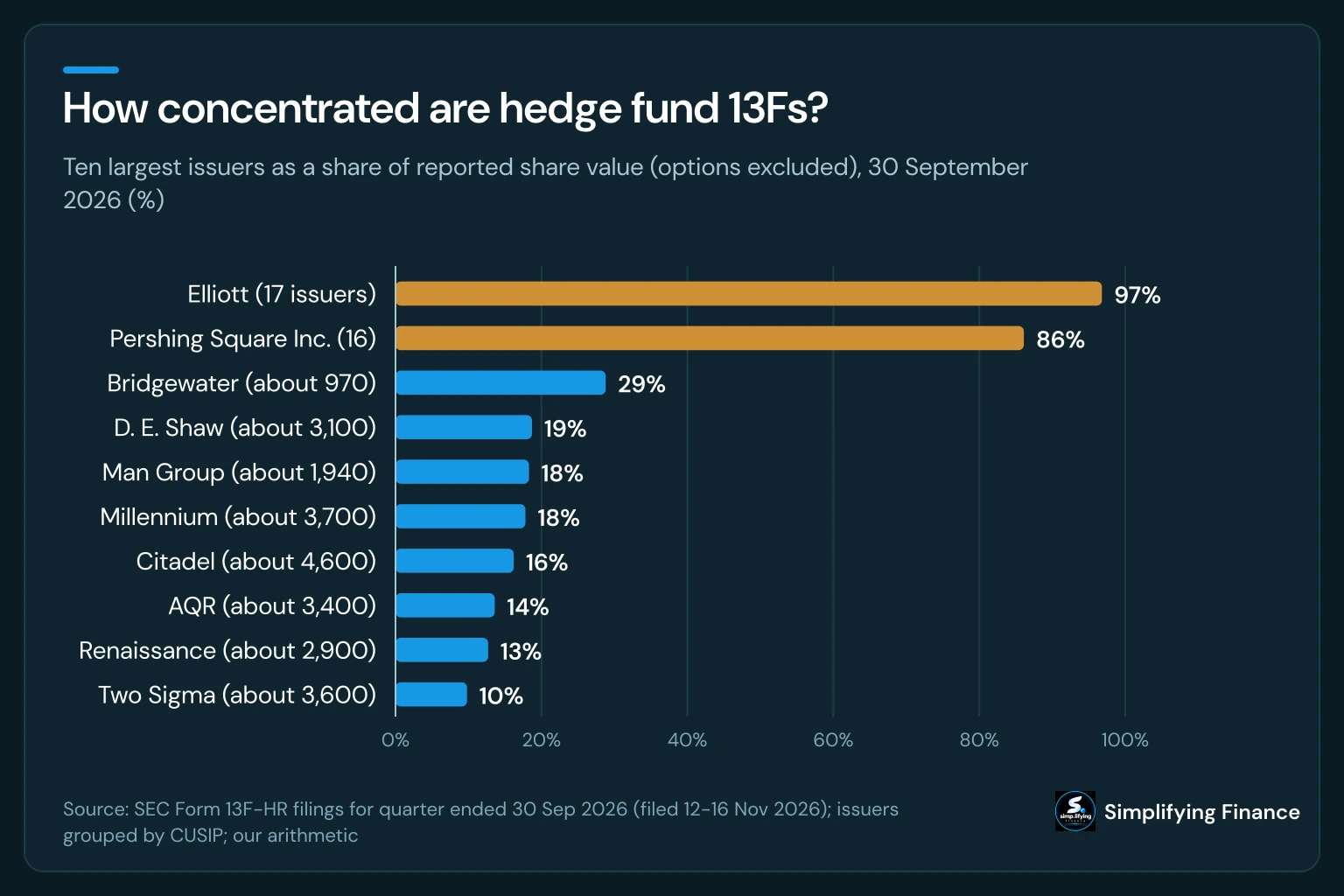
Two very different styles
The ten filings in this section fall into two broad groups. Activist and concentrated managers, Elliott and Pershing Square, held fewer than 20 issuers, with the ten largest making up 86% to 97% of reported share value. Quantitative and multi-strategy firms, Renaissance, Two Sigma, AQR, Citadel, Millennium, D. E. Shaw and Man Group, held thousands, with the ten largest at 10% to 19%. Bridgewater sat in between.
Neither style is right or wrong. Each fits a different strategy, team and set of tools.
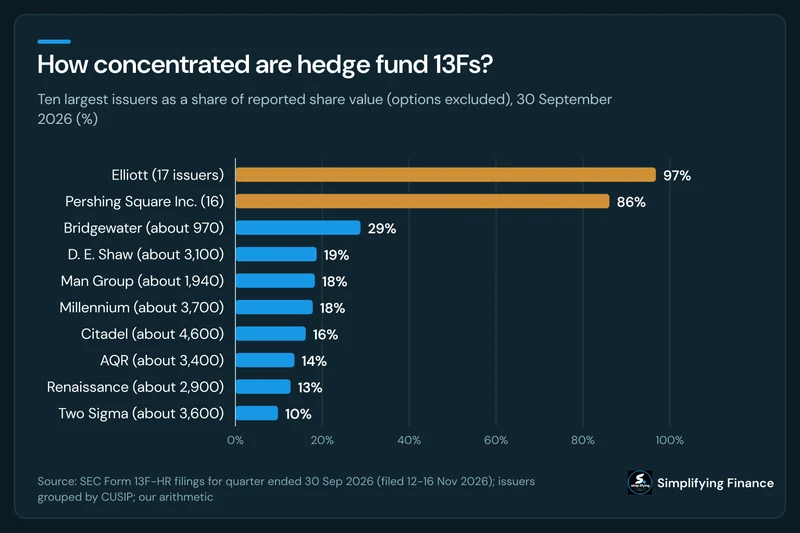
See the numbers behind the chart
| Firm | Top-10 share |
|---|---|
| Elliott (17 issuers) | 97% |
| Pershing Square Inc. (16) | 86% |
| Bridgewater (about 970) | 29% |
| D. E. Shaw (about 3,100) | 19% |
| Man Group (about 1,940) | 18% |
| Millennium (about 3,700) | 18% |
| Citadel (about 4,600) | 16% |
| AQR (about 3,400) | 14% |
| Renaissance (about 2,900) | 13% |
| Two Sigma (about 3,600) | 10% |
What you cannot copy
A 13F omits short positions, bonds, futures, currencies and non-US shares; it reports options at underlying value; and it arrives up to 45 days after the quarter ends. It says nothing about leverage, costs or why trades were made. Fast-trading funds can turn over much of their portfolios in a quarter: Renaissance's filings showed hundreds of new and closed positions between June and September 2026.
Copying the long positions alone gives you a different portfolio from the fund's, often with more risk, and at a later date. It also cannot copy skill, research, data or, in the case of activists, influence over companies.
What you can learn
Several principles are visible across the filings. Quantitative firms spread risk across thousands of small positions, which individuals can approximate cheaply with broad index funds. Multi-strategy firms impose strict limits on each team, which individuals can mirror by capping single holdings. Many firms hedge, which reminds individuals to think about what in their portfolio would hold up in a fall. And all of them start with a process, not a tip.
Survivorship and selection
The firms in this section are famous partly because they survived and grew. Many hedge funds close every year after poor results, and studies of hedge fund performance must allow for this survivorship bias. Looking only at the best-known names can make the industry seem more successful than it is. The library lesson on survivorship bias explains why.
Fees and access
Hedge funds are generally open only to institutions and wealthy investors, often with high minimums and lock-up periods, and their fees are usually far higher than those of index funds. Some ideas, such as factor tilts and trend following, are now available in lower-cost public funds. Before using any alternative strategy, compare its total cost and its behaviour in past market falls with a simple diversified portfolio.
A checklist for reading any 13F
Before drawing conclusions from a filing, check five things: the quarter-end date and filing date; which entity filed it; how much of the total is options rather than shares; how concentrated the long positions are; and what the firm's main strategy is, since futures, bonds and short positions will be missing. With those answers, a 13F becomes a useful window into a firm's style rather than a misleading shopping list.
Bringing the guide together
This section completes the Portfolios & Diversification guide. Across sovereign wealth funds, endowments, giant asset managers and hedge funds, the same lessons recur: decide your mix of assets first, spread risk across many holdings and several kinds of asset, keep costs under control, limit any single bet, and stick to a plan through good and bad markets. Professional investors use more tools, but these principles are available to everyone.
A final word on risk
Hedge funds are often described as risky, but many are designed to reduce particular risks, such as exposure to the overall market. Others take large, concentrated bets. The word "hedge fund" describes a legal structure and fee model more than a level of risk. For individuals, the more useful question is always the same: how does each part of my portfolio behave, and how do the parts work together when markets are calm and when they are not?
Where to go next
If this section has been useful, the library lessons below cover survivorship bias, active versus index investing and overconfidence in more depth. Each helps explain why simple, diversified and low-cost portfolios remain a strong choice for most savers, even in a world of sophisticated hedge funds.
A note on this page
This page is educational only. Holdings come from the firm's SEC Form 13F-HR for the quarter ended 30 September 2026, as filed; values are as reported and percentages are our arithmetic on the filing. A 13F is a snapshot of certain long US-listed positions on one date. It does not show short positions, most non-US holdings, bonds, cash or private investments, and positions may have changed since. Nothing here is a recommendation to buy or sell any security.
Copying a 13F, step by step
Suppose an investor copies a fund's ten largest long positions on 20 November 2026 using its September 13F. The positions are already seven weeks old. The fund may also hold short positions and index puts that offset much of its market risk, which the investor does not copy.
| Filing used | quarter ended 30 Sep 2026 |
| Copied on | 20 Nov 2026 (about 7 weeks later) |
| Missing | shorts, hedges, leverage, timing |
| Result | a different, usually riskier portfolio |
The investor ends up fully exposed to ten companies chosen by someone else, without the hedges, without the reasons, and without knowing when the fund sells. That is a very different, and usually riskier, portfolio than the fund's own.
Where people go wrong
- Treating 13Fs as tips. They are partial, delayed snapshots.
- Copying only the long side. The hedges that control risk are missing.
- Studying only winners. Survivorship bias hides the funds that failed.
- Paying high fees for simple ideas. Many principles can be applied with low-cost funds.
- Skipping the checklist. Date, filer, options, concentration and strategy all matter.
Put it to work
- Copy principles, not positions. Apply diversification, position limits and a clear process.
- Build a simple core. Use broad, low-cost funds for most long-term money.
- Review the whole guide. Return to the Portfolios & Diversification hub to revisit any section.
- Write your own rules. Record your asset mix, position limits and rebalancing schedule.
- Keep learning. Explore the related library lessons below.
You cannot copy a hedge fund from its 13F: shorts, hedges, leverage, timing and skill are all missing. What you can copy are principles: diversification, position limits, low costs where possible and a clear process.
Facts checked against the sources above on 27 November 2026. Figures are as of the dates stated and will change. Worked examples use round illustrative numbers to show the arithmetic, not forecasts. Educational content only, not personal investment advice.