The firm
AQR Capital Management was co-founded by Cliff Asness and colleagues with backgrounds in academic finance. Its name stands for Applied Quantitative Research. AQR is known for factor investing: building portfolios that tilt towards characteristics, such as cheapness (value), recent strength (momentum), profitability (quality) and lower risk, that research suggests have been rewarded over long periods. It runs both hedge funds and lower-cost funds open to a wider range of investors.
See the numbers behind the chart
| Position | Share of reported value |
|---|---|
| Nvidia | 3.0% |
| Apple | 2.1% |
| Microsoft | 1.9% |
| Alphabet | 1.4% |
| Amazon | 1.2% |
| Micron Technology | 1.2% |
| Meta Platforms | 0.8% |
| Broadcom | 0.8% |
What the 13F shows
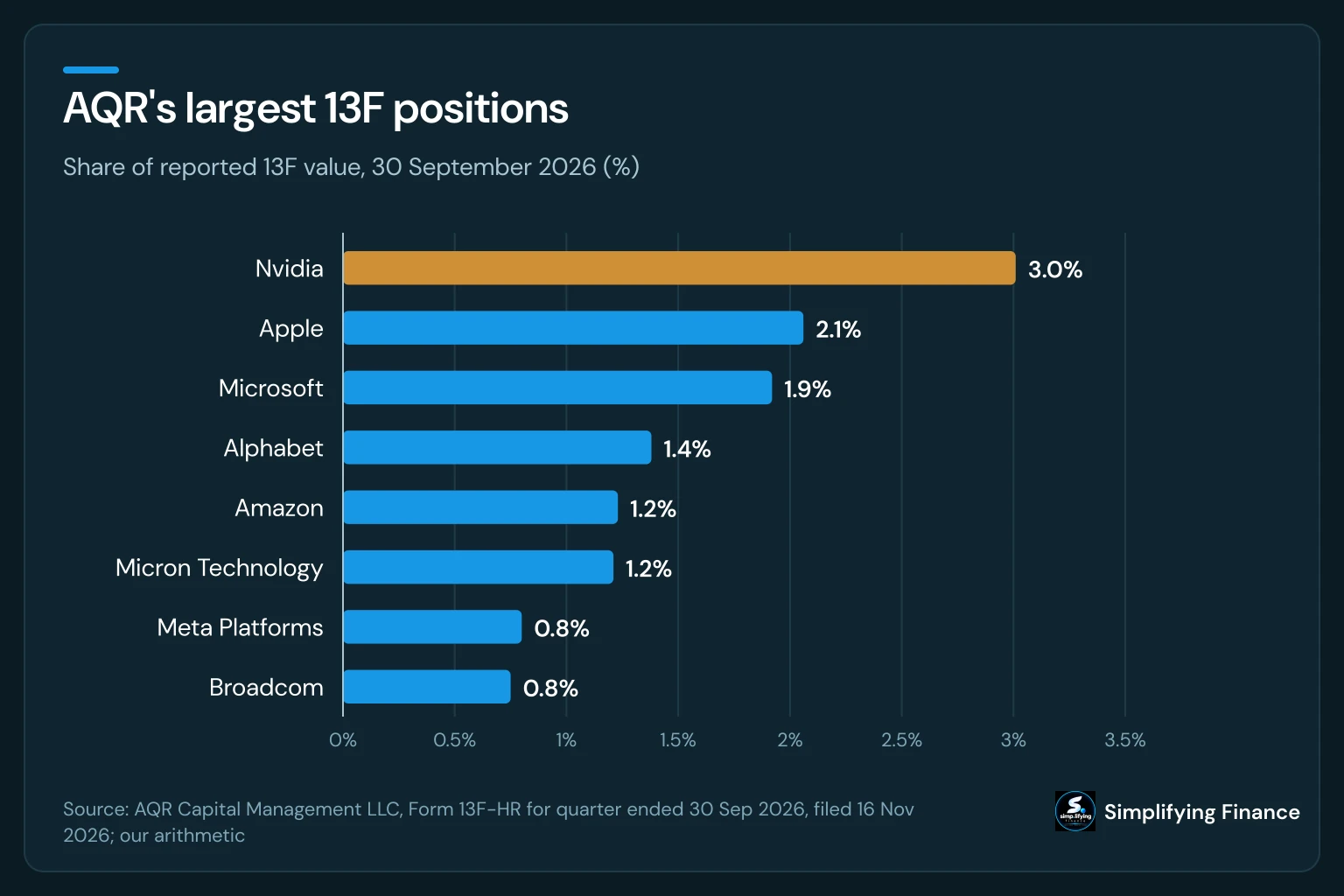
AQR's 13F for the quarter ended 30 September 2026, filed on 16 November 2026, listed 25,388 rows covering about 3,400 issuers, with a total reported value of about US$337.4 billion and no options. The large number of rows reflects holdings reported separately across many accounts and funds.
The largest positions were Nvidia (3.0%), Apple (2.1%), Microsoft (1.9%), Alphabet (1.4%) and Amazon (1.2%). The ten largest issuers made up about 14% of the reported value.
Why it looks like the market
Factor portfolios usually start from a broad universe and tilt towards or away from certain companies, rather than holding a handful of picks. Many of AQR's funds are long-only and diversified, so their largest holdings resemble the market's largest companies. In its hedge funds, AQR also runs short positions to isolate factors, which the 13F does not show.
What the 13F misses
Short positions, futures, currency positions and non-US shares are excluded. For factor strategies that go long cheap companies and short expensive ones, the short side is half the story.
The lesson for individuals
Factor investing is one of the few hedge fund ideas that has become widely available in low-cost form, through funds that tilt towards value, momentum, quality or smaller companies. Factors can underperform for long stretches; value, for example, had a long period of poor results in the 2010s. The library lesson on factor investing explains the trade-offs.
Research behind factors
Factor investing grew out of academic research showing that, over long periods, certain kinds of shares, such as cheaper ones or those with strong recent performance, have tended to earn higher returns than others. Researchers debate why: some see compensation for risk, others see investor behaviour. AQR publishes much of its research, which has helped make factor ideas widely known.
Because the evidence covers long periods and many countries, factor investors argue that patience is essential. Short periods tell little about whether a factor still works.
Long-only versus long-short
A long-only factor fund holds shares with more of the desired characteristic and fewer of the rest, but still owns the market broadly, so it rises and falls largely with the market. A long-short factor fund buys shares with the characteristic and sells short those without, aiming to capture the factor alone, with little market exposure. The two behave very differently. AQR runs both kinds, and only the long side appears on its 13F.
Why so many rows
AQR's filing had more than 25,000 rows but only about 3,400 issuers. Large managers often report the same company several times, once for each group of accounts or each combination of voting authority. Adding rows without grouping by issuer can therefore make a portfolio look far more complicated than it is. In this section, issuers were grouped by their CUSIP identifiers to measure concentration consistently across firms.
Factors in a household portfolio
For most households, the main decision is still the overall mix of shares, bonds and cash. Factor tilts are a refinement, not a substitute. A broad, low-cost core with an optional modest tilt keeps the portfolio close to the market while allowing some exposure to factors for those who understand and accept their long cycles.
Reading the top holdings
AQR's largest positions, Nvidia, Apple, Microsoft, Alphabet and Amazon, mirror the largest companies in the US market. In a factor portfolio, a company can rank highly simply because it is very large, even if the portfolio is slightly underweight it relative to an index. A 13F shows the holding but not the benchmark weight, so it cannot reveal whether the firm is tilting towards or away from a company.
A note on this page
This page is educational only. Holdings come from the firm's SEC Form 13F-HR for the quarter ended 30 September 2026, as filed; values are as reported and percentages are our arithmetic on the filing. A 13F is a snapshot of certain long US-listed positions on one date. It does not show short positions, most non-US holdings, bonds, cash or private investments, and positions may have changed since. Nothing here is a recommendation to buy or sell any security.
A modest factor tilt
An investor with US$50,000 might hold US$40,000 in a broad global index fund and US$10,000 in a fund tilted towards value or quality.
| Broad index core | US$40,000 (80%) |
| Factor-tilted fund | US$10,000 (20%) |
| If the factor lags | portfolio trails the market a little |
| Key requirement | patience through poor spells |
If the factor does well, the portfolio beats the market slightly; if it does badly, the portfolio lags slightly. Keeping the tilt modest limits the regret if the factor goes through a long poor spell, which history shows can happen.
Where people go wrong
- Expecting factors to work every year. They can lag for many years.
- Over-tilting. A large tilt makes results very different from the market.
- Ignoring the short side. In hedge funds, factor bets are often long-short.
- Paying hedge fund fees for simple tilts. Low-cost factor funds exist for many factors.
- Confusing long-only and long-short factor funds. They have very different risks.
Put it to work
- Learn the main factors. Read about value, momentum and quality.
- Keep tilts modest. If you tilt, keep most money in a broad core.
- Commit to a horizon. Factors need many years to judge fairly.
- Check market exposure. Find out whether a factor fund is long-only or long-short.
- Read on. Next: what investors can and can't copy.
AQR builds portfolios around factors, such as value, momentum and quality, that academic research links to long-run returns. Its 13F is broad and closely resembles the overall market at the top, because many of its funds are diversified.
Facts checked against the sources above on 27 November 2026. Figures are as of the dates stated and will change. Worked examples use round illustrative numbers to show the arithmetic, not forecasts. Educational content only, not personal investment advice.