Saving a resource that will run out
Oil from Alaska's North Slope began to bring large revenues to the state in the 1970s. In 1976, Alaskan voters approved a constitutional amendment creating the Alaska Permanent Fund, so that part of that income would be saved rather than spent. At least 25% of certain mineral lease rentals, royalties and related payments must be placed in the fund.
The thinking was simple: oil is a non-renewable resource, so the wealth it creates should be turned into something that lasts. The fund is managed by the Alaska Permanent Fund Corporation (APFC), a state-owned corporation with a Board of Trustees.
See the numbers behind the chart
| Asset class | Target weight |
|---|---|
| Public equities | 32% |
| Fixed income | 20% |
| Private equity | 18% |
| Real estate | 11% |
| Private income | 10% |
| Absolute return | 7% |
| Tactical opportunities | 1% |
| Cash | 1% |
The size of it
At 30 June 2025, the end of its fiscal year, the fund was worth US$85.1 billion, up 5.7% from a year earlier and its highest fiscal year-end value. The total fund return for that year was 9.35% after fees. In its mid-year review, APFC reported an annualised return since inception of 8.71% as of December 2024.
Eight asset classes
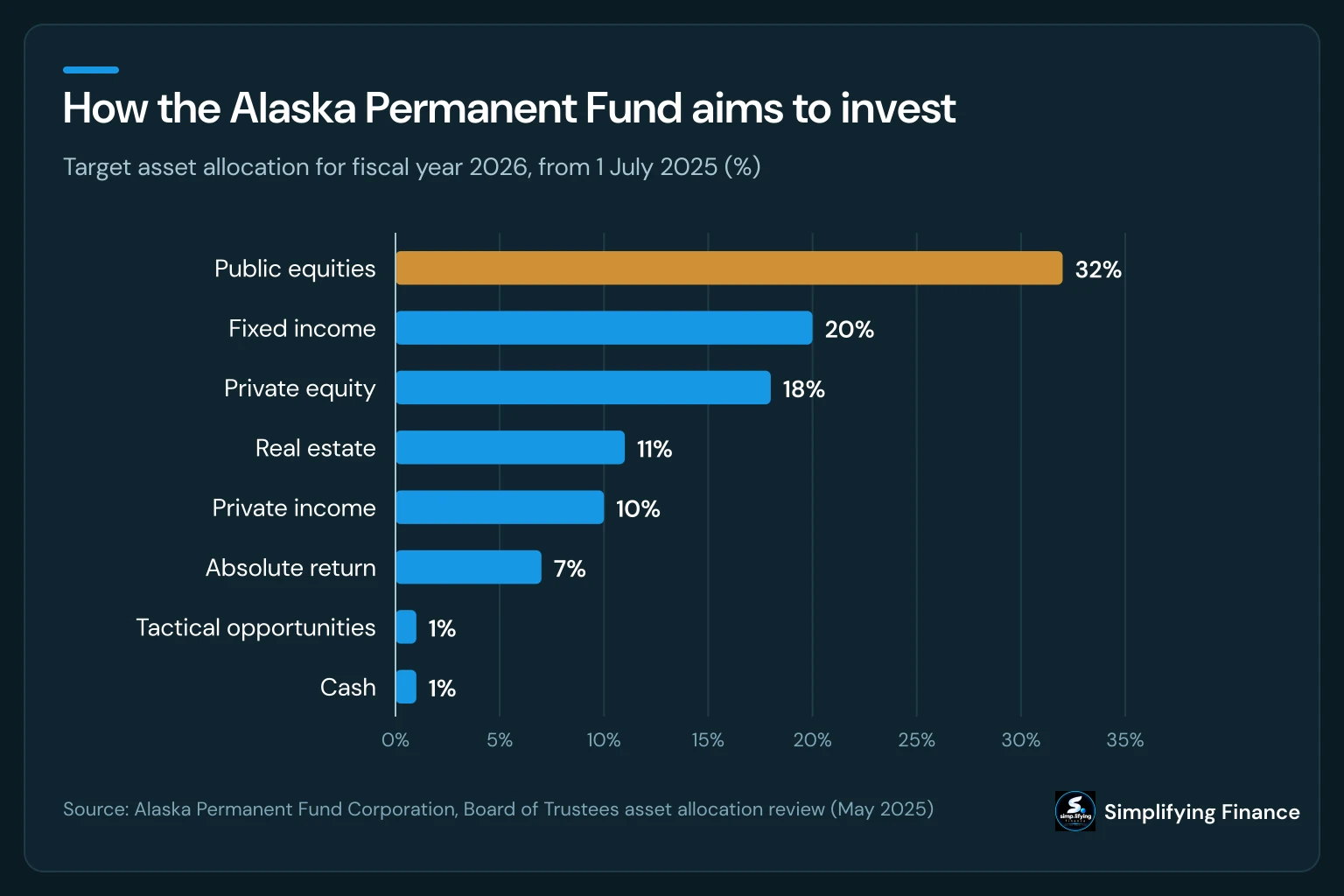
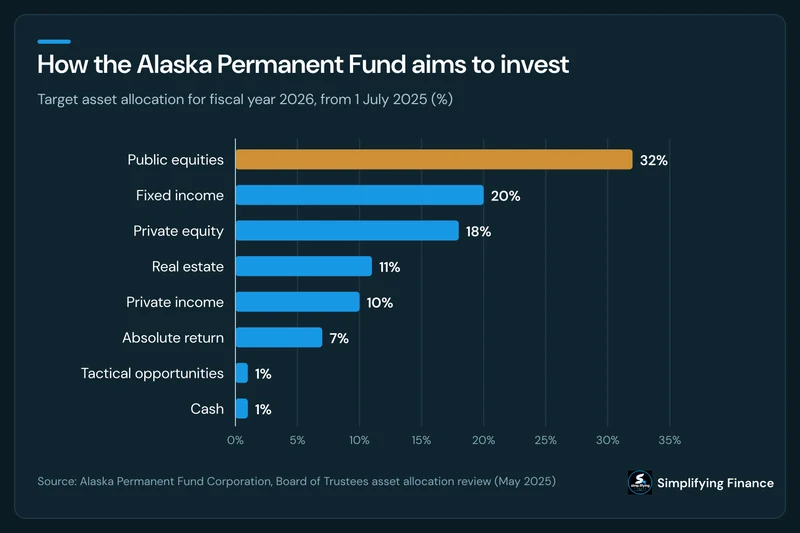
APFC describes diversification as one of the fund's most important strengths. Its portfolio spans public equities, fixed income, private equity, real estate, private income, absolute return strategies, tactical opportunities and cash. The Board's targets for the 2026 fiscal year are 32% public equities, 20% fixed income, 18% private equity, 11% real estate, 10% private income, 7% absolute return, 1% tactical opportunities and 1% cash.
That makes Alaska less reliant on listed shares than many funds. In a review of US state permanent funds as of June 2025, Alaska had the fifth-lowest allocation to public equity among the funds surveyed and the third-highest allocation to alternative assets. In early 2026, the Board discussed possible changes that would increase public equities and fixed income while reducing private markets.
Two parts: principal and earnings
The fund has two parts. The principal is protected by Alaska's constitution and cannot be spent. The Earnings Reserve Account holds realised earnings, and it is from this account that the state can draw money. This structure separates what must be kept for future generations from what is available to use today.
A rule for spending
Since 2018, Alaska has used a Percent of Market Value (POMV) rule. Annual draws from the Earnings Reserve Account are limited to 5% of the fund's average value over the previous five fiscal years. Averaging over five years smooths the draw, so a single good or bad year in markets does not cause a sudden jump or fall in spending.
In fiscal year 2025, APFC transferred US$3.7 billion to the State of Alaska through the POMV draw, supporting both public services and the Permanent Fund Dividend, an annual payment to eligible Alaska residents that has been paid since 1982. APFC's 2025 annual report notes that the state's reliance on this draw is growing.
Lessons for households
Alaska's approach maps neatly onto personal finances. A windfall, such as an inheritance, a business sale or a bonus, can be treated like a resource that will not come again. Putting it into a diversified long-term pot, keeping the core intact and drawing a modest, smoothed amount each year is the same discipline on a smaller scale. The library lesson on investing a windfall covers the first steps.
Why the fund invests outside Alaska
The fund's money is invested mostly outside the state, in markets around the world. That matters because Alaska's economy and state budget already depend heavily on oil and gas. If the fund were invested mainly in Alaskan businesses, a downturn in energy prices could hit the fund and the state's other income at the same time. Spreading the savings globally means the fund can keep supporting the state when the local economy is weak.
The same logic applies to anyone whose income depends on one industry or one employer: the library lesson on home bias explains why savings are safer when they do not move in step with your pay cheque.
How a five-year average smooths a withdrawal
Use illustrative figures. Suppose a fund was worth US$70 billion, US$75 billion, US$80 billion, US$82 billion and US$85 billion at the end of five years. The average is US$78.4 billion, and 5% of that is about US$3.9 billion.
| Five year-end values (illustrative) | US$70bn to US$85bn |
| Five-year average | US$78.4 billion |
| 5% draw | about US$3.9 billion |
| Household example: US$500,000 at 5% | about US$25,000 a year |
If markets fell 20% in the next year, the draw would barely move, because only one of the five years in the average changes. A household could use the same idea: with savings of US$500,000, a 5% rule gives about US$25,000 a year, and basing it on a multi-year average stops one bad year from forcing a sudden cut.
Where people go wrong
- Spending a windfall as income. Alaska saves resource income because it will not last; a one-off gain is similar.
- Drawing a fixed percentage of this year's value. Withdrawals then swing sharply with markets; averaging smooths them.
- Copying a large private-markets share. Private assets are hard to sell and suit investors with very long horizons.
- Ignoring rising reliance on withdrawals. Depending more and more on a fund puts pressure on its spending rule.
- Investing a windfall in your own industry. If your job and your savings depend on the same sector, one downturn can hit both.
Put it to work
- Separate core from spending money. Keep a protected long-term pot apart from money you can draw on.
- Write a withdrawal rule. If you will live off savings, set a percentage and decide how to smooth it.
- Check how easy your assets are to sell. Make sure you could raise cash without selling at a bad time.
- Diversify away from your income. Put long-term savings into assets that do not depend on your employer or local economy.
- Read on. Next: growing sovereign funds in Asia and Africa.
Alaska turned a one-off resource into a permanent, diversified fund with a fixed rule for spending. A clear withdrawal rule is what keeps a long-term fund long-term.
Facts checked against the sources above on 27 November 2026. Figures are as of the dates stated and will change. Worked examples use round illustrative numbers to show the arithmetic, not forecasts. Educational content only, not personal investment advice.