A spreading model
The first sovereign funds were created by resource exporters and trading economies with large surpluses. Over the past two decades, many more countries have set up funds of their own, sometimes to save, sometimes to develop their economies and often to do both. This page looks at four examples across Asia and Africa, each at a different stage.
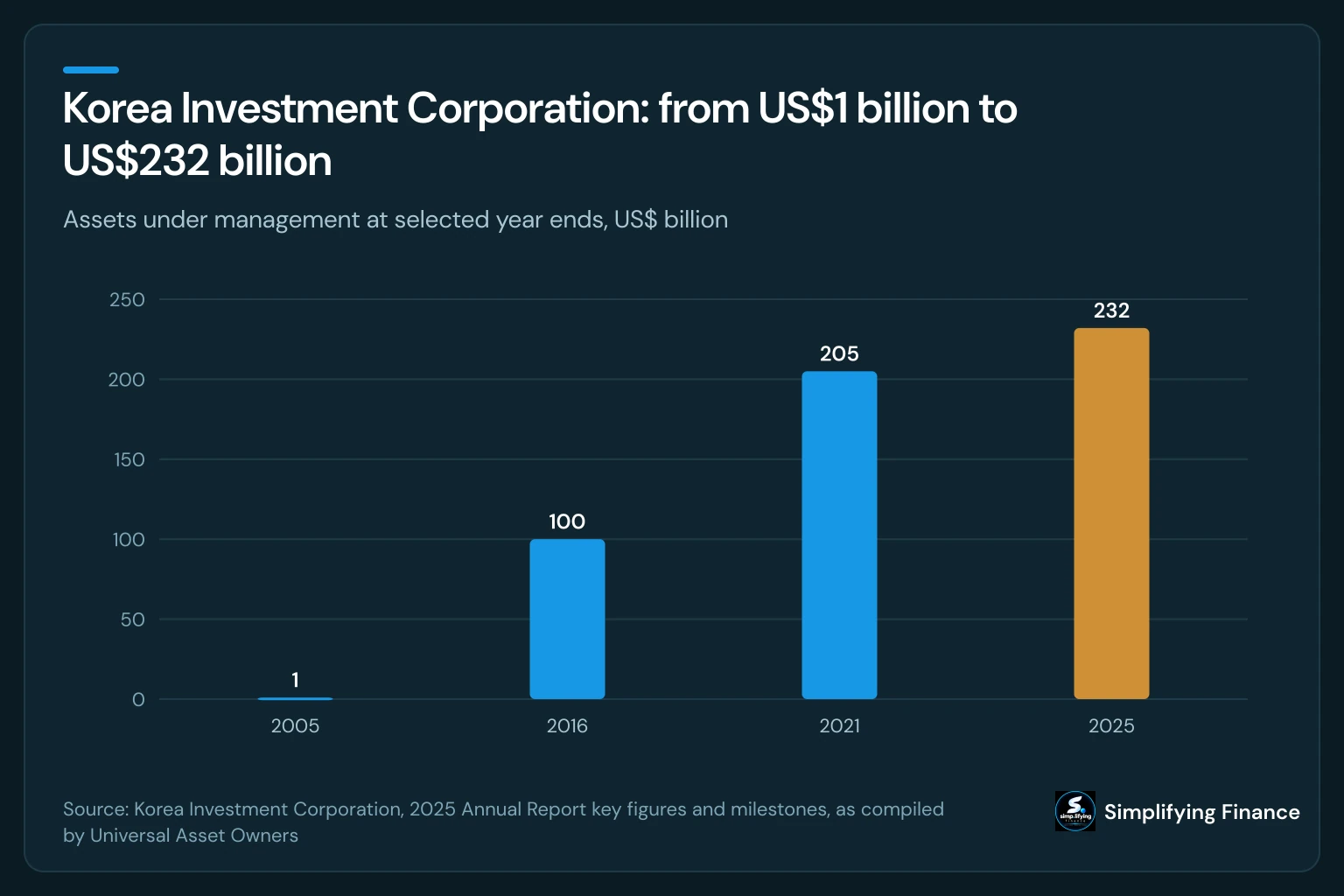
See the numbers behind the chart
| Year end | US$ billion |
|---|---|
| 2005 | 1 |
| 2016 | 100 |
| 2021 | 205 |
| 2025 | 232 |
Korea: a global savings fund
Korea Investment Corporation (KIC) was established in 2005 to manage part of Korea's foreign reserves and other public funds entrusted to it. It began with about US$1 billion. By the end of 2025, its assets under management had reached a record US$232 billion, after an investment gain of US$28.5 billion in 2025, a return of 13.91% for the year.
Over the past ten years, KIC's annualised return was about 7.07%. In 2025, its cumulative net investment gains since inception, about US$122.4 billion, exceeded the principal entrusted to it, about US$118.6 billion, for the first time. At the end of 2025, about 78.1% of its assets were in traditional assets (shares and bonds) and about 21.9% in alternatives such as private equity, real estate, infrastructure and hedge funds.
Malaysia: a strategic investor at home and abroad
Khazanah Nasional, Malaysia's sovereign wealth fund, holds stakes in major Malaysian companies and a growing global portfolio. In its Annual Review 2026, it reported a 5.2% return for 2025 and a seven-year rolling annualised return of 6.1%. Its net assets rose to RM105 billion and its total assets, measured as realisable asset value, to RM156 billion.
Khazanah reports that its net assets have grown from RM33 billion in 2004 to RM105 billion, and that it paid a RM2 billion dividend to the government for 2025, bringing cumulative dividends since 2004 to RM21.1 billion. Its managing director said the fund's global strategy centres on diversifying risk across asset classes and capturing long-term growth.
Nigeria: building from a small base
The Nigeria Sovereign Investment Authority (NSIA) manages funds set aside from Nigeria's oil revenues, with roles in savings, infrastructure and stabilisation. In its audited 2025 results, NSIA reported total assets of ₦4.91 trillion (about US$3.42 billion), up 10.9% in naira terms, supported by ₦360.8 billion in new capital contributions and record core earnings of ₦478.8 billion.
NSIA reports 13 consecutive years of earnings and asset growth since inception. Its results also show the effect of currency: a weaker naira in 2024 raised the naira value of its foreign assets, while a steadier naira in 2025 reversed part of that gain. Reporting in both naira and US dollars helps readers see the difference between investment performance and exchange-rate effects.
Indonesia: a new consolidation fund
Indonesia launched Danantara, the Daya Anagata Nusantara Investment Management Agency, on 24 February 2025. It brings together the government's stakes in large state-owned enterprises, including major banks and energy and telecommunications companies, and was expected at launch to oversee more than US$900 billion in assets, with initial funding of about US$20 billion. It is Indonesia's second sovereign fund, after the Indonesia Investment Authority set up in 2021.
Funds built by consolidating state companies are mainly about managing and developing existing national assets, rather than saving surplus revenue abroad. Their diversification therefore depends on the mix of businesses they hold and on how they invest new capital over time.
What the newer funds have in common
Despite their differences, these funds share several features with the older giants. Each has a defined owner and mandate. Each reports results over more than one year: KIC over ten years, Khazanah over a seven-year rolling period and NSIA as a record of consecutive years of growth. And each balances investment at home with exposure to the wider world, in proportions that reflect its purpose.
Korea's fund is almost entirely global, because its job is to grow national reserves. Khazanah balances strategic Malaysian holdings with a growing global portfolio. NSIA combines savings abroad with infrastructure investment at home. Danantara is mainly a manager of domestic state assets. The right mix depends on the job.
The same is true for individuals. Someone saving for retirement decades away can lean heavily on broad global investments, while money set aside for a local goal, such as a home in their own country, is better kept closer to home and in their own currency.
Compounding from small beginnings
KIC's growth from US$1 billion to US$232 billion came from both new money entrusted to it and investment returns. By 2025, cumulative gains of about US$122.4 billion had overtaken the US$118.6 billion of principal, about 1.03 times as much.
| KIC starting assets (2005) | about US$1 billion |
| KIC assets (end 2025) | US$232 billion |
| Cumulative gains vs principal | US$122.4bn vs US$118.6bn |
| US$100,000 at 7.07% for 10 years | about US$198,000 |
The same pattern happens for individual savers who start early: in the first years, contributions do most of the work; later, returns take over. At KIC's ten-year rate of about 7.07% a year, US$100,000 would grow to about US$198,000 in ten years.
Where people go wrong
- Comparing young and old funds directly. A fund in its first years is still building its base and track record.
- Ignoring currency in local results. Exchange-rate moves can flatter or hide investment performance.
- Treating consolidation funds like savings funds. Funds built from state companies have different jobs and risks.
- Expecting returns to do the work early on. In the first years, regular contributions matter most.
- Assuming one model fits every country. Savings, development and consolidation funds each suit different national needs.
Put it to work
- Start, even small. KIC began with US$1 billion; your plan can begin with a small monthly amount.
- Report in two currencies. If you save abroad, track your wealth in your home currency and in US dollars.
- Keep contributing. Let regular saving build the base until returns can take over.
- Match the mix to the job. Keep local-currency savings for local goals and invest globally for distant ones.
- Read on. Next: what ordinary investors can learn from sovereign funds.
Newer sovereign funds range from global savings funds such as Korea's to development-focused funds such as Nigeria's and Indonesia's. Their early years show how patient compounding builds wealth from small beginnings.
Facts checked against the sources above on 27 November 2026. Figures are as of the dates stated and will change. Worked examples use round illustrative numbers to show the arithmetic, not forecasts. Educational content only, not personal investment advice.