Investing part of China's reserves
China Investment Corporation was established in 2007 to manage part of China's large foreign exchange reserves and earn a better long-term return on them than very safe, short-term holdings would provide. It invests overseas through its international arms, while its subsidiary Central Huijin has managed state investments in major Chinese financial institutions.
According to its 2024 annual report, CIC's total assets stood at about US$1.57 trillion at the end of 2024, with net assets of about US$1.37 trillion.
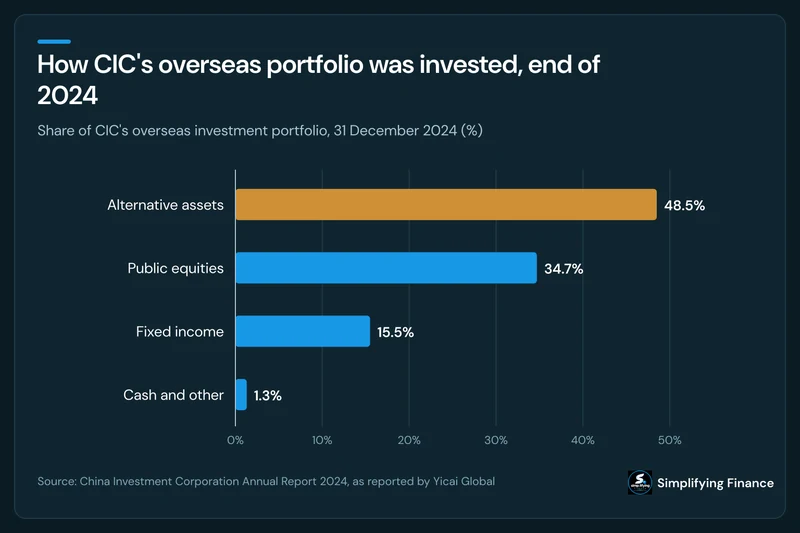
See the numbers behind the chart
| Asset class | Share of portfolio |
|---|---|
| Alternative assets | 48.5% |
| Public equities | 34.7% |
| Fixed income | 15.5% |
| Cash and other | 1.3% |
Why a reserve manager takes more risk
Foreign exchange reserves are traditionally held in very safe, liquid assets such as short-term government bonds. Once a country's reserves are larger than it needs for day-to-day stability, part of them can be invested for the long term, accepting more short-term ups and downs in return for higher expected growth. CIC was created to do exactly that with a portion of China's reserves.
Measured over ten years
CIC reports its overseas performance as a cumulative annualised net return over ten years, in US dollars. For the decade ending 2024, it was 6.92%, beating its ten-year performance target by 61 basis points, or 0.61 percentage points. For the decade ending 2023, the figure was 6.57%. Its annualised return since inception was reported at 6.39%.
Setting a target in advance and reporting against it is good practice for any investor. Without a target, there is no clear way to judge whether a result is good or poor.
How the equity portfolio changed
Within listed shares, CIC's 2024 report showed information technology as the largest sector, at about 25.9% of the equity portfolio. That reflects the growing weight of technology companies in world stock markets: a portfolio that follows global markets broadly will naturally hold more technology as those companies grow.
This is a useful check for individual investors too. A broad global fund today has a large technology share, so adding a separate technology fund on top can concentrate a portfolio more than expected. The library lesson on fund overlap explains how to spot this.
A shift towards alternatives
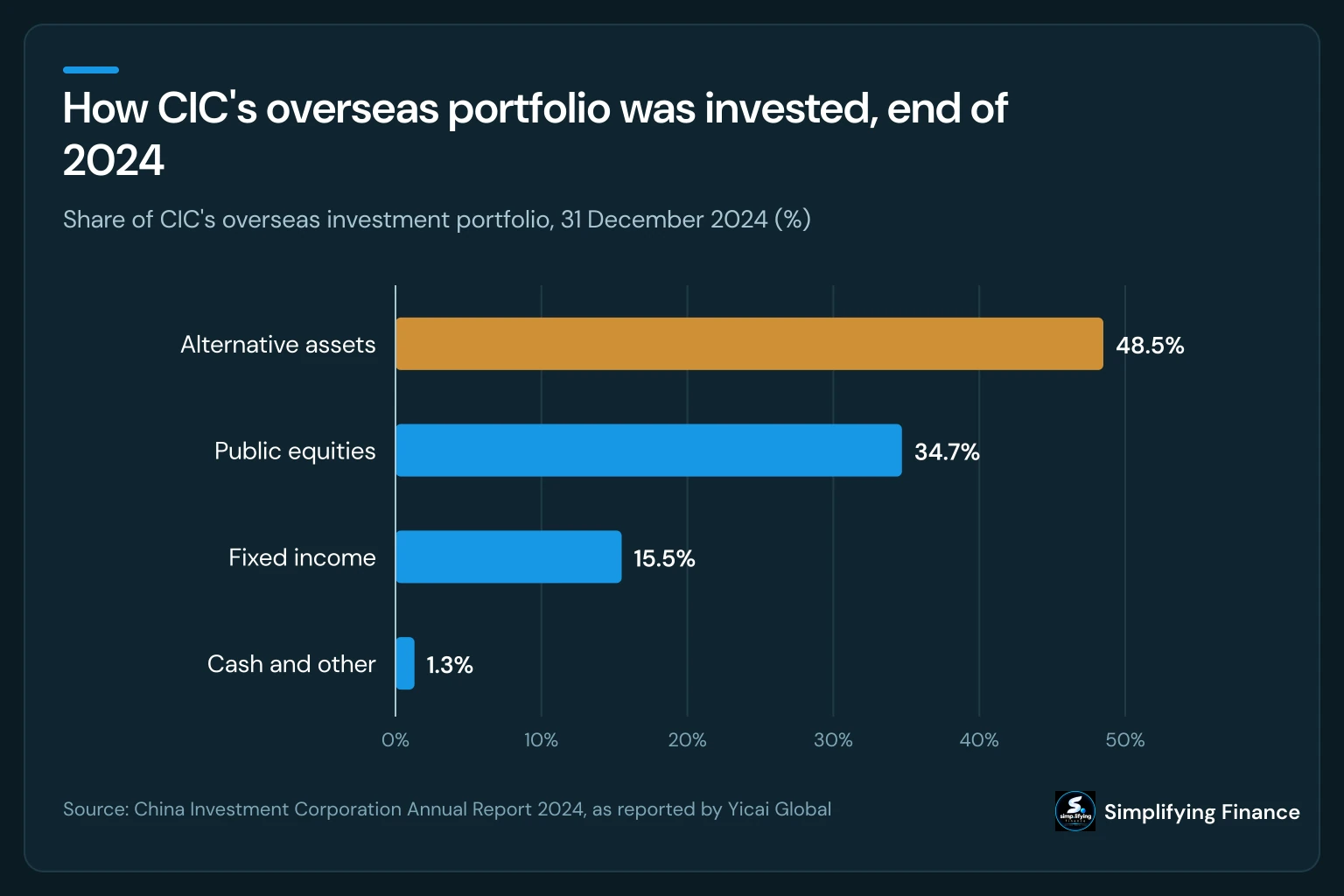
At the end of 2024, CIC's overseas portfolio held about 48.5% in alternative assets, including hedge funds, multi-sector private equity, private credit, real estate, infrastructure and commodities. Public equities made up about 34.7%, fixed income about 15.5% and cash and other holdings about 1.3%.
A year earlier, public equities had been about 33.2% and fixed income about 16.5%. Information technology was the largest sector in the equity portfolio, at about 25.9% at the end of 2024.
Why big funds favour private markets
Large, long-term investors can commit money for ten years or more, negotiate terms directly and spread risk across many private deals. In return they may earn a premium for accepting that the assets cannot be sold quickly. CIC's long horizon and scale make that trade-off workable.
For individuals, private markets usually come with higher fees, long lock-ups and less transparency. The guide's page on private markets and alternatives explains the options and their costs in more detail.
Risk across the whole portfolio
CIC describes a layered approach to building its portfolio: a reference portfolio that anchors the overall level of risk, a policy portfolio that sets strategic allocations, and the actual portfolio that results after implementation and adjustments. Separating the level of risk from the choice of assets is a disciplined way to keep a large, complex portfolio on track.
Lessons for ordinary investors
CIC's approach offers three practical lessons. First, set a long-term target return in advance and measure against it. Second, keep the overall level of risk under control before deciding which assets to hold, as its reference portfolio does. Third, recognise that the move into alternatives is suited to an investor with enormous scale and a very long horizon.
For most households, a low-cost mix of global shares and bonds, rebalanced from time to time, captures most of the benefit of diversification without the complexity, cost and lock-ups of private markets. That is a simpler path to the same goal: steady, long-term growth that beats inflation.
Finally, CIC's reporting is a reminder to compare like with like. Its returns are stated in US dollars and over ten years. An investor saving in another currency needs to think about their own currency and horizon when drawing lessons from these figures.
Those are the habits worth borrowing, at any scale and in any currency.
What 6.92% a year compounds to
Take US$100,000 invested for ten years at CIC's reported ten-year annualised net return of 6.92%. It would grow to about US$195,000, close to doubling.
| Starting amount | US$100,000 |
| 10 years at 6.92% a year | about US$195,000 |
| 10 years at 6.31% a year | about US$184,000 |
| Difference | about US$11,000 |
If the target had been 61 basis points lower, about 6.31% a year, the same money would have grown to about US$184,000. Over ten years, a gap of just over half a percentage point a year adds up to around US$11,000.
Where people go wrong
- Copying a 48% alternatives weight. Private assets suit investors who can lock money away for a decade.
- Ignoring fees on alternatives. Higher costs can erase the extra return for small investors.
- Investing without a target. A target return tells you whether your plan is working.
- Judging on one year. CIC reports ten-year results because single years are noisy.
- Doubling up on a theme. A global fund already holds a large technology share; adding more concentrates risk.
Put it to work
- Set a target return. Decide what long-run return your plan needs, after inflation.
- Keep it simple first. Build a core of listed shares and bonds before considering alternatives.
- Review over ten years. Judge progress over long periods, not months.
- Check for overlap. Compare the top holdings of your funds to avoid owning the same companies twice.
- Read on. Next: Australia's Future Fund and New Zealand's NZ Super Fund.
CIC has moved steadily towards alternative assets and measures itself on a 10-year return against a target. Its mix shows how large, patient investors use private markets, and why that path is harder for most households.
Facts checked against the sources above on 27 November 2026. Figures are as of the dates stated and will change. Worked examples use round illustrative numbers to show the arithmetic, not forecasts. Educational content only, not personal investment advice.