The first sovereign wealth fund
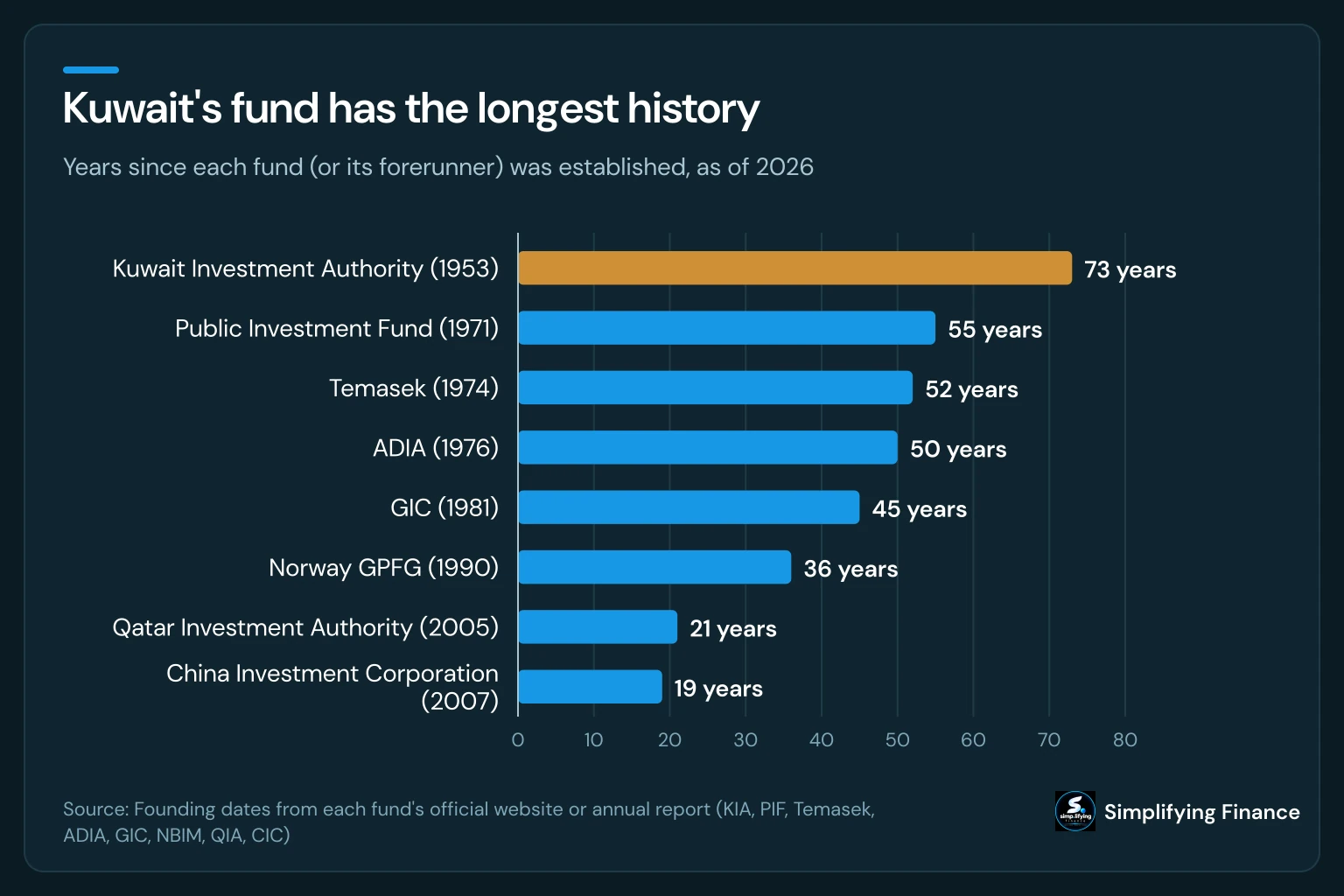
In February 1953, Kuwait established the Kuwait Investment Board in the City of London, with a mandate to invest surplus oil revenue and reduce the country's reliance on a single finite resource. That was eight years before Kuwait's independence in 1961. The IFSWF describes the Kuwait Investment Authority as the oldest sovereign wealth fund in the world.
In 1965, as Kuwait adopted a policy of diversifying its assets and portfolios, the board was replaced by the Kuwait Investment Office (KIO). The Kuwait Investment Authority itself was created in 1982 by Law No. 47 as an autonomous government body responsible for managing the country's assets, with the KIO in London becoming part of it.
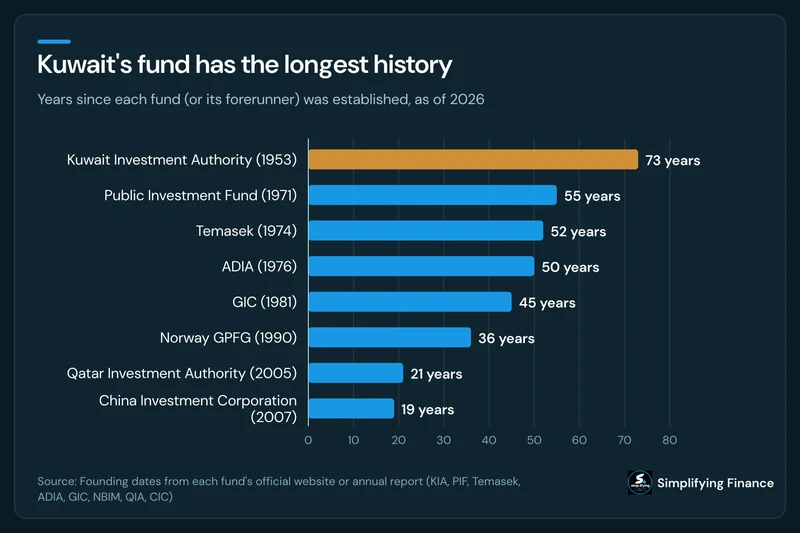
See the numbers behind the chart
| Fund | Years |
|---|---|
| Kuwait Investment Authority (1953) | 73 years |
| Public Investment Fund (1971) | 55 years |
| Temasek (1974) | 52 years |
| ADIA (1976) | 50 years |
| GIC (1981) | 45 years |
| Norway GPFG (1990) | 36 years |
| Qatar Investment Authority (2005) | 21 years |
| China Investment Corporation (2007) | 19 years |
Two pots: today and tomorrow
KIA manages two main funds. The General Reserve Fund is the government's public treasury: it receives state revenues, including oil revenues and income from its own investments, and pays for government spending. The Future Generations Fund is the flagship intergenerational savings fund.
The Future Generations Fund was created by decree in 1976. At its creation, 50% of the General Reserve Fund's assets were transferred into it, and a minimum of 10% of state revenues is allocated to it each year. KIA also manages any other funds entrusted to it by the Minister of Finance on behalf of the State of Kuwait.
Rules that protect the future fund
The 1976 law that created the Future Generations Fund also set clear rules for it. Analyses of the law by the Columbia Center on Sustainable Investment and others note that, as originally framed, it required a set share of government revenue and of the General Reserve Fund's income to flow into the future fund each year, and limited withdrawals from it.
Clear rules matter because they make saving automatic and protect long-term money from short-term pressures. They are the institutional version of a household locking retirement savings into an account that is hard to raid.
Global from the start
Kuwait's first investment office was in London, and KIA has kept a strong international focus. In 2018 it opened a second overseas office, in Shanghai. KIA invests mostly through external fund managers and has created specialised entities to build expertise in particular asset classes, while the London office is able to trade directly.
Investing abroad served the original purpose: to reduce Kuwait's dependence on oil by owning assets whose value comes from the wider world economy.
Active in new areas
KIA continues to evolve. According to the data firm Global SWF, as reported by Bloomberg and Gulf News, the Kuwait Investment Authority invested about US$6 billion in artificial intelligence and digitalisation in 2025, among the largest such commitments by sovereign investors that year.
Disclosure
KIA does not publish the total value of its funds. Its Santiago Principles self-assessment sets out its legal framework and objectives, and its law defines its role as managing the General Reserve Fund, the money allocated to the Future Generations Fund and other money entrusted to it, in the name and for the account of the State of Kuwait. This page uses only those published facts.
The two-pot lesson
Kuwait's structure separates money for current needs from money that must be left to grow. A fixed share of income flows into the long-term pot every year, whatever happens. That automatic rule removes the temptation to spend windfalls and builds savings steadily over decades.
It is the same idea behind paying yourself first: setting up an automatic transfer of a fixed percentage of income into long-term savings before spending the rest. The library lesson on dollar-cost averaging shows how regular contributions also smooth the price you pay for investments.
Patience over seven decades
Starting in 1953 means Kuwait's overseas savings have compounded through many market cycles: oil booms and busts, high inflation in the 1970s, the 2008 financial crisis and the shocks of recent years. A long track record does not guarantee future results, but it shows the value of starting early and staying invested through difficult periods.
Different jobs, different investments
The two pots are invested differently because they have different jobs. Money that must pay for government spending needs to be available and relatively stable, while money saved for future generations can take a long view and accept short-term ups and downs in return for growth. Matching each pot's investments to its job is the core of good planning.
A household version of the two-pot rule
Suppose a household in Kuwait earns KWD 2,000 a month. Following the spirit of Kuwait's rule, it sends 10%, KWD 200, to a long-term "future" pot every month and uses the rest as its "treasury" for bills and spending.
| Monthly income | KWD 2,000 |
| 10% to the future pot | KWD 200 a month |
| Saved in one year | KWD 2,400 |
| Saved in 20 years (before growth) | KWD 48,000 |
Over a year that is KWD 2,400 saved without any further decision. Over 20 years, before any investment growth, it is KWD 48,000. Invested and left untouched, the future pot grows independently of day-to-day spending.
Where people go wrong
- Keeping one pot for everything. Mixing spending money and long-term savings makes it easy to dip into the future.
- Saving only what is left over. A fixed share saved first is more reliable than saving leftovers.
- Investing only at home. Kuwait looked abroad from the start to reduce reliance on one resource.
- Assuming the oldest is the largest. A fund's age and its size are separate questions.
- Raiding long-term savings for short-term wants. Kuwait's rules protect the future fund from that pressure.
Put it to work
- Set up two accounts. One for spending and bills, one for long-term savings.
- Automate a fixed share. Move a set percentage of income to savings on payday.
- Invest the future pot broadly. Use diversified funds rather than single holdings.
- Make withdrawals hard. Keep long-term savings in an account that takes effort to access.
- Read on. Next: China Investment Corporation.
Kuwait split its national wealth into two pots: one to pay today's bills and one that saves a share of income every year for future generations. That two-pot structure is a model any household can use.
Facts checked against the sources above on 27 November 2026. Figures are as of the dates stated and will change. Worked examples use round illustrative numbers to show the arithmetic, not forecasts. Educational content only, not personal investment advice.